7 Questions to Include in Your Next Project Feedback Survey

- Most AEC firms think they understand client satisfaction, but real clarity comes only from structured project feedback that shows what’s actually working.
- Those insights sharpen when you ask at multiple milestones, especially since 78% of buyers say a consistent experience shapes who they select, helping you catch issues early.
- As you refine these surveys, you turn scattered opinions into measurable data, especially when you use tools like ClearlyRated to benchmark trust, loyalty, and communication quality.
- And with the right questions guiding each phase, you start predicting repeat business while building long-term partnerships driven by proactive improvement and a smarter client experience.
Only 45% of AEC firms survey clients after every project, and even fewer ask the questions that actually predict repeat business. Are you leaving revenue on the table?
You have just wrapped up a successful project. The client seemed pleased. Then they hired a competitor for the next phase. What question could have warned you?
Many leaders believe their approach works. But without focused, AEC-specific feedback questions, they are relying on assumptions. Generic surveys miss the signals that reveal whether a client relationship is growing stronger or quietly drifting away.
The right questions replace guesswork with clarity. They show the difference between simple project close-out surveys and true relationship health checks. They reveal how client experience shapes referrals, repeat work, and long-term profitability.
These seven project feedback survey questions for AEC firms will help you turn vague feedback into actionable insight and one-time projects into lasting partnerships.
The Problem with Most AEC Project Feedback Surveys
Many AEC firms rely on standard survey questions like “How did we do?” or “Rate our service from 1–5.” These questions rarely capture the complexity of architecture, engineering, and construction (AEC) projects.
These projects involve multiple phases, stakeholders, and decision points. A client’s perception of the firm evolves throughout design, permitting, construction, and handover. Generic questions fail to:
- Reveal relationship health
- Identify hidden frustrations before they escalate
- Predict repeat business or high-quality referrals
- Highlight opportunities for service expansion
Surveys that focus only on project completion metrics often miss these nuances. AEC firms that track client satisfaction survey questions consistently report stronger client loyalty, increased cross-selling, and higher referral rates.Understanding the difference between client feedback vs project feedback in AEC helps firms design surveys that capture both relationship health and delivery performance.
What Makes a Good Project Feedback Question?
Good project feedback questions make a real difference by extracting insights that actually lead to better client relationships. Here’s what distinguishes strong questions from vague ones:
- Actionable: A good project feedback question reveals concrete steps you can take to improve. In the AEC industry, firms that embed structured feedback loops report up to an 83% reduction in repeat client frustrations.
- Predictive: They highlight whether a client is likely to return or refer others. According to a 2025 industry report, 65% of AEC firms believe that excellent customer experience directly influences repeat business.
- Benchmarkable: When firms use consistent survey frameworks across projects, they can track trends in satisfaction, communication, and delivery quality, making continuous improvement measurable and systematic.
- Honest-inducing: They encourage clients to share accurate, candid feedback. In 2025, openly asking for feedback shows clients that their opinions matter, building trust and encouraging honest critiques rather than superficial praise.
- Role-specific: Because AEC projects involve multiple stakeholders, including owners, contractors, consultants and end users, all-in-one questions often miss key concerns. Targeted questions for each stakeholder group help capture nuanced opinions and reveal gaps before they become costly issues.
If you ground your survey in these principles, especially when you build engineering project feedback questions, you move beyond generic checkboxes to meaningful data. That gives you a real chance to improve client experience, build loyalty, and shape better outcomes on future projects.
When to Ask: Timing Your Project Feedback Surveys
The moment you send a survey, it decides how valuable the feedback will be. If you line up your surveys with key project stages, you get sharper, more meaningful insights.
Consider:
- Post-milestone surveys right after design approval, permitting, or the start of construction give early feedback on process clarity and initial impressions.
- Mid-project check-ins at roughly 50% completion help you spot issues while there is still time to fix them.
- Post-project close-out surveys to capture clients’ overall impressions while everything remains fresh in their minds.
- 90-day post-occupancy surveys or follow-up surveys after the space has been used for a while reveal whether the building performs as intended and whether occupants are satisfied in the long term.
Firms that combine milestone-based and post-occupancy feedback report far stronger client loyalty. In fact, a recent survey found that when clients receive a consistent, positive experience through a complete feedback loop, 78% are likely to rehire the contractor.
Waiting until project completion often comes too late to correct issues or to identify expansion opportunities. This is why you should include feedback collection at multiple stages rather than relying on a single “after handover” survey.
Question #1: Overall Satisfaction and Loyalty
Measuring overall satisfaction and loyalty shows how much clients trust your firm and how likely they are to recommend you to others. One of the most effective ways to capture this is through the Net Promoter Score (NPS).
The question
NPS measures how happy your clients are with your brand through direct feedback. You can collect NPS data via surveys sent by email, in-app notifications, or any channel that fits your industry. It focuses on a single, powerful question that captures both satisfaction and willingness to advocate for your firm.
“On a scale of 0–10, how likely are you to recommend [Firm Name] to others in your position?”
Clients are grouped based on their responses:
- Promoters (9–10): Loyal clients who often recommend your firm to others.
- Passives (7–8): Satisfied clients who show little enthusiasm to advocate for your firm.
- Detractors (0–6): Unhappy clients who may damage your brand’s reputation.
This question measures both loyalty and trust, not just the first impression. In the AEC industry, where repeat projects and referrals drive profitability, systematically tracking NPS can significantly impact growth. Firms that do so see up to a 25% increase in revenue growth compared to firms relying on informal feedback.
AEC-specific variation
You can make this question more relevant to the AEC industry by adapting it to project-specific situations. These variations provide actionable insights about future collaboration:
- “Based on this project phase, would you choose us for your next project?”
- “How likely are you to expand the scope of this project with us?”
What to do with the answers
Use these responses to strengthen client relationships, turn satisfied clients into advocates, and resolve issues before they escalate.
- Promoters (9–10): Request testimonials, ask for referrals, and explore opportunities for upselling additional services. Treat promoters as your brand ambassadors.
- Passives (7–8): Identify what changes could move them into the promoter category. Focus on more frequent updates, more precise documentation, or faster response times.
- Detractors (0–6): Investigate the root causes immediately. Early intervention prevents problems from escalating and may save the relationship.
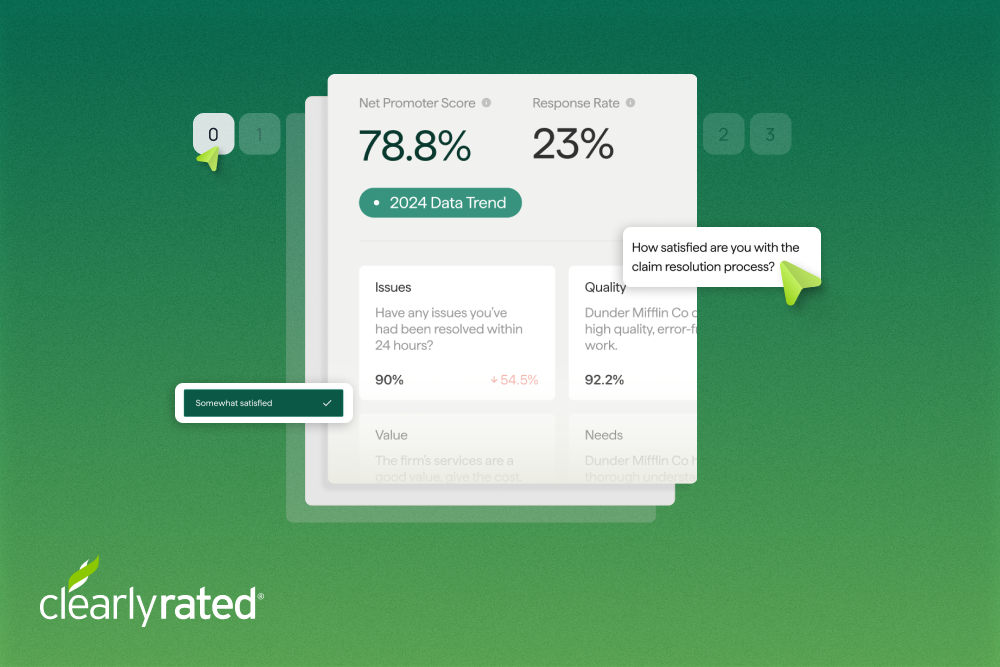
You can also use NPS software and customer experience measurement tools like ClearlyRated to make the process easier. Our Client Savvy Platform helps you collect client feedback, benchmark your scores against industry standards, and track your performance over time.
Question #2: Communication and Responsiveness
Measuring communication and responsiveness helps you understand how well your team keeps clients informed and engaged throughout a project. In the AEC industry, clear and timely communication can make or break client satisfaction.
The question
Ask questions that reveal how well your team keeps clients informed and engaged throughout the project:
- “How would you rate the quality and timeliness of our communication throughout this project phase?”
- “How well did we keep you informed of project progress and challenges?”
Why this question matters
Communication is consistently the No. 1 client complaint in the AEC industry. Even projects that meet technical and budgetary goals can be perceived as failures if clients feel out of the loop. Tracking communication satisfaction:
- Highlights specific team members, processes, or touchpoints that need attention
- Helps prevent misunderstandings that can escalate into larger issues
Our 2025 Benchmarks, Insights, and Trends: Client Experience in the AEC Industry report found that 78% of buyers say a seamless experience influences their decision when selecting a firm, and 68% say strong communication and relationship quality matter as much as technical skills.
AEC-specific variation
To get actionable feedback, tailor communication questions to project phases, such as:
- “Were you proactively informed of design changes, delays, or budget impacts?”
- “How clear was our communication about regulatory approvals and timelines?”
- “Did you receive sufficient updates during the [design/permitting/construction] phase?”
What to do with the answers
Once you receive the responses, use the scores to guide your next steps. For example:
- Low scores: Implement more frequent touchpoints, assign a dedicated client liaison, or clarify reporting processes. Early intervention can prevent dissatisfaction from escalating.
- High scores: Document what’s working and replicate these communication practices across other projects to maintain consistency and strengthen client relationships.
Question #3: Value and ROI Perception
Measuring perceived value and ROI helps you understand whether clients see your firm as a strategic partner and whether your work contributes meaningfully to their business goals.
The question
These questions focus on understanding how clients perceive the impact of your services:
- “How well did this project phase meet your business objectives and goals?”
- “Do you feel the investment in our services is delivering clear value?”
Why this question matters
Clients who do not perceive value are unlikely to return. Understanding perceived ROI lets your firm be recognized not just as a service provider, but as a strategic partner who contributes to their success.
When you track this feedback, you identify areas where your solutions can be better aligned with client priorities.
AEC-specific variation
You can adapt these questions to capture insights specific to project phases or strategic objectives:
- “How confident are you that this design will achieve your sustainability, budget, or timeline goals?”
- “Has our work helped mitigate risks or capture opportunities you hadn’t considered?”
- “Do you understand how our recommendations impact long-term operational costs?”
What to do with the answers
Once you receive the responses, address gaps, reinforce successes, and strengthen the perception of value across your projects:
- Low scores: Schedule value realization workshops, clarify how recommendations drive business outcomes, and document ROI to demonstrate tangible impact.
- High scores: Capture examples for case studies, testimonials, or marketing materials to showcase the value your firm delivers.
Question #4: Project Team Performance
In the AEC sector, clients work closely with people, not firms, so team interactions often shape the overall perception of your company.
The question
These questions focus on evaluating the skills, professionalism, and responsiveness of your project team:
- “How would you rate the expertise and professionalism of the project team?”
- “Did our team demonstrate the technical knowledge and responsiveness you expected?”
Why this question matters
Feedback on team performance highlights both strengths and areas for improvement:
- Identifies star performers versus team members who may need support
- Reveals training, coaching, or staffing needs
- Reinforces that strong client relationships are built on people, not just processes or brand reputation
AEC-specific variation
Tailoring the questions to project workflows and roles can yield actionable insights:
- “How effectively did our project manager coordinate between disciplines and stakeholders?”
- “Did you feel our team understood the unique challenges of your project type or industry?”
- “Were handoffs between design, engineering, and construction phases seamless?”
What to do with the answers
After gathering client feedback, here’s what you can do:
- Identify high-performing team members for future similar projects
- Address underperformers through coaching or reassignment
- Celebrate wins publicly to reinforce positive behaviors
Question #5: Process and Expectations Management
Even technically successful projects can leave clients dissatisfied if timelines, budgets, or scope changes are poorly communicated.
Understanding how well your processes align with client expectations helps prevent misunderstandings and builds trust.
The question
These questions assess how effectively your team sets and manages expectations throughout the project:
- “How well did we manage your expectations throughout this project phase?”
- “Were timelines, budgets, and scope changes clearly communicated and justified?”
Why this question matters
Feedback on process and expectations management provides insight into client satisfaction beyond technical delivery:
- Mismanaged expectations can prevent repeat business, even on otherwise successful projects
- Identifies where communication or process breakdowns occurred
- Highlights opportunities for process improvements that increase client confidence and satisfaction
AEC-specific variation
Ask questions like these to uncover practical insights that improve project outcomes:
- “Were change orders clearly explained and did they feel fair?”
- “Did we provide sufficient advance notice of delays or scope adjustments?”
- “How well did we prepare you for regulatory or permitting challenges?”
What to do with the answers
Once you collect responses, use the insights to refine processes and prevent future issues:
- Low scores: Revise project kickoff processes, improve communication around change orders, and ensure scope adjustments are clearly explained and documented.
- Pattern detection: If multiple clients cite similar issues, implement a systemic process improvement to prevent recurring problems.
Question #6: Problem Resolution and Responsiveness
How a firm handles issues and concerns often leaves a stronger impression on clients than the final project outcome.
In fact, challenges and unexpected changes are inevitable. Hence, showing effective problem-solving and responsiveness is necessary to build trust and long-term relationships.
The question
These questions help evaluate how well your team addresses problems and supports clients when challenges arise:
- “When issues or concerns arose, how effectively did we address them?”
- “Did you feel heard and supported when challenges emerged?”
Why this question matters
Tracking client feedback on problem resolution reveals whether your team is perceived as proactive, reliable, and accountable:
- Clients remember how problems are handled, not just the result
- Effective recovery from mistakes can strengthen relationships
- Identifies whether clients feel comfortable raising concerns and trusting your team to resolve them
AEC-specific variation
Customizing these questions to project workflows and stakeholder interactions provides insights:
- “When design changes were required, how smoothly were they implemented?”
- “Were conflicts between stakeholders (owner/contractor/municipality) handled professionally?”
- “Did you feel we took ownership of problems or deflected responsibility?”
What to do with the answers
Use the insights to refine problem-solving processes and build client confidence. Here’s how
- Implement escalation protocols and ensure clients feel heard at every stage
- Document practical resolution approaches for training and replication across teams
Question #7: Future Intent and Improvement Opportunities
Finally, gather feedback on future projects to see where clients want growth. Act on it to improve your services and strengthen relationships.
The question
These questions capture insights on what clients would like to see improved or added:
- “What one thing could we improve to make your experience even better?”
- “Are there additional services you wish we offered?”
Why this question matters
Asking about future intent provides valuable information for strategic growth:
- Identifies service gaps and opportunities for expansion
- Shows clients you value their input and are committed to continuous improvement
- Uncovers potential upsell or cross-sell opportunities
AEC-specific variation
Customize these questions to project types or related service lines for actionable feedback:
- “Would you consider us for [related service line] on future projects?”
- “What additional expertise would make us a more valuable partner?”
- “If you could change one thing about this phase, what would it be?”
What to do with the answers
Once responses are collected, use the feedback to guide improvements and future service offerings:
- Aggregate feedback: Identify common improvement themes across projects
- Service expansion: Explore opportunities based on repeated requests
- Follow up: Reach out individually to show clients you listened and are acting on their suggestions
ClearlyRated: Pre-Built Survey Questions Tested on 1,000+ AEC Projects
Most AEC firms collect feedback, but very few do it when it actually influences the next project. Our Client Savvy platform helps structure this process effectively by turning feedback into data-driven insights.
Here’s how we support your post-project strategy through features that simplify client experience management.
Industry-specific question templates for each project phase
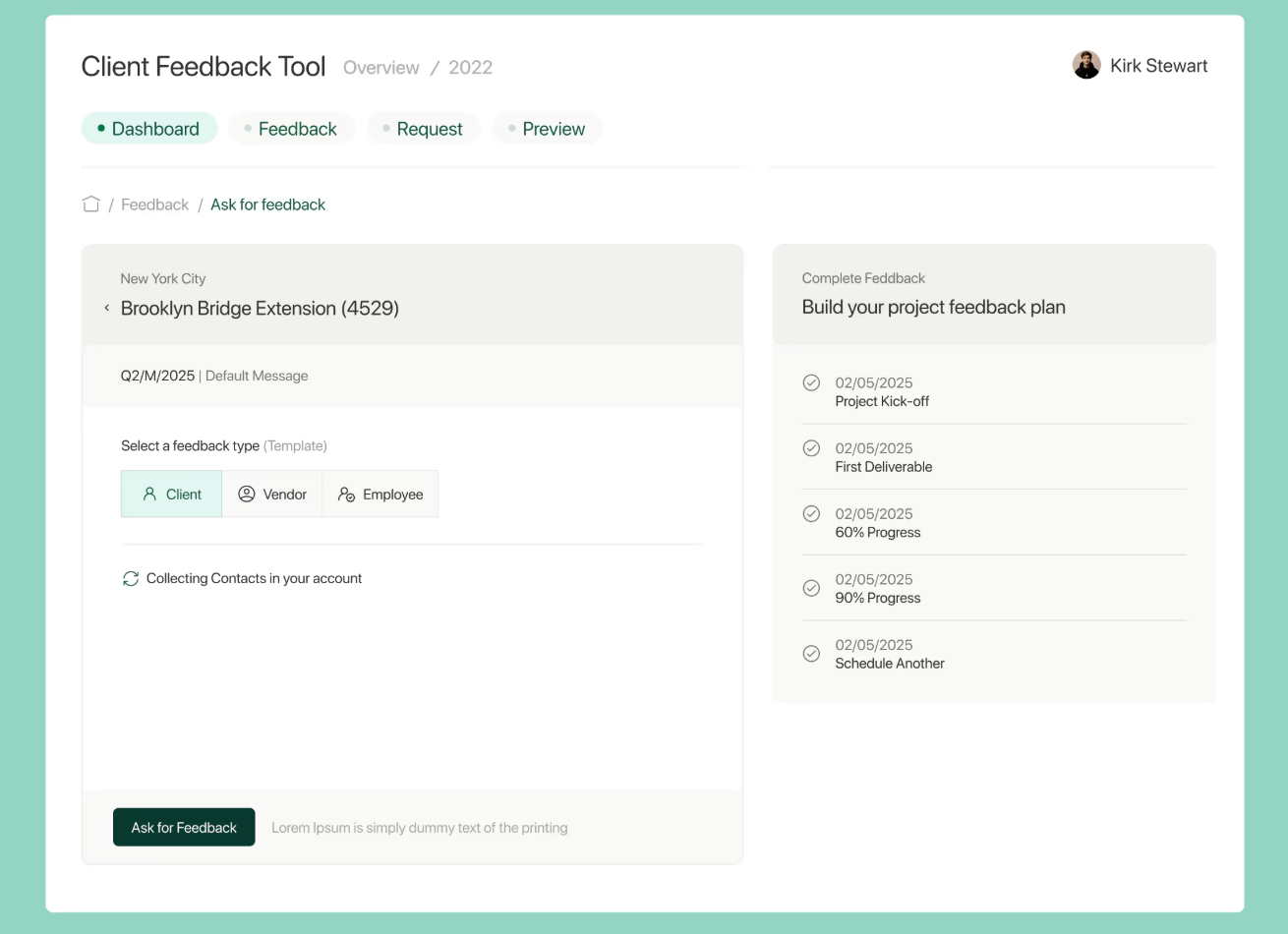
Independent benchmarking surveys reveal how your firm performs compared to industry peers. This unbiased perspective highlights competitive strengths while exposing blind spots that might remain hidden in self-reported surveys. Benchmarking not only validates your strengths but also builds credibility with prospective clients who value data-driven proof of performance.
For instance, the Client Savvy Platform provides real-time dashboards that allow firms to review feedback at the individual, project, and client levels. Beyond raw scores, these tools offer comparative insights and industry benchmarks, giving leaders a clearer picture of how their client experience stacks up against competitors.
With this data, AEC firms can identify gaps, highlight areas of excellence, and make improvements that strengthen their reputation in the market. These pre-built construction project survey questions and architecture firm survey templates are tailored to each phase, ensuring you collect relevant, actionable feedback.
Automated survey deployment at key milestones
We also give AEC firms like yours the ability to capture feedback at the right moments, not just at handover. You can send milestone feedback questions that automatically trigger when key stages close, such as after punch-list resolution or warranty phase check-ins.
Instead of waiting for issues to pile up, your team receives feedback while the experience is still fresh in the client’s mind. As firms shift from occasional surveys to ongoing Voice of the Client (VoC) programs, this kind of automation has become a 2025 trend.
Benchmark your responses against similar firms and project types
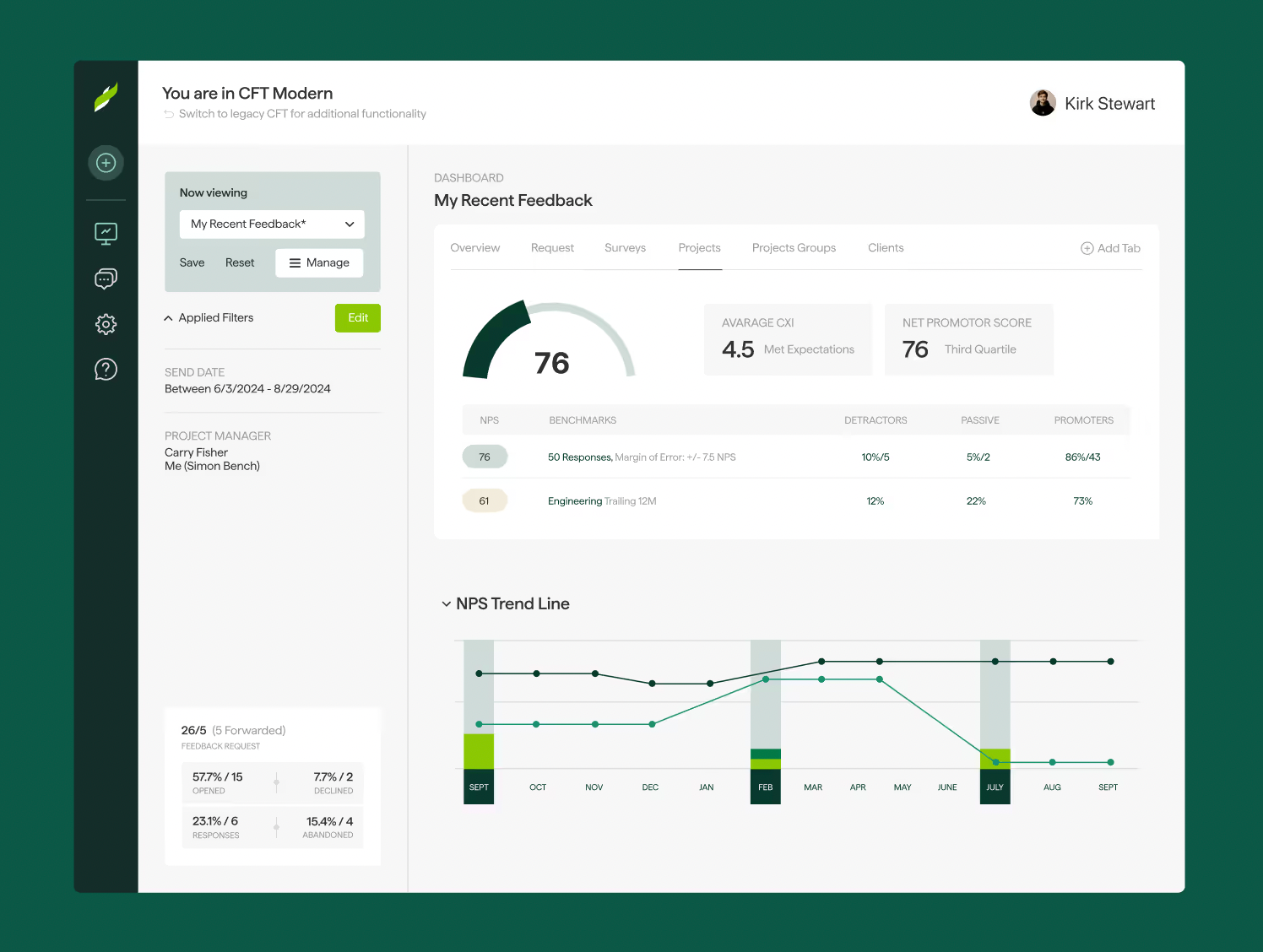
Firms that run feedback programs consistently often see their NPS rise by an average of 17 points. Our benchmarking tools let you compare your project results against industry peers and past performance. Weekly and monthly reports are generated automatically, giving leadership a clear view.
Every piece of feedback is tagged by client, project, manager, and business unit, making it easy to sort, track, and respond. You can filter results by project type, delivery stage, or stakeholder group to identify areas for improvement.
With thousands of report combinations in both visual and table formats, your team can move quickly from data to decisions.
Automatic testimonial collection from promoters
When clients raise concerns, the platform flags those responses and alerts the right people. Each task gets tracked, so it’s always clear who is responsible for follow-up.
You can identify which clients are still awaiting a response and where delays in follow-up may affect the next engagement. This captures positive feedback automatically from promoters, creating a reliable pipeline of testimonials to strengthen your firm’s reputation.
Ask the Questions That Predict Repeat Business
A strong client feedback process does more than gather opinions. It helps your firm strengthen relationships, improve project outcomes, and protect future revenue. These seven questions give you a practical framework to spot what is working, fix what is not, and make clients feel heard at every stage of the project.
With ClearlyRated, you can collect feedback at key milestones, track results in real time, and turn satisfied clients into advocates who drive referrals and repeat work. You can also download the 7-Question AEC Project Feedback Survey Template and embed it into your milestone check-ins and post-project reviews.
Get started today and turn every client interaction into an opportunity for long-term growth.
FAQs
1. When should AEC firms send project feedback surveys—during or after the project?
Send surveys at multiple points, including post-milestone, mid-project, post-project, and 90 days post-occupancy. This captures both immediate impressions and long-term satisfaction.
2. Should AEC firms use anonymous surveys or track responses by client?
Track responses when possible. Linking feedback to specific clients allows for personalized follow-ups and strengthens relationships. Anonymous surveys can complement this for candid insights from stakeholders hesitant to provide identified feedback.
3. What is a good response rate for AEC client feedback surveys?
Aim for at least 30% per survey. Higher rates indicate strong engagement, and automated milestone surveys can improve completion rates.

FAQs
%20(1).png)
.webp)
.png)