Staffing Agency Success Metrics: Beyond Placements to Client Satisfaction

April 14, 2026
Staffing Agency Success Metrics: Beyond Placements to Client Satisfaction
Staffing agencies must measure client satisfaction, candidate quality, and relationship-based KPIs—not just placement volume—to predict long-term growth and prevent hidden churn.
Macro pressures like rising living costs, AI adoption, and a tight labor market make tracking outcomes essential, as shown by a 2025 SHRM report that found average cost-per-hire is $5,475 for non-executive roles versus $35,879 for executive roles while the industry’s gross profit margin rose 1.75 percentage points to 17.37% between 2023 and 2025.
Placement-focused metrics miss warnings about client loyalty, referrals, and candidate disengagement, whereas Net Promoter Score (NPS) and quality-of-hire measures better predict repeat business—industry NPS climbed from 28 in 2020 to 45 in 2024 and 31% of agencies now prioritize quality of hire.
Essential KPIs to track include client NPS, client retention rate, candidate retention and quality of hire, time-to-fill and fill rate, and financial measures like revenue per placement, gross margin per placement, and client lifetime value (CLV).
Platforms such as ClearlyRated that deliver event-triggered surveys, benchmarking, automated reporting, and alerts help convert feedback into actions that reduce churn, increase referrals, and improve profitability.

- The staffing world is shifting fast, and teams now rely on better success metrics to stay ahead in a tight market.
- That matters even more when you see a huge gap between non-executive and executive cost-per-hire, which proves how important smarter tracking really is. Those metrics get even more powerful when you layer in tools like ClearlyRated to turn raw feedback into decisions that improve loyalty and performance.
- Once you connect all these insights, you move past placement counts and start building long-term growth driven by client satisfaction and stronger relationships.
Your staffing firm placed 200 candidates last quarter. A record high. Yet client retention dropped by 15%.
What went wrong?
This is the blind spot many staffing agencies face when success is measured only by placements, not long-term outcomes.
The staffing landscape is evolving fast. Rising living costs, increased use of AI, and a tight labor market are reshaping how agencies operate. In this environment, tracking the right metrics isn’t optional. It’s what separates sustainable growth from short-term wins that quietly erode trust with clients and candidates.
Recent data makes this clear. A 2025 SHRM report shows that the average cost-per-hire remains significantly lower for non-executive roles ($5,475) compared to executive roles ($35,879). At the same time, the staffing industry’s average gross profit margin rose by 1.75 percentage points between 2023 and 2025, reaching 17.37%. On the surface, the industry looks healthy. But profitability alone doesn’t tell the full story.
This is where staffing metrics and analytics come in. KPIs like Employee Net Promoter Score (ENPS) reveal how your workforce actually feels, how effective your staffing strategies are, and whether your team is engaged enough to deliver consistent results. Without these insights, you may keep filling roles while missing early warning signs of churn, disengagement, or declining client satisfaction.
In this guide, we’ll break down the most important staffing agency KPIs, show you how to measure client satisfaction more effectively, and explore how platforms like ClearlyRated can help turn performance data into meaningful business growth.
Why Placement Volume Alone Doesn't Tell the Full Story
To truly gauge long-term success, staffing firms need to look beyond the numbers and evaluate the quality and impact of each placement.
The traditional focus on placements
For decades, staffing firms have evaluated success based on placements and revenue per placement. According to the 2024 edition of the State of Staffing Report, 63% of staffing firm leaders still identified acquiring new clients (and thus generating placements) as their top organizational priority.
While these numbers indicate short-term performance, they don’t reflect whether clients are satisfied, whether candidates remain in their roles, or whether clients will return for future projects. Indeed, the same industry has begun re‑shifting its performance metrics. In 2025, 31% of agencies now regard quality of hire as their top metric for judging talent source ROI, followed by cost-per-hire at 19% and time-to-fill at 18%.
Agencies relying solely on placement volume often find that client churn hinders profits. High placement numbers may mask low client retention, missed referral opportunities, and operational inefficiencies that cost time and money.
What placement-only metrics miss
Placement-focused metrics fail to capture:
- Client loyalty: Repeat clients contribute more long-term revenue than one-off placements.
- Referrals: Satisfied clients who refer colleagues or industry peers drive lower-cost business acquisition.
- Relationship quality: Clients may accept placements but still feel underserved, which can risk future engagement.
The shift from transactional to relationship-based staffing
Modern staffing agencies increasingly view themselves as strategic partners rather than transactional vendors. They use relationship-focused metrics to understand client needs, improve service delivery, and generate high-quality referrals.
Fast-growth staffing firms that achieve 21% or more revenue growth focus on formal referral programs, with 86% of these firms using them compared to only 60% of no-growth firms. They also rate referrals as extremely important to their business success.
Staffing agencies that track KPIs beyond placements, such as referral performance, quality of hire, retention rates, and client satisfaction, keep growth profitable and sustainable rather than just high in volume.
So if placement volume isn’t enough, what should staffing firms measure instead? The answer starts with client satisfaction.
.png)
The Case for Client Satisfaction as a Core Metric
Candidate satisfaction ratings provide an honest look at how well job expectations match the actual experience. Here’s how it builds a stronger long-term talent pipeline that clients will value:
Client satisfaction predicts revenue growth
Satisfied clients are the backbone of long-term revenue, and recent data shows why this matters:
- Repeat business: Clients who report high satisfaction return for subsequent staffing needs, reducing the cost of acquiring new clients. In fact, our 2024 NPS® Staffing Industry Benchmarks suggests that staffing firms earned an all-time high client Net Promoter Score (NPS) of 45 in 2024, up sharply from -2 in 2019, showing that clients respond when service quality improves.
- Referrals: Happy clients naturally advocate for your services, creating a pipeline of warm leads. In the 2025 Bullhorn GRID Industry Trends Report, staffing firms that adopted automation and AI, which often improves customer experience, were twice as likely to report revenue growth last year compared to firms that did not.
- The cost of client churn vs. retention: Firms that focus on client experience and retention report significantly lower churn. According to a 2025 industry survey, 65% of staffing firms say enhanced customer experience efforts directly improved client retention.
By tracking client satisfaction, agencies can proactively address dissatisfaction before it escalates.
How client satisfaction impacts your reputation
Positive client experiences don’t just secure loyalty. They build a reputation that fuels future growth. Here’s how:
- Word-of-mouth and referral potential: Positive client experiences lead to referrals and strengthen your firm’s reputation in your niche. Since 42% of businesses shut down because they cannot find enough buyers, leveraging those referrals through a structured program helps you tap into existing relationships, create demand, and attract the right audience.
- Online reviews and industry credibility: Clients often leave reviews on platforms such as Google, LinkedIn, or industry forums. Monitoring satisfaction helps you maintain a positive online presence.
Essential Staffing Agency Success Metrics to Track
To grow a staffing agency that clients love and candidates trust, you need more than just placement numbers.
Tracking the right customer retention and satisfaction metrics helps you see what’s really working, uncover opportunities for improvement, and build long-lasting relationships that fuel sustainable growth.
The table below highlights the difference between traditional, volume-focused metrics and modern, relationship- and quality-driven metrics:
1. Client satisfaction metrics
When you measure client satisfaction metrics, it gives you a clear window into how your staffing clients feel and how likely they are to stick with you. Here are some of the most common KPIs:
Net promoter score (NPS)
NPS remains a powerful indicator of client loyalty, but in staffing, it’s especially useful for predicting repeat business and referrals. Clients rate your services on a 0–10 scale, and your score is calculated as the percentage of Promoters minus Detractors. Scores range from -100 to +100.
For example, if 70% of clients are Promoters, 20% are Passives, and 10% are Detractors, your NPS is 70 – 10 = 60. A positive score shows strong client satisfaction and growth potential.
For staffing firms, a strong NPS is typically 50 or higher, signaling that clients are not only satisfied but likely to return and recommend your agency.
Client retention rate
The retention rate indicates whether clients choose to stay with your agency rather than turn to competitors. It directly reflects long-term satisfaction and loyalty.
You can calculate it like this:
A high retention rate means your service, communication, and results consistently meet client expectations, signalling that your relationships are healthy and your business is sustainable.
Client feedback surveys
Direct feedback is invaluable. Surveys give clients a voice and allow you to uncover insights that numbers alone can’t show.
In client feedback surveys, ask about their experience, pain points, and expectations. As a result, you’ll find opportunities to strengthen your relationships, improve processes, and even create advocates for your agency.
2. Candidate quality metrics
Your candidates are the heart of your staffing agency. Measuring their quality ensures that you’re placing the right people in the right roles, keeping both clients and candidates satisfied.
Candidate retention rate
Candidate retention rate shows how well you match candidates to positions and keep them engaged in their roles. High retention in staffing means your placements stick, which enhances your reputation with clients and reduces recruitment costs.
You can calculate it as:
Here’s how you can do it:
- Define the time period you’re measuring (e.g., 90 days, six months, one year).
- Count how many candidates you placed during that period.
- Count how many of those candidates are still employed with the client at the end of the period.
- Divide the number of retained candidates by the total number of placements, then multiply by 100 to get a percentage.
For example, if you’ve placed 50 candidates in the past six months and 40 of them are still employed at the client, your candidate retention rate is:
Candidate Retention Rate = (40 ÷ 50) × 100 = 80%
This percentage gives a clear measure of how well your agency is making strong, sustainable matches for both clients and candidates.
Hiring manager satisfaction
Hiring managers are your clients, too. Their satisfaction reflects the quality of your service, from candidate screening to communication and follow-through.
Regular check-ins, surveys, and candid conversations help you detect issues early, refine your process, and ensure that managers see you as a trusted partner.
Quality of hire indicators
Quality of hire measures performance, cultural fit, and impact on the client’s business. To see if your candidates are truly adding value, look at the following factors:
- Performance reviews
- Promotion rates
- Retention metrics
This metric helps you continuously improve your recruitment process and make smarter placements.
3. Operational efficiency metrics
Even the best matches won’t matter if your processes are slow or inconsistent. Operational metrics help you identify challenges, optimize workflow, and provide a reliable, predictable experience for clients and candidates alike.
Time-to-fill & fill rate
Time-to-fill and fill rate measure the speed and success of your placements. Time-to-fill tracks the days from job requisition approval to candidate acceptance, while fill rate measures the percentage of job orders you complete.
Together, these metrics show how well you balance supply and demand. For example, if a specialized IT role takes 45 days to fill compared to 20 days for general roles, you can set realistic client expectations and refine your strategy.
To track it effectively:
- Define a time frame, such as a day, week, month, or quarter
- Count the total job orders received
- Count the number completed within the same period
- Divide completed orders by total orders and multiply by 100
Here are the steps to calculate:
- Record the start date when the job was posted or approved
- Record the end date when the offer was accepted
- Subtract start from end for each role
- Sum the total days for all roles and divide by the number of roles
Submittal-to-interview ratio
This metric shows how effective your candidate submissions are in generating interviews. A high ratio indicates a strong candidate fit and precise screening, while a low ratio signals areas for improvement in candidate selection or job matching.
By analyzing trends, you can customize sourcing strategies and strengthen your client relationships.
4. Financial performance metrics
Finally, your financial metrics reveal whether your staffing agency is thriving, sustainable, and delivering real value. They connect the dots between operations, client satisfaction, and profitability.
Below are the most common financial performance metrics to track.
Revenue per placement
Revenue per placement measures the direct financial return from each successful placement.
To measure revenue per placement:
For example, if your agency earned $50,000 from 10 placements in a month, your revenue per placement would be: $50,000 ÷ 10 = $5,000 per placement.
Tracking it ensures your pricing strategy aligns with your costs and effort, helping you identify the most profitable roles, clients, or sectors.
Gross margin per placement
Gross margin per placement goes a step further, revealing the profitability of each placement after accounting for costs. You can calculate it as:
Consider:
- Revenue from 10 placements = $50,000
- Direct costs for those placements (recruiter time, advertising, background checks, etc.) = $15,000
Gross Margin per Placement = ($50,000 – $15,000) ÷ 10 = $3,500 per placement
This metric helps you prioritize high-margin roles, control expenses, and make data-driven decisions about resource allocation.
Client lifetime value (CLV)
Client lifetime value (CLV) represents the total revenue a client generates over the course of your relationship, not just a single transaction. A high CLV shows you’re retaining clients and increasing the value they bring over time.
You can calculate CLV as:
For example, if a client spends $1,000 per year for five years, CLV is $5,000. After subtracting costs, you get the net profit from that client over their lifetime.
Here’s what you can do to improve your CLV:
- Focus on building strong, trust-based relationships with clients
- Provide consistent communication, updates, and personalized service
- Engage clients with helpful content, industry insights, or exclusive offers to encourage repeat business and referrals
- Leverage predictive CLV analysis to anticipate client needs and prioritize high-value accounts
How to Measure Client Satisfaction Effectively
Measuring staffing agency success can strengthen relationships, anticipate their needs, and grow your agency with confidence. Once you’ve calculated the KPIs, here’s what to do next:
Implementing NPS surveys for staffing firms
An NPS survey is a two-part questionnaire:
Rating question: Ask clients to respond on a scale from 0 to 10. Here’s an example:
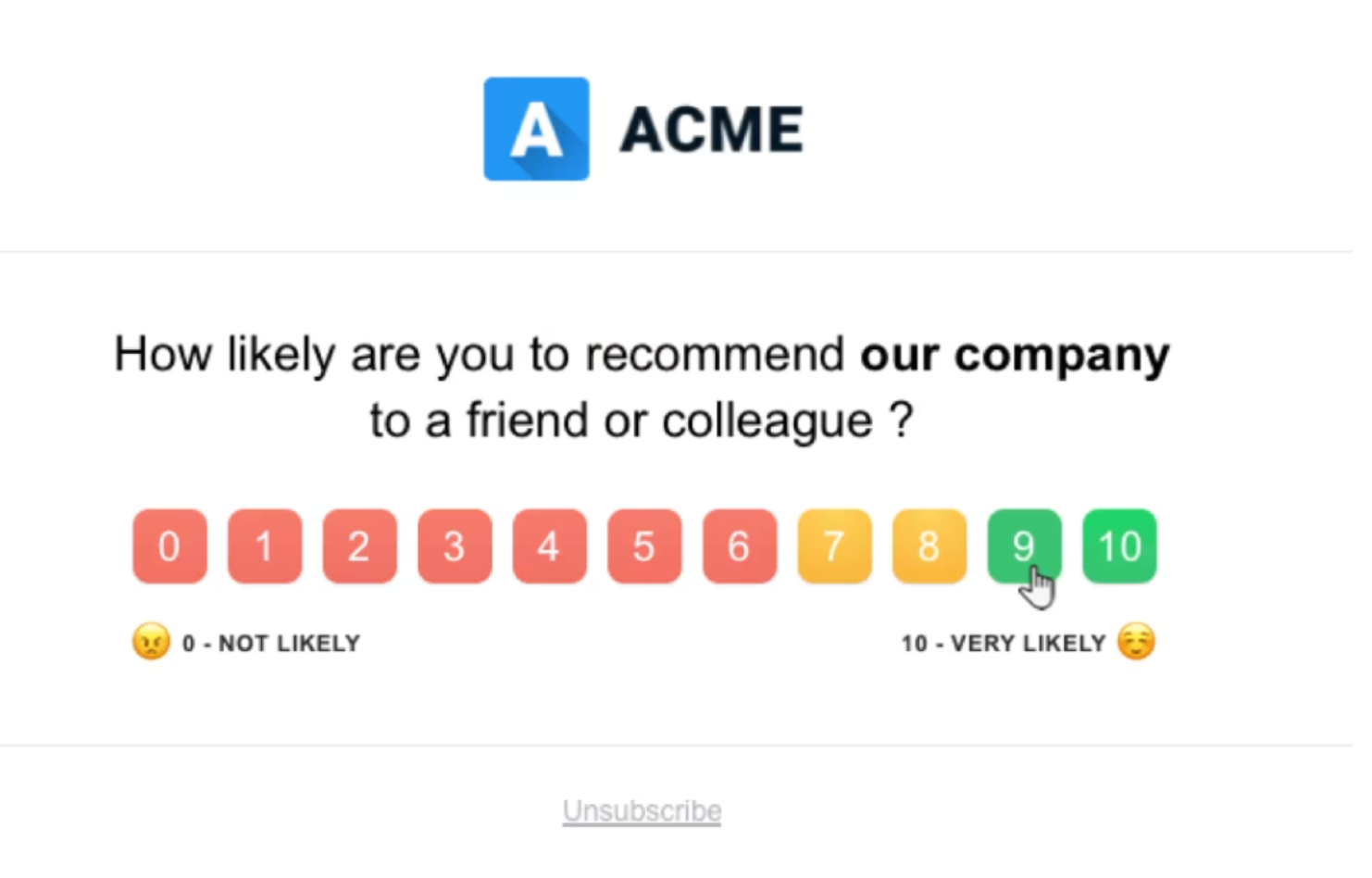
Follow-up question: The second part of your survey gives clients a chance to explain their rating in their own words. Often called an open-ended question, it can be as simple as asking, “What’s the main reason behind your score?” You can present this question immediately after customers click the survey link in your email. Here’s an example of how it could appear:

Next, use the responses you’ve gathered to calculate your NPS and see what the numbers reveal about client loyalty.
However, timing can make all the difference. Consider sending surveys right after a placement to capture immediate impressions. For example:
- Quarterly surveys are great for ongoing relationships.
- Project milestone surveys help you track satisfaction during longer engagements.
Each touchpoint gives you valuable insight and a chance to act while the experience is fresh in the client’s mind.
Segmenting feedback by client type
Not all clients experience your staffing services in the same way. Enterprise clients may focus on process efficiency and scalability, while small and mid-sized businesses often prioritize personal attention and flexibility. Segmenting feedback by size helps you address what matters most to each group.
For example:
- Clients in healthcare may struggle with strict compliance and credentialing requirements.
- IT clients often need candidates with rapidly evolving technical skills.
- Finance clients may demand candidates who meet rigorous regulatory standards and security clearances.
Segmenting by service line helps your team see which areas excel and where processes need fine-tuning. This approach turns raw feedback into clear, actionable insights for every part of your business.
Acting on client feedback
Collecting feedback is only the first step. Acting on it turns information into relationships, trust, and growth. Here’s what to do next:
- Close the loop with detractors: Reach out to dissatisfied clients and listen closely. Understand their pain points, acknowledge the issue, and share what you will do to fix it. Showing responsiveness can transform a frustrated client into a loyal partner.
- Leverage promoters for referrals and testimonials: Promoters are your champions. Encourage them to share their positive experiences through testimonials or referrals. Their enthusiasm can attract new clients and reinforce your agency’s reputation. Turning satisfaction into advocacy is one of the most powerful ways to grow organically.
📌Also read: NPS Detractors: How to Turn Them into Promoters
Benchmarking Your Metrics Against the Industry
When you compare your numbers to broader industry benchmarks, your agency can see clearly where you shine and where you could do better. This kind of comparison helps you set smarter goals, stay competitive, and grow with confidence.
Staffing industry NPS benchmarks
If you look at recent data across staffing firms, you’ll find a real story of progress and hope, but also an opportunity to raise the bar even higher.
Between 2020 and 2024, staffing firms significantly improved on the feedback dimensions that matter most. They boosted their scores on Issue Resolution by nine points, improved the Culture Fit of candidates by eight points, and got faster at delivering services within expected timeframes, adding another six‑point gain. These gains probably fuelled the rise in overall NPS over those years.
The jump from 2023 to 2024 shows why those improvements matter most. During that year, gains came especially from faster service delivery (up eight points), a more proactive approach to service (up six points), a deeper understanding of client needs (up five points), and delivering value relative to cost (up another five points).
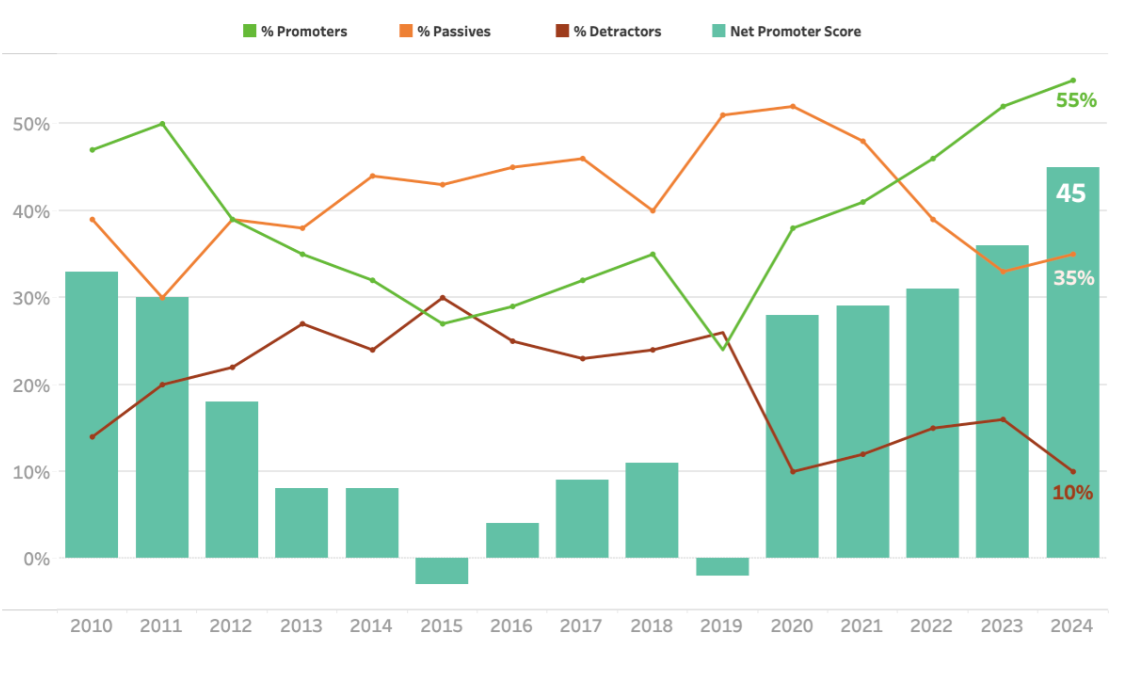
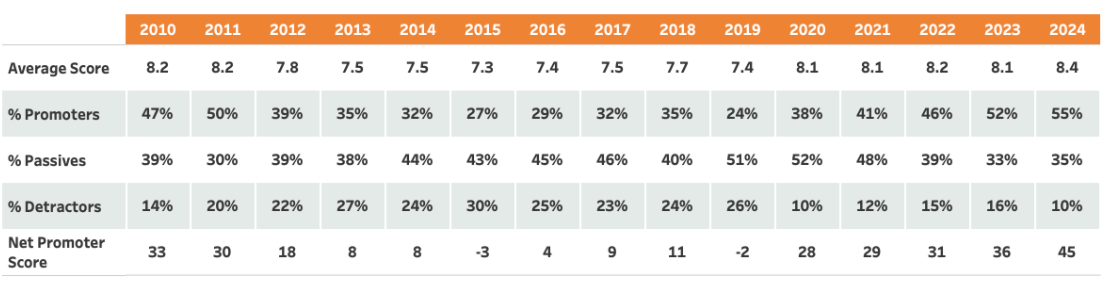
According to the 2024 NPS® Benchmarks for the Staffing Industry, the overall NPS rose from 28 in 2020 to 45 in 2024. That nine‑point jump between 2023 and 2024 marks the biggest single‑year improvement since tracking began in 2010.
Most of that positive change came from better issue resolution, stronger culture‑fit placements, and more reliable service delivery times. Even though a score of 45 is the highest recorded client NPS for staffing firms to date, the industry still trails global NPS standards, where a score above 50 is usually considered excellent.
At this point, many firms view client satisfaction not only as a matter of goodwill or morale but also as a real competitive differentiator that supports retention. Agencies that take client feedback seriously use those survey results to guide investments in systems, training, and service process improvements. Those who treat staffing firm KPIs with respect begin to shift their identity, from being mere transactional vendors to becoming trusted partners for their clients.
Operational benchmarks
Measuring staffing firm performance metrics doesn’t end with satisfaction. Operational speed and consistency matter just as much.
Recent reports show that average time-to-fill is shifting across industries in 2025. For example, roles in manufacturing (assemblers, maintenance technicians, etc.) now often fill in 18 to 35 calendar days. Logistics and distribution roles tend to fill in 15 to 30 days under typical conditions.
These benchmarks offer a useful guide, especially when demand surges or candidate supply tightens. Comparing your average fill times to ranges like these lets you spot when you’re falling behind or when you’re outperforming market norms.
Why benchmarking matters for growth
Tracking staffing agency benchmarks regularly gives you a clear picture of your performance and opportunities. It helps you:
- Build a strong foundation for sustainable growth
- Move from reacting to pressure to planning with purpose
These actionable insights help you set realistic targets, build strategies based on actual market trends, and invest in improvements that deliver real value.
ClearlyRated: The Platform for Measuring What Matters
At ClearlyRated, we know the unique challenges staffing firms face when delivering exceptional experiences for both clients and candidates. Our platform is built specifically to meet those needs, helping staffing firms collect actionable feedback, benchmark performance, and build strong reputations that fuel growth.
Here is how we help staffing firms elevate their customer experience to stay competitive and profitable:
NPS surveys built for staffing firms
We provide industry-specific B2B surveys designed just for staffing firms, covering every key stakeholder. Unlike generic survey tools, our platform triggers surveys at crucial moments, including after interviews, onboarding, placements, and even months later, to capture timely and relevant feedback.
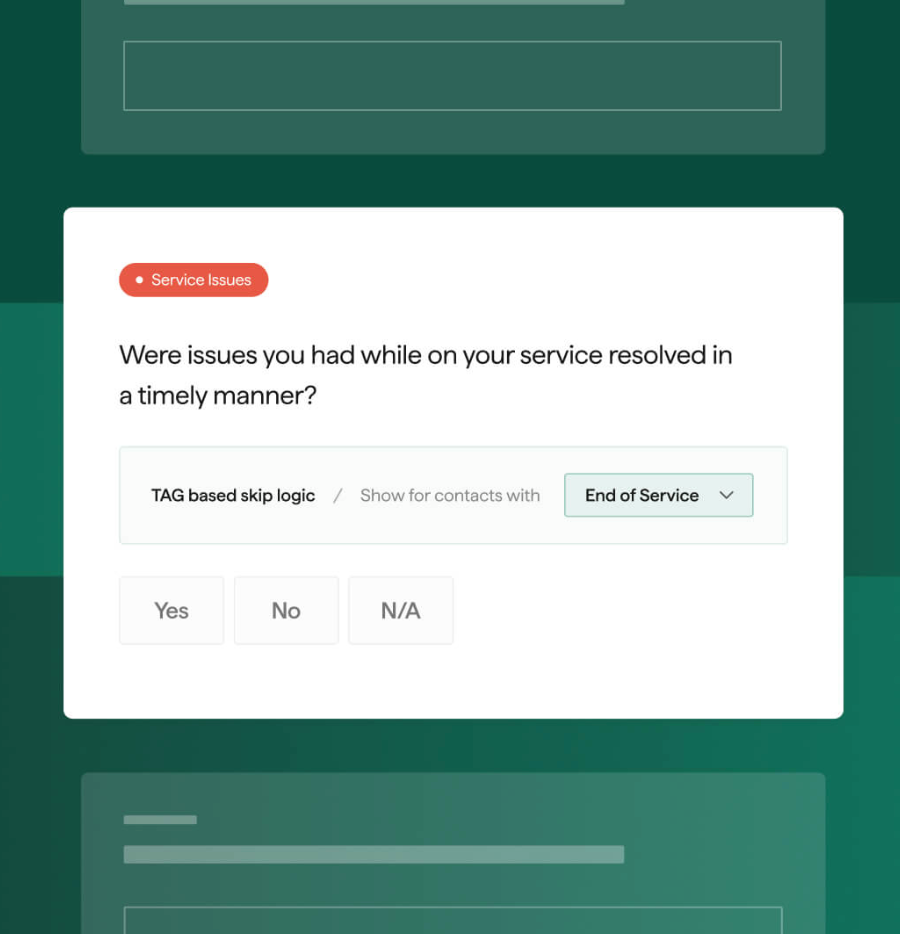
This structured approach delivers precise and actionable data to improve retention and service quality. Our surveys combine quantitative scores with qualitative comments, giving you a full picture of the experience across all touchpoints.
Our surveys feature strategically crafted questions, industry-specific formats, and the ability to collect responses ready to become testimonials. Automated delivery and follow-ups integrate smoothly into your workflows, while streamlined reminders help maintain high response rates and keep your data current.
Industry benchmarking and competitive insights
We offer clean, intuitive NPS dashboards that show live data on response rates and satisfaction trends. Your team can quickly spot patterns and address potential issues before they grow.
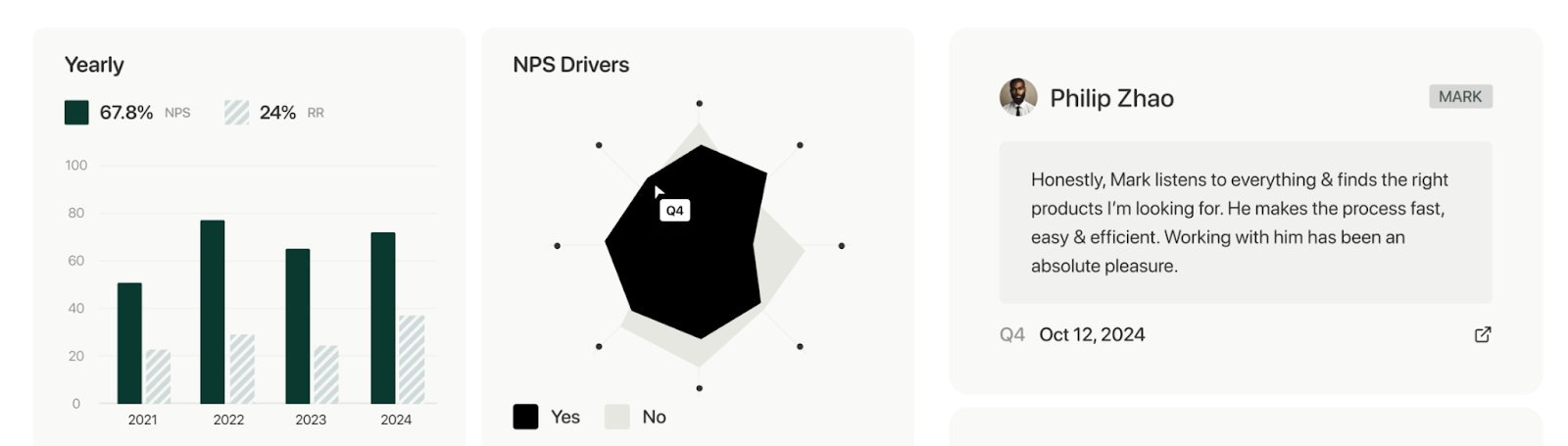
What sets us apart is our benchmarking feature, which compares your scores to those of industry leaders and local competitors. You always know exactly where you stand. You can identify at-risk clients or candidates with alerts that prompt proactive outreach, reducing silent churn and boosting loyalty.
Automated feedback collection and reporting
Our platform automatically delivers surveys at the right moments, captures responses in real time, and organizes the data into clear insights. You can see satisfaction trends, track response rates, and monitor changes over time, all from an intuitive dashboard.
With automated reporting, your team can quickly identify at-risk clients or candidates and take proactive steps before small issues become bigger problems.
Turning satisfaction data into business growth
Our clients consistently report strong returns on investment after switching to our platform. For example, TekCom Resources used our tools to reduce candidate falloff by 9% and increase client referrals by 50%, helping them achieve their highest-ever quarterly revenue.
Many staffing firms use our insights to uncover cross-selling opportunities, forecast future job orders, and reduce the risk of losing valuable accounts. ClearlyRated is designed to make customer experience measurable, manageable, and a powerful competitive advantage that drives sustainable growth.
Measure What Predicts Long-Term Success
Placement volume alone is no longer enough to gauge staffing agency success. Agencies that track recruitment agency metrics such as client satisfaction, NPS, retention, candidate quality, and operational efficiency can more accurately predict long-term growth.
With ClearlyRated, firms can turn feedback into actionable insights, improve client relationships, generate referrals, and optimize business performance. Our platform enables your staffing firm to move beyond reactive placement-focused operations and toward a proactive, client-centric approach that drives profitability, loyalty, and market differentiation.
FAQs
1. What is a good NPS score for a staffing agency?
A good NPS for a staffing agency typically ranges from 40 to 50, showing strong client loyalty. Scores above 50 are excellent, while scores above 70 are generally considered world-class. However, tracking improvement over time and acting on client feedback drives growth and matters more than the score itself, and ClearlyRated helps you do exactly that… and more!
2. How often should staffing agencies survey clients for satisfaction feedback?
Staffing agencies should survey clients after each placement, quarterly, and at key project milestones. Collecting feedback at these regular intervals ensures you capture timely insights, address issues quickly, and continuously improve client satisfaction.
3. What's the difference between client satisfaction and client retention metrics?
Client satisfaction measures perceived service quality, while retention tracks repeat business. High satisfaction usually correlates with retention, but both should be monitored for complete insight.

FAQs







.png)




.png)


