Choosing the Right AI Customer Experience Platform for Your Business

April 2, 2026
Choosing the Right AI Customer Experience Platform for Your Business
An AI customer experience (CX) platform is a centralized software system that uses AI (NLP, machine learning, sentiment analysis, predictive analytics, generative and agentic AI) to manage, automate, and personalize customer interactions across channels while surfacing real‑time, actionable insights.
Adopting an advanced AI CX platform is critical for B2B retention and growth—the AI CX market is projected to reach $47.82 billion by 2030 and 70% of customers will abandon a company after just two bad experiences—so unmet expectations quickly translate into churn.
When evaluating platforms, prioritize integration with existing CRMs and workflows, true omnichannel visibility, proactive AI capabilities, personalization and benchmarking, robust analytics and alerts, strong security/compliance, scalability, and reliable vendor support rather than feature checklists alone.
Implementation is often the main barrier—only 9% of companies report mature AI CX adoption even though 84% of leaders see high value; success depends on change management and training, deployment timelines range from days to six months, and mid‑market firms typically break even within six to 12 months.

- Your dashboards may look fine, but almost three-quarters of customers can leave after just two bad experiences. This shows why it is important to capture feedback quickly.
- The right AI CX platform turns insights into action, predicting at-risk clients, personalizing interactions, and integrating seamlessly with your tech stack to drive retention and growth.
- Our Client Savvy platform goes beyond surveys with industry-tested question models and the patented CXI® scale, uncovering up to 380% more hidden pain points than NPS alone.
- When evaluating platforms, focus on features, integrations, and usability, run pilots, include stakeholders, and track KPIs to ensure you select the best solutions that deliver measurable ROI.
Why are your best clients quietly exploring other providers while your dashboards say customer satisfaction is “on track”?
Imagine losing almost three-quarters of your customers in a single day. For good. Because that’s exactly what could happen after just two negative customer experiences.
The AI customer service market is projected to reach $47.82 billion by 2030. This is how critical it has become for growth and customer retention. In fact, even when people love a company or product, 70% will walk away after just two bad experiences. At the same time, 71% expect personalized interactions at every touchpoint. When those expectations are not met, frustration turns into customer churn.
For B2B service firms, this is no longer about small improvements. The right AI customer experience platform affects retention, expansion, and competitive positioning.
However, most firms are still in their early stages. Only 9% of companies have reached mature AI CX implementation, even though 84% of those leaders report high value from their investments. The gap often stems from how teams evaluate platforms that focus on features while overlooking integration complexity, change management, and what automation alone can fix.
This guide provides a framework to evaluate the best AI customer experience platforms for your business, technology, and budget.
What Is an AI Customer Experience Platform?
An AI customer experience (CX) platform is a centralized software system that uses AI technologies to manage, automate, and personalize customer interactions across every touchpoint throughout the client lifecycle.
Traditional CX tools focus on managing tickets and contact records. An advanced AI-powered customer experience software analyzes client sentiment in real time, predicts at-risk relationships, automates follow-up workflows, personalizes outreach, and surfaces actionable insights from one unified system.
For example, our Client Savvy platform goes beyond basic satisfaction surveys. It helps manage expectations, close the feedback loop, and drive loyalty by turning customer feedback into real insights and action. Several core AI technologies power these capabilities, each contributing to a better customer experience. For example:
- Natural language processing (NLP): Understands and interprets customer messages automatically
- Machine learning: Learns from data to improve predictions and recommendations over time
- Sentiment analysis: Detects emotions and attitudes in customer interactions
- Predictive analytics: Identifies at-risk clients and predicts future behavior
- Generative AI: Creates personalized messages, content, and responses at scale
- Agentic AI: Enables the platform to make autonomous decisions and take proactive actions
Together, these AI technologies enable organizations to anticipate customer needs, respond proactively, and turn every interaction into an opportunity to strengthen loyalty and drive growth.
Key Criteria for Evaluating AI Customer Experience Platforms
If you’re wondering how to choose an AI CX platform, start by looking at these implementation factors. Each is designed to help you separate platforms that simply track satisfaction from those that actively improve the customer experience.
Let’s start!
AI & automation capabilities
AI-powered features should go beyond basic ticketing to drive proactive engagement. Look for intelligent chatbots, AI triage and routing, predictive NPS and CSAT scoring, and generative AI for agents.
For B2B firms, the system should identify promoters, passives, and detractors automatically and trigger follow-up workflows.
To ensure the platform meets your needs, ask:
- Does the platform automatically identify at-risk clients and trigger workflows?
- Can AI analyze feedback and predict satisfaction trends, such as NPS or CSAT?
- Does it support generative AI to assist agents or personalize outreach?
Omnichannel support
Customers expect seamless interactions across all touchpoints. The best platforms unify voice, email, chat, SMS, social media, AI-powered client feedback surveys, and in-app channels into a single, context-rich view.
So, ask yourself:
- Are all client interactions visible on a single dashboard with shared context?
- Can users manage outreach across multiple channels without switching systems?
- Does the platform track engagement history to support consistent experiences?
Integration with existing systems
A platform that integrates smoothly with your existing tools reduces friction and eliminates data silos. Look for connections to CRM systems like Salesforce or HubSpot, ATS/project management tools, and industry-specific platforms.
Keep these questions in mind:
- Can the platform sync automatically with your CRM and other core systems?
- Are industry-specific integrations available for your workflows?
- Will your teams be able to access all relevant data without manual updates?
For example, ClearlyRated connects seamlessly with business systems to simplify workflows and surface actionable insights. It integrates directly with top CRMs like Salesforce, Dynamics 365, and HubSpot, ATS/project management tools such as Bullhorn and Avionté, and other industry-specific platforms like WorkN and TargetRecruit.
These integrations give your team a unified view of client interactions and the ability to act on insights quickly, without manual data entry.
Personalization & customer intelligence
AI customer service platforms should enable real-time client segmentation, industry-specific survey templates, sentiment-based follow-ups, and benchmarking against peers in the sector. Personalization helps turn insights into meaningful actions.
To guide your evaluation:
- Can the platform segment clients dynamically based on behavior or sentiment?
- Does it support personalized follow-ups and automated engagement?
- Are satisfaction benchmarks available for your specific industry?
Analytics, reporting, and actionable insights
Real-time dashboards and actionable insights are critical for proactive client management. Platforms should track NPS, CES, client health scores, sentiment trends, and team performance.
We go further by providing real-time insights that display feedback at the individual, project, and client levels. It also benchmarks your response rates, survey timing, and overall client experience against hundreds of other firms, helping leaders spot patterns, uncover potential issues early, and take action before small problems escalate.
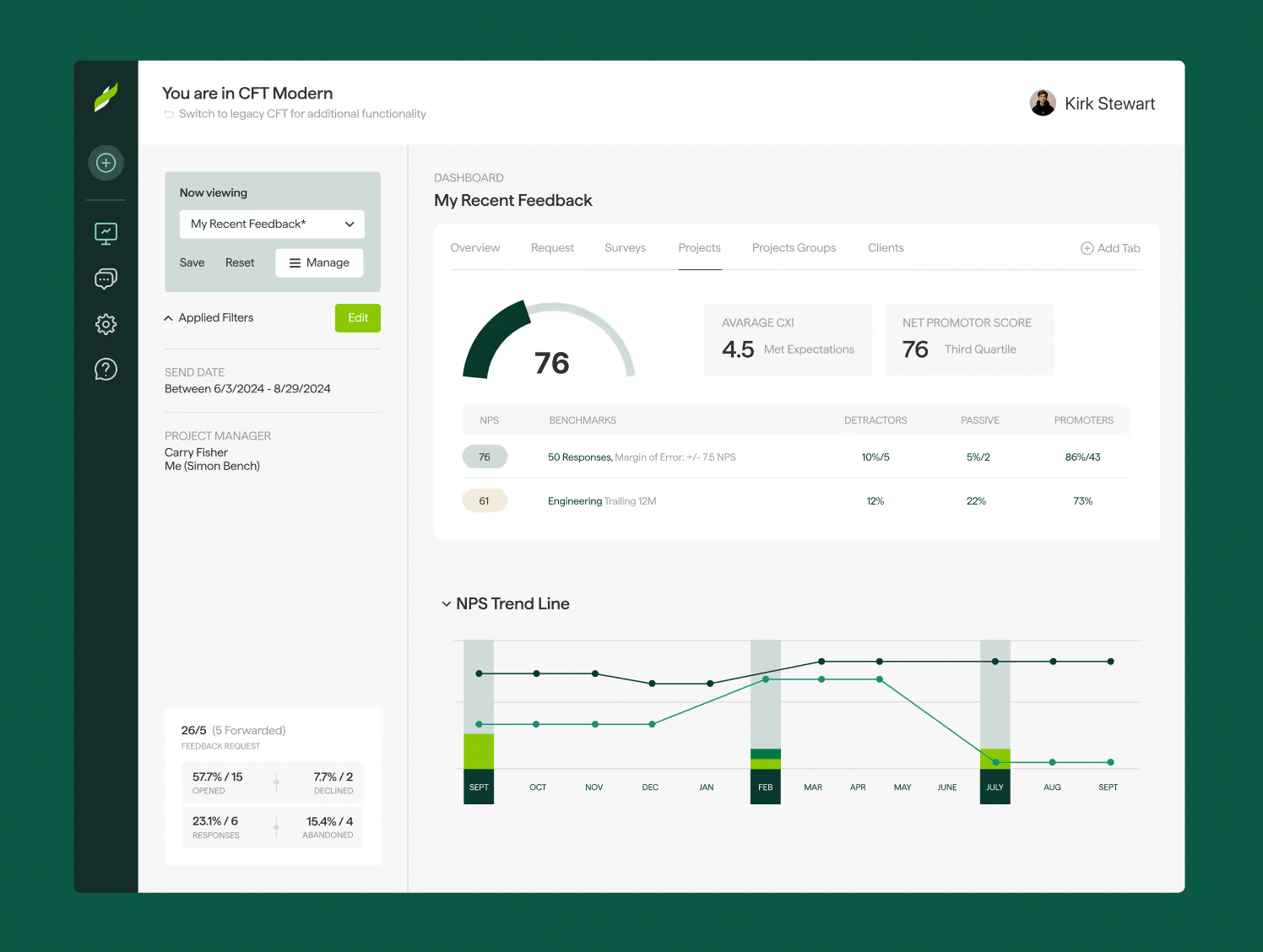
Firms using the platform see measurable results, including:
- Uncovering 4x more pain points than with traditional NPS surveys
- Retaining 83% of at-risk clients by addressing hidden frustrations through closed-loop accountability
- Achieving a 17-point increase in NPS through ongoing, milestone-based feedback
- Generating $1.8 million in referrals by activating promoters identified through the platform
While looking for a platform, check whether it can deliver these capabilities by asking:
- Does the platform provide real-time dashboards for key metrics?
- Can it alert you to clients who are at risk of churn?
- Are insights actionable and designed to drive follow-up actions?
Usability & user interface
Even the most advanced platform is only valuable if your team uses it. So, look for intuitive interfaces that minimize training time.
Ask yourself:
- Is the interface easy for all team members to navigate?
- How quickly can users become proficient?
- Are dashboards and workflows straightforward and visually clear?
Security, compliance, and data privacy
Did you know that in 2025 alone, over 345 million records were exposed globally due to breaches and system vulnerabilities?
This shows how data protection is non-negotiable. To prevent unauthorized access and data loss, adopt platforms that support strong encryption, SOC 2 compliance, GDPR readiness, role-based access, and PII masking.
Some of the key evaluation questions include:
- Does the platform meet or exceed compliance requirements for your industry?
- Are access controls and privacy features robust and configurable?
- Is customer data encrypted and securely stored across all systems?
Built on Google Cloud Platform (GCP), our system leverages a globally trusted infrastructure for peak data security, speed, and reliability. We follow rigorous standards, including GDPR, CAN-SPAM, and CCPA, and hold SOC 2 Type II certification to reduce compliance risks, protect your clients’ data, and instill confidence across your organization. Our team conducts annual Independent Application Penetration Testing, following the OWASP Secure Application Development Framework and using full access to our source code to verify resilience.
With these measures, your team can trust that client information stays secure while you act on insights quickly.
Scalability & performance
The platform should scale as your business grows, handling increasing interaction volumes without performance degradation. Multi-region support is essential for global operations.
Hence, you must ask questions like:
- Can the platform handle the growing volume of client interactions?
- Does it maintain performance under heavy usage?
- Are multi-region deployments supported if your business operates internationally?
Customer support and vendor reliability
Strong vendor support ensures your investment succeeds. Look for 24/7 support, dedicated customer success managers, onboarding assistance, and industry-specific expertise.
To evaluate vendor reliability:
- Is 24/7 support available for your teams?
- Will you have a dedicated customer success manager?
- Does the vendor have proven experience in your industry?
Our platform actively supports your success at every stage, providing 24/7 assistance, dedicated customer success managers, and tailored onboarding to get your team up and running quickly. With over 700 AEC and professional services firms relying on us, you can trust that our support and guidance consistently deliver results.
Implementation and Onboarding Considerations
Getting an AI CX platform up and running requires clear planning, strong coordination, and active change management to deliver value quickly.
Implementation timelines vary by solution type:
- No-code chatbot solutions take 1–2 days
- Custom NLP-based systems take 2–8 weeks
- Comprehensive AI CX solutions require up to six months to fully deploy, depending on data size, channel setup, AI tuning, and workflow complexity
During onboarding, teams migrate data, configure communication channels such as email, SMS, and surveys, and fine-tune AI models to match your firm’s language and context. For survey-based CX platforms, this also includes importing contacts, configuring templates, and enabling automated survey distribution so feedback flows from day one.
Our platform uses question models that have been tested across thousands of architecture and engineering firms over the past 20 years. These surveys form the backbone of its Voice of Customer (VoC) programs, encouraging clients to provide detailed and honest feedback.
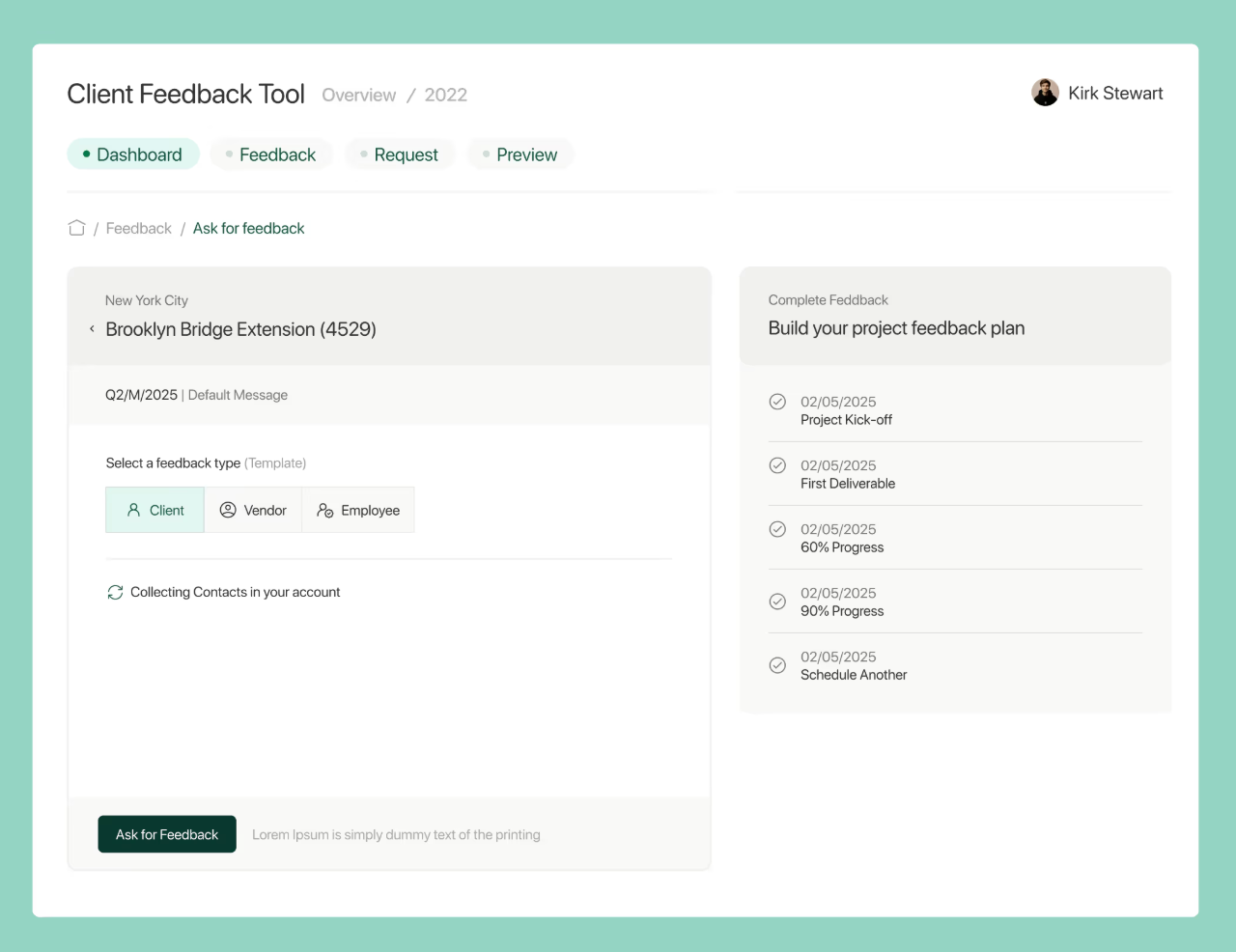
The patented Client Experience Indicator (CXI®) scale identifies up to 380% more hidden pain points than NPS alone. Technology alone does not guarantee results. McKinsey research shows that over 50% of successful AI CX implementations succeed because of change management, training, and user adoption. Firms that prepare teams, refine processes, and reinforce value realize faster adoption and stronger business outcomes.
Pricing & Value for Money
When it comes to the cost of an AI CX platform, you must evaluate long-term value. In fact, different platforms charge in different ways. Some charge per agent per month, others per resolution, usage-based, or per survey or contact. For example, rates range from $15 per agent per month for entry-level tools to more than $240 per agent per month for platforms like Genesys.
Some providers also add hidden costs for premium AI features, integrations, overages, or contract obligations, so you need a platform that fits your business without surprises. In that case, we offer flexible pricing plans that scale with your needs, including:
- Establish: Launch a foundational CX program, build a baseline, and showcase progress
- Expand: Connect feedback data, engage more deeply, and gain actionable insights
- Transform: Access in-depth insights, advanced integrations, and mature CX management capabilities
This shows how structured CX programs drive retention, growth, and measurable ROI. Mid-market firms typically break even in six-12 months. Additionally, Forrester research shows that 86% of B2B buyers are willing to pay more for superior customer experiences.
TekCom Resources illustrates the real-world impact of structured CX programs. After partnering with us, they tracked client and candidate feedback, turned insights into action, and improved every touchpoint using NPS for B2B firms. As a result, they achieved a 9% drop in candidate falloff, an 18.6% increase in gross profit margin, and a 50% increase in referrals.
Comparing Popular AI Customer Experience Platforms
To make an informed choice, this AI CX platform comparison highlights the strengths and limitations of leading CX solutions for AEC firms, helping you select the platform that best drives client retention and business growth.
Also read: 13 Best NPS Software Platforms & Tools to Use in 2026
Best Practices for Teams Evaluating AI Customer Service Platforms
When choosing the right platform for your firm, start by looking at CX solutions for AEC firms that align with your workflow and client needs.
- Run a pilot: Test each platform with real client data before committing. This lets your team see how top customer experience software performs in real scenarios and reveals potential gaps early.
- Include key stakeholders: Bring together CX leaders, IT, marketing, sales, and frontline account managers in the evaluation process. Their input helps match the solution to different organizational priorities.
- Set success metrics upfront: Define baseline KPIs such as NPS, CSAT, and retention rates before implementation. Clear customer experience metrics let your team track improvements and accurately measure the platform’s impact.
- Use feedback loops during evaluation: Hold weekly check-ins, maintain stakeholder scorecards, and run A/B tests between shortlisted platforms. These activities help teams compare options and select the solution that drives client satisfaction and long-term retention.
Choose the AI CX Platform That Puts Your Clients First
B2B service firms succeed when they capture client feedback at every stage of the engagement. The right AI CX platform gathers insights, benchmarks performance, strengthens relationships, and drives measurable growth.
Before choosing a platform, think about your current gaps:
- Are you capturing honest feedback fast enough?
- Are you spotting at-risk clients before issues escalate?
- Are you personalizing interactions across every touchpoint?
- Are you turning feedback into actionable insights that drive real results?
Firms using our Client Savvy platform quickly see the difference. By sending real-time, AI-powered industry-specific surveys and tracking CX metrics, teams uncover hidden pain points, retain at-risk clients, and activate promoters to generate referrals. Leaders use these insights to open meaningful conversations, improve client satisfaction, and make data-driven decisions that impact the bottom line.
Are you ready to turn every client interaction into growth? Schedule a personalized demo today and see how your firm can close the client experience gap.
FAQs
1. What is an AI customer experience (CX) platform?
An AI customer experience (CX) platform is software that uses artificial intelligence to manage, analyze, and improve customer interactions across different channels. It automates tasks like feedback analysis, sentiment detection, predictive insights, and personalized communication to enhance customer satisfaction and retention.
2. How do AI customer experience platforms improve customer retention?
AI CX platforms analyze customer feedback, behavior, and sentiment in real time to identify at-risk clients early. They can automatically trigger follow-up workflows, personalized outreach, or service interventions to resolve issues before they lead to customer churn.
3. What features should you look for in an AI customer experience platform?
Key features include AI-powered sentiment analysis, predictive analytics, omnichannel support, CRM integrations, automated workflows, real-time analytics dashboards, and personalization capabilities. Strong security, scalability, and vendor support are also essential.
4. What is the difference between traditional CX tools and AI CX platforms?
Traditional CX tools mainly focus on managing tickets, surveys, and customer records. AI CX platforms go further by analyzing customer sentiment, predicting behavior, automating responses, and generating insights that help businesses proactively improve the customer experience.
5. Why is omnichannel support important in AI customer experience platforms?
Omnichannel support allows businesses to manage customer interactions across channels like email, chat, voice, SMS, social media, and surveys from one platform. This ensures consistent communication and provides teams with complete customer context.
6. How do AI CX platforms use predictive analytics?
Predictive analytics helps businesses forecast customer behavior based on historical data. AI models can identify potential churn risks, highlight dissatisfied clients, predict NPS or CSAT scores, and recommend proactive actions to improve customer relationships.
FAQs


.webp)



_.png)

