Customer Feedback Analysis: Turning Insights into Strategy

- Customer feedback gives insights into what your customers love, what frustrates them, and where your business can improve. However, these insights only matter if you act on them consistently.
- Gathering feedback from surveys, reviews, social media, and support tickets gives you the full picture, while tools like ClearlyRated help centralize, analyze, and turn it into actionable insights.
- Analyzing trends, prioritizing issues, and combining qualitative and quantitative feedback shows you what’s working, what needs fixing, and which clients are at risk of leaving.
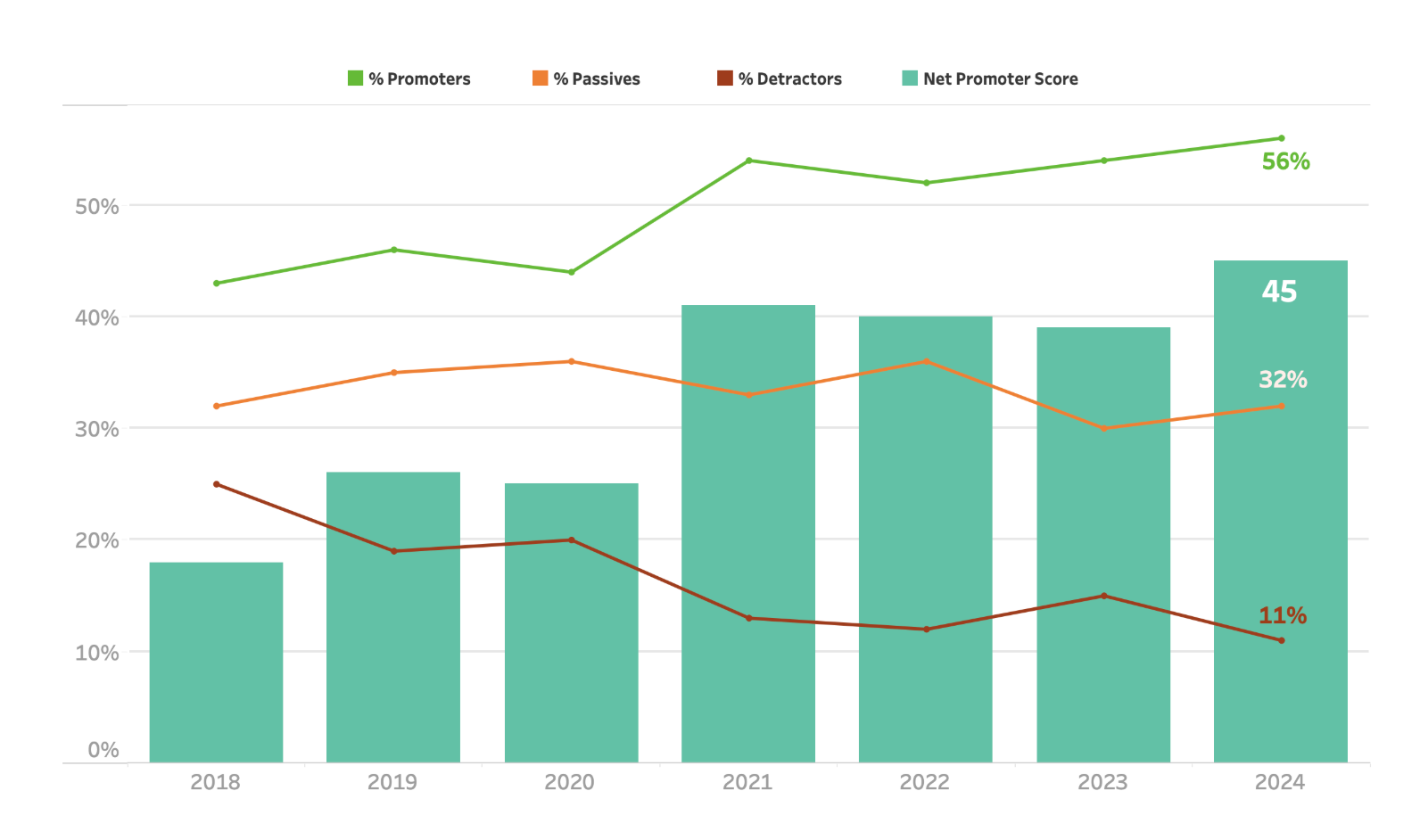
- Benchmarking results reveals opportunities and successes, like a six-point NPS increase in 2024, helping your team make smarter, data-driven decisions that strengthen relationships and drive growth.
A big part of improving your product or business comes down to listening to your customers and what they have to say. Most business owners would agree with that. But when it comes time to make decisions, many still fall back on gut feelings.
Why does that happen? Because customer feedback analysis is hard to do well. Pulling clear insights out of messy feedback takes effort, and it is easy to get overwhelmed.
Still, those insights help you see problems more clearly, understand customer satisfaction, and make better choices about your products or services. Without them, it is tough to make decisions that support real business growth and customer retention.
If you are like most modern businesses, you already have more than enough data. You have customer conversations, survey responses, and reviews piling up every day. Going through all of it can feel daunting. This guide will show you how to analyze customer feedback in a practical way and turn it into clear, actionable input you can actually use.
⚠️ 3 Common Customer Feedback Analysis Mistakes
- Collecting feedback but never reviewing it
- Analyzing feedback in silos instead of cross-functionally
- Focusing only on negative feedback while ignoring positive patterns
What Is Customer Feedback Analysis?
Customer feedback analysis is the process of collecting, organizing, and interpreting feedback from your customers to inform decisions that improve your products, support, marketing, and overall experience.
Today’s advanced feedback analysis relies on tools that automate this interpretation at scale. These systems combine quantitative scores (like Net Promoter Score or Customer Satisfaction Score) with qualitative insights (open‑ended comments, sentiment, and emerging themes) to provide a coherent picture of customer expectations and perceptions.
One of the biggest advantages of using data in feedback analysis is what it allows you to see and measure over time. Some key benefits include:
- Predictive insights: You can forecast customer churn or future purchases by identifying patterns in customer feedback over time.
- Segmentation clarity: You can see how feedback varies across customer segments, regions, or product lines, which helps you tailor your decisions more precisely.
- Sentiment quantification: You can identify how customers feel about specific aspects of your product or service, rather than relying on anecdotal impressions.
- Outcome measurement: You can connect voice-of-customer (VoC) signals directly to revenue, retention, and growth metrics.
This is where sentiment analysis and thematic analysis become essential. Sentiment analysis helps you understand the emotional tone of customer feedback, whether responses skew positive, negative, or neutral. Thematic analysis groups recurring themes and issues to help you focus on the most critical areas for improvement.
The outcome is clear. You move from scattered feedback to data-driven decisions that lead to meaningful improvements in customer experience and stronger long-term business outcomes.
Types of Customer Feedback
Not all feedback is created equal. To properly analyze it, you need to understand the different types of customer feedback, where it comes from, and how it informs your strategy.
Now that we have a fair understanding of the different types of customer feedback, let’s break them down.
Direct feedback
Direct feedback is the most straightforward. This includes:
- Customer surveys
- Reviews and ratings
- Interviews and testimonials
These sources explicitly tell you what customers think and feel. For example, surveys can reveal satisfaction scores after support interactions, while reviews might highlight specific product features users love or dislike.
Indirect feedback
This is feedback customers don’t explicitly say, but show through behavior:
- Website abandonment
- Support ticket patterns
- Social media comments
- Usage analytics
Indirect feedback is especially valuable because it captures real customer actions. A sharp drop in product engagement, for instance, may signal frustration even before customers send a complaint.
Qualitative vs. quantitative feedback
Qualitative feedback is rich in detail. It gives context and emotion, and the “why” behind customers’ feelings. Techniques such as sentiment analysis and thematic analysis help turn qualitative comments into patterns brands can decipher.
Quantitative feedback, on the other hand, includes numerical scores like CSAT, NPS, and CES. These metrics help you measure changes in satisfaction over time and benchmark performance.
Together, qualitative and quantitative feedback give you both breadth and depth of understanding, enabling decisions grounded in real customer experience.
How to Collect Customer Feedback
The way you measure client experience directly shapes the value you get from it. Each feedback method captures something different, but together they create a fuller picture of how clients experience your projects and your firm.
1. Surveys
Client surveys are one of the most effective ways for AEC firms to gather structured feedback at scale. Clients can respond on their own time, which often leads to more thoughtful and honest answers.
Well-designed surveys include a mix of open-ended and closed-ended questions, rating scales, and industry-specific formats that capture both qualitative and quantitative feedback. They also track key metrics like Net Promoter Score (NPS) and Client Effort Score (CES). NPS, in particular, helps categorize clients as promoters, passives, or detractors, giving you early insight into who might churn and who could become an advocate for your firm.
When you run surveys at key project milestones, they give you visibility into client sentiment before small frustrations turn into larger issues.
2. Online reviews and ratings
Online reviews on platforms like Google, industry directories, and third-party sites provide indirect but powerful feedback.
These reviews are public, unfiltered, and often shape how potential clients perceive your firm before they ever reach out.
3. Social media listening
Social media platforms contain a steady stream of feedback that does not always show up in formal surveys.
Monitoring mentions, conversations, and sentiment on channels like LinkedIn, Facebook, and X helps you spot emerging trends, concerns, and opportunities in real time.
4. Live chat and support tickets
Every interaction with customer support carries feedback, whether positive or negative. Reviewing live chat transcripts and support ticket themes can uncover operational friction and unmet needs that clients may not raise elsewhere.
5. Focus groups
When you need deeper insight from specific client segments, focus groups offer a level of detail that quantitative methods cannot provide on their own.
Guided discussions help uncover motivations, expectations, and perspectives that explain the “why” behind the data.
Tools and Platforms for Feedback Analysis
Collecting feedback is only the first step. You also need the right customer feedback tools to analyze, act on, and scale insights.
A 2025 industry study projects that the customer feedback software market will grow rapidly, reaching $8.65 billion by 2035, as businesses adopt advanced analytics, real‑time dashboards, and AI‑driven systems to make sense of customer data.
These tools help you:
- Aggregate feedback from diverse channels
- Run sentiment analysis on open‑ended responses
- Identify recurring themes and patterns
- Benchmark performance against competitors and industry standards
- Prioritize actions based on impact potential
In fact, global enterprises leveraging unified feedback platforms report a 10–15% increase in customer retention and faster response times to complaints, leading to stronger loyalty and brand reputation.
However, there is no single tool that fits every business. Some platforms are purpose-built for specific industries, such as ClearlyRated for professional services firms, that need standardized benchmarking. Others, like Google Forms, work well for lightweight surveys or early-stage feedback programs. Many teams also depend on CRM integrations to connect feedback directly to accounts, projects, and outcomes, which makes insights easier to act on in context.
As feedback volumes increase, another challenge emerges. Large datasets quickly become unmanageable without automation. AI-driven platforms address this by processing large amounts of text, flagging urgent issues, and surfacing trends without requiring manual review. This not only saves time, but also allows teams to respond faster and more consistently.
More advanced systems now go a step further. Instead of labeling feedback as simply positive or negative, modern sentiment analysis can detect nuanced emotional signals such as frustration, hesitation, excitement, or trust. This gives teams richer emotional context than ever before.
The right tool, ultimately, is one that matches your scale and maturity. For example:
- Smaller businesses often benefit from simple survey tools and basic analytics
- Growing companies should prioritize tools that integrate with CRM and support systems
- Enterprise organizations benefit from scalable platforms offering real‑time dashboards and automated insight delivery
Tools that combine surveys, analytics, and dashboards, such as ClearlyRated, make it easier to centralize feedback, spot trends quickly, and act without switching between disconnected systems.
Analyzing Customer Feedback: Turning Data Into Actionable Insights
To turn customer feedback into real business outcomes, you need a clear, repeatable process that transforms raw responses into actionable insights.
Tools like ClearlyRated make that process smarter, faster, and more strategic.
1. Organize the data
The first step is bringing all feedback together in one place. Feedback comes from multiple touchpoints, including surveys, live chats, reviews, social media, and support tickets, and it’s easy for critical signals to get lost.
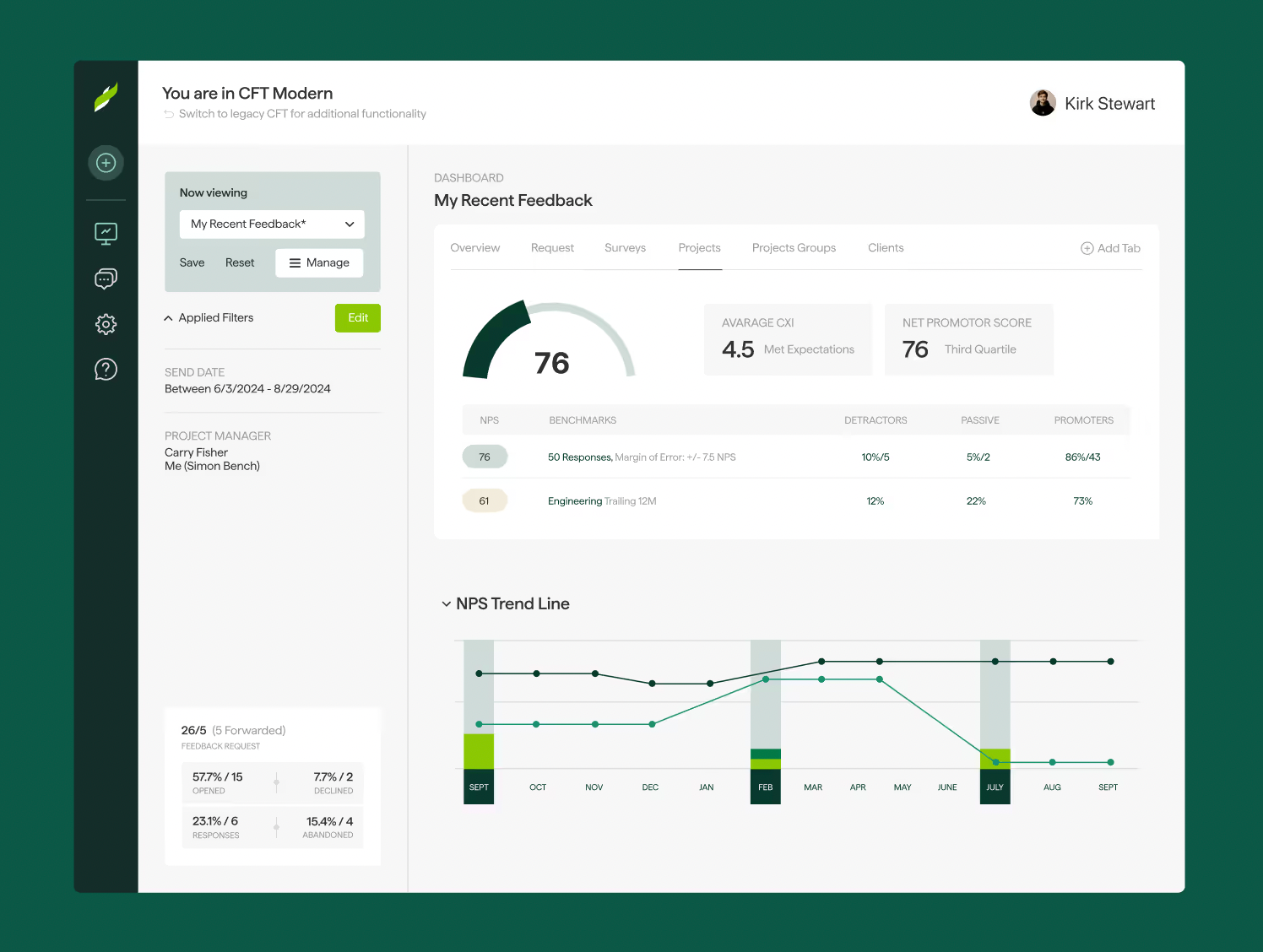
Our platform centralizes your data, collecting client surveys, testimonials, and ratings into a single dashboard. With everything in one place, your team can see the full picture of client satisfaction, spot patterns quickly, and avoid surprises during quarterly business reviews (QBRs) or client renewals.
2. Look for trends
Once the data is organized, the next step is identifying trends.
Are certain service lines consistently praised? Do recurring frustrations emerge at specific project milestones?

We offer actionable insights that use real-time dashboards and AI-powered sentiment analysis to reveal trends across client accounts, segments, and service lines. It goes beyond simple positive/negative scoring, decoding emotions like excitement, hesitation, frustration, or trust.
This helps you understand not just what clients are saying, but how they feel about your work.
3. Prioritize issues
Not every issue is equally urgent. Some feedback points highlight minor irritations, while others signal risks that could lead to churn. Advanced tools let you prioritize based on impact potential.
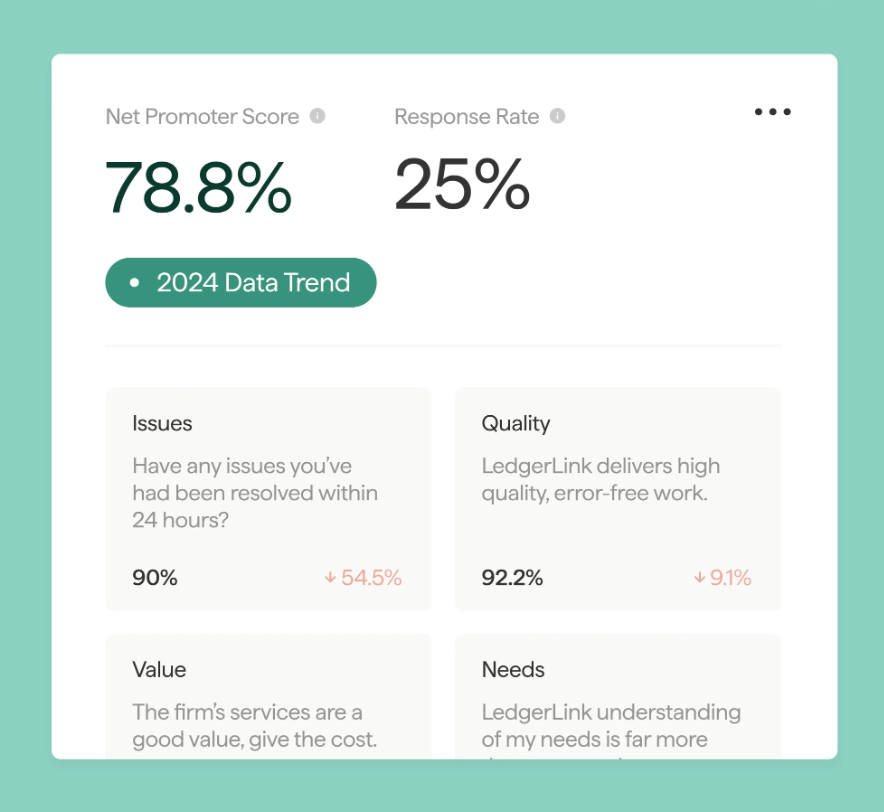
For example, our early-warning alerts flag at-risk clients in real time, so your team can intervene before dissatisfaction grows. At the same time, you can identify expansion opportunities among highly satisfied clients, turning insights into both retention and growth.
4. Benchmark and compare
Understanding your own trends is important, but context matters, too. We provide benchmarking across the B2B services industry, allowing you to compare your NPS and satisfaction ratings against competitors and historical data.
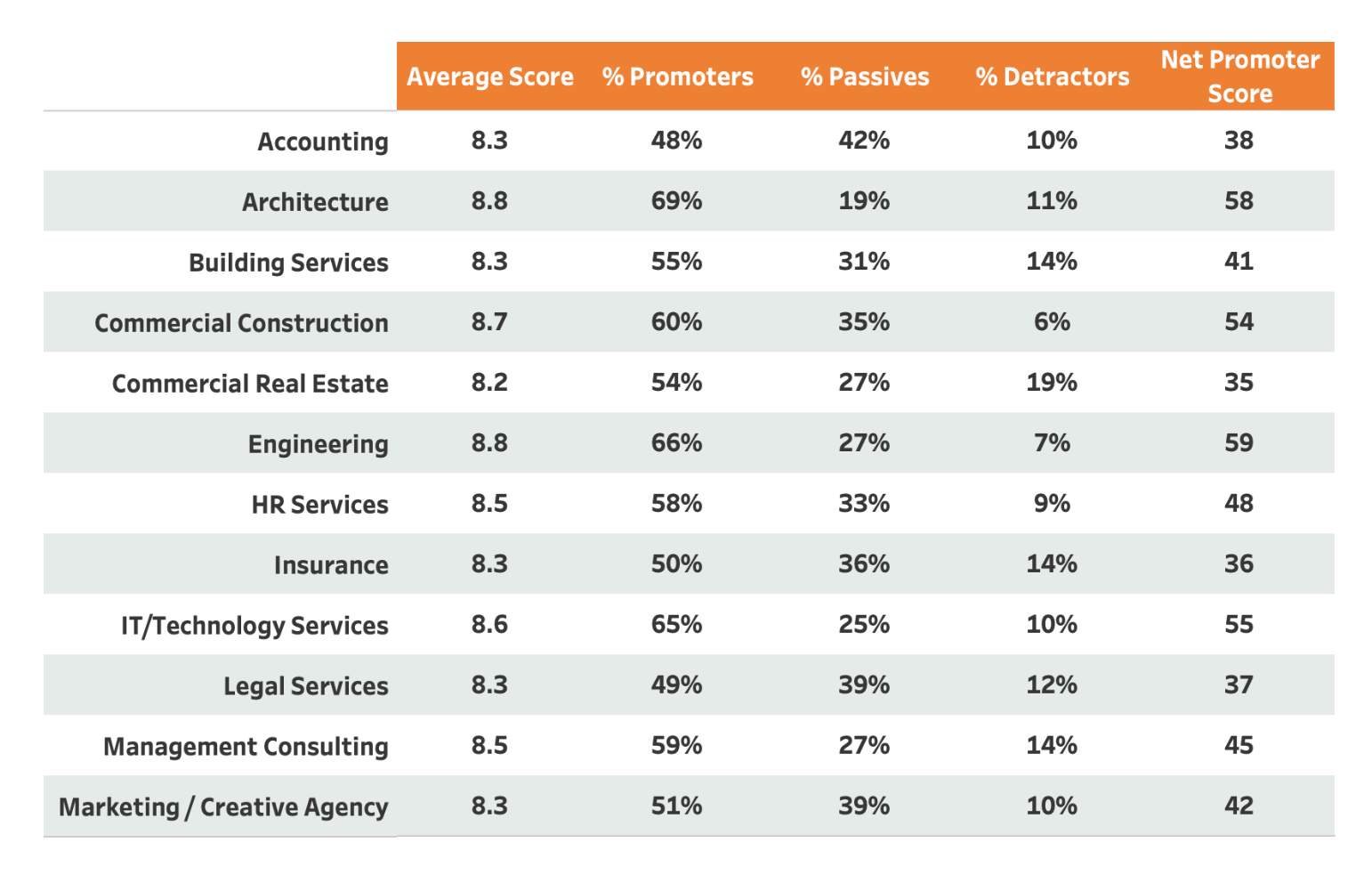
For example, our Annual Survey Benchmark Study shows that the NPS for general B2B services hovered around 40 from 2021 to 2023, then rose six points in 2024 to 45. Key improvements, such as meeting committed timeframes (+8 points) and service quality (+5 points), directly contributed to stronger client satisfaction and loyalty.
Benchmarking tools highlight exactly where your firm is succeeding and where teams should focus:
- Compare your firm against industry peers using established benchmarks
- Pinpoint internal strengths and weaknesses to prioritize improvements
- Track trends in satisfaction across teams and accounts to identify patterns and measure progress over time
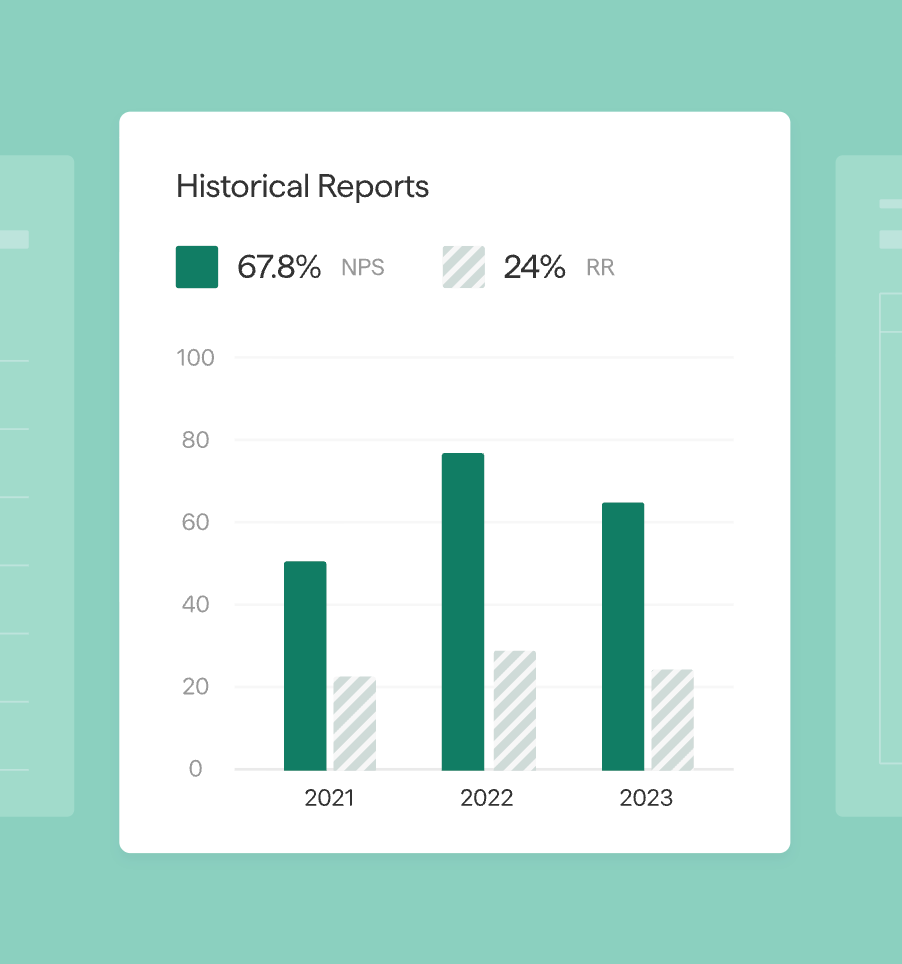
By combining this context with real-time insights from ClearlyRated, you not only understand what’s happening today but also make informed decisions to drive strategic growth and strengthen client relationships.
5. Combine qualitative and quantitative insights
Numbers tell only one part of the story, and words tell the other. Quantitative metrics like NPS, CES, and satisfaction scores reveal what is happening, while open-ended survey responses show why.
Our surveys capture both, including structured, numerical ratings, and testimonial-ready answers from clients. AI-powered sentiment and thematic analysis then convert qualitative feedback into actionable categories, so your team can address real client needs systematically rather than guessing from a few anecdotes.
How to Use Customer Feedback for Business Improvement
Once feedback is analyzed, it becomes the foundation for strategic improvement and business growth.
Here’s how you can apply it across functions:
- Product improvement: Customer feedback often reveals what users wish existed. Whether it’s a missing feature or a confusing interface, feedback helps product teams prioritize development based on actual customer needs.
- Service enhancement: Patterns in support tickets, satisfaction ratings, and sentiment trends indicate where customers struggle. Teams can revamp service protocols, improve training, or streamline workflows to make interactions smoother.
- Marketing adjustments: Marketing teams can leverage insights from feedback to refine messaging. Positive themes become value props in campaigns, while negative patterns help marketers avoid misaligned promises.
- Boosting customer retention: Retention is where value compounds. Acting on feedback shows customers you care, which boosts loyalty. Research shows that customers who feel their feedback matters are more likely to stay engaged and remain 70% more loyal, leading to higher lifetime value.
Best Practices for Feedback Collection and Analysis
To make the most of your feedback efforts, follow these proven practices:
- Collect feedback at the right moments: Ask for input immediately after key interactions, such as purchases, support calls, and renewals, while the experience is fresh. This captures genuine sentiment you can analyze for patterns like product/service quality, customer support, pricing/value perception, usability, and feature requests. When reviewing results, focus on themes that appear in more than 20% of responses to identify systemic issues rather than isolated comments.
- Engage customers in the process: Offer incentives or make participation easy and mobile‑friendly to boost response rates. Higher participation improves confidence when assessing which issues correlate with customer churn or long-term retention.
- Keep methods consistent: Standardize questions and channels to maintain comparable trends over time. Consistency allows you to see how satisfaction changes and where patterns emerge across customer segments.
- Handle negative feedback with care: Respond professionally and openly, showing customers their opinions matter. During analysis, compare responses from promoters and detractors to understand where perceptions diverge and what drives loyalty versus dissatisfaction.
How to Continuously Improve Your Feedback Strategy
Feedback strategy isn’t a one‑time project, but a cycle of listening, acting, and adapting. Here’s how you can improve it continuously:
Analyzing feedback trends over time
Track changes in sentiment and theme frequency. Are older issues resolved? Are new pain points emerging?
This longitudinal view helps teams anticipate needs before they escalate.
Constantly adapting your strategy
Use insights to refine questions, expand channels, and include new customer segments.
As market expectations evolve, so should your feedback methods.
Companies that embed this continuous loop of feedback, analysis, and action become more adaptive, resilient, and customer‑centric, ultimately fueling long‑term success.
Make Customer Feedback a Habit
Looking at customer feedback once is helpful, but the real magic happens when you make it a habit.
The most valuable insights come from tracking changes over time, identifying recurring themes, and observing trends month over month or quarter over quarter. This ongoing habit helps you anticipate customer needs, improve products and services, and make data-driven decisions that drive growth.
Client experience platforms like ClearlyRated make it easy to gather surveys, track NPS, and spot trends in real time, so your team can act quickly instead of guessing. By paying attention consistently, you turn everyday feedback into smarter decisions, happier clients, and real business growth.
Stop letting valuable feedback go to waste. ClearlyRated centralizes, analyzes, and turns customer insights into growth strategies. See how in a personalized demo.
FAQs
Why is customer feedback analysis important?
Customer feedback analysis shows you what your customers truly want, what frustrates them, and where your business can improve. It helps you make smart, data-driven decisions, boost satisfaction, and strengthen loyalty, turning insights into real growth.
How do I collect customer feedback effectively?
You can collect feedback effectively by asking the right questions at the right time. Use surveys, reviews, support tickets, and social listening to capture honest opinions. Make it easy, timely, and personal so customers feel heard and valued.
What tools can help with customer feedback analysis?
Client experience and feedback platforms like ClearlyRated help you gather, organize, and analyze feedback. They identify trends, track sentiment, and highlight risks or opportunities, making it simple for your team to act quickly and strategically.
What is the difference between qualitative and quantitative feedback?
Quantitative feedback gives numbers and scores, showing what is happening. In contrast, qualitative feedback tells the story behind those numbers, revealing why customers feel a certain way. Together, they create a full picture of experience and guide meaningful improvements.

FAQs


.png)
.webp)