How AEC Firms Can Navigate Uncertain Times With CX

April 2, 2026
How AEC Firms Can Navigate Uncertain Times With CX
Customer experience (CX) strategy is essential for architecture, engineering, and construction (AEC) firms to retain clients, reduce churn, and drive growth amid shifting federal spending, rising competition, and tight margins.
Major market shifts include the IIJA’s roughly $1.2 trillion in authorized infrastructure funding with slower rollouts, and buyer preferences that make CX decisive—78% rank a seamless client experience as a top decision factor and 68% prefer strong communication/relationships over technical skill—while Forrester finds customer-focused companies grow 41% faster and 86% of B2B buyers will pay more for superior experiences.
Despite the stakes, many firms lack formal CX programs—about 47% report no formal CX strategy, only 4.2% say CX is enculturated, and 76% report no formal CX structure—yet regression analysis attributes roughly 69% of firm performance variance to how CX is managed and measured.
To survive and thrive, firms should operationalize CX by appointing a dedicated CX owner, implementing milestone-based surveys, Voice-of-Customer programs, and real-time dashboards, and benchmarking with metrics like NPS and CXI®—approaches shown to raise NPS by about 17 points, uncover up to 4× more hidden pain points, and retain roughly 83% of at-risk clients.

What does it take to survive, and thrive, in uncertain times?
Speed.
Adaptability.
Relationships.
Trust.
And the kind of client experience that turns uncertainty into opportunity.
The AEC industry is at a crossroads. Shifts in federal spending, rising competition, and economic instability are redefining what stability even means. Firms can no longer rely on long-standing agency relationships, and depending too heavily on one client or sector creates serious risk.
In fact, one of our clients recently laid off nearly 300 employees after a federal agency they served shut down. That firm delivered strong projects and maintained technical excellence, yet revenue challenges still caught up to them.
This reality forces a difficult question: If funding runs out tomorrow, what protects your firm today?
By treating client experience (CX) as a strategy, strengthening relationships, and differentiating with intention. In this article, we’ll learn how an AEC customer experience strategy helps firms retain clients, reduce customer churn, and drive growth, even during uncertain economic conditions.
Why the Ground is Shifting Beneath AEC Firms
Across the AEC landscape, the rules of the game are changing, and they’re changing fast. Federal project pipelines are changing direction, competition for non‑federal work has intensified, and client expectations have moved far beyond traditional technical delivery.
Here’s a quick snapshot of the key trends affecting AEC firms today:
These trends force firms to rethink how they win work and maintain strong client relationships. Let’s explore each challenge in detail and see what actions you can take to stay ahead.
Federal spending changes and their ripple effect
Recent federal policy and infrastructure funding changes are creating uncertainty for AEC firms that rely on government projects. But large funding streams from the Infrastructure Investment and Jobs Act (IIJA), which authorizes roughly $1.2 trillion for transportation, water, energy, and broadband projects, continue to create significant opportunities.
However, slower rollouts, paused funding, and the removal of DEI requirements are clouding near-term project pipelines and changing which firms may be competitive. These effects extend beyond federal work, influencing state and local markets as clients adjust spending and bidding plans.
Increased competition from displaced firms
When federal contracts shrink, competition grows in all other markets.
A recent analysis by McKinsey & Company indicates that firms that prepare tenders under high competitive pressure often deliver lower realized margins. Surprisingly, the margins they assumed in their bids are about the same as in less competitive periods. In other words, competitive pressure drives overly optimistic cost estimates rather than immediate margin cuts.
Construction is already a low-margin industry, which makes firms cautious about investing in productivity. Returns on capital are low, and risky investments are harder to justify with earnings this tight.
This means firms that once relied on reputation alone now have to stand out.
Clients compare multiple technically qualified firms. They check responsiveness, clarity of communication, and relationship strength. In order for clients to choose your firm, you must deliver both strong technical skills and an outstanding client experience.
Technical excellence is now table stakes
Nowadays, delivering on time and on budget is barely a bare minimum, and technical performance alone no longer sets a firm apart.
The AEC CX Benchmarks Report shows that 78% of buyers rank a seamless client experience as a top decision factor. The same report shows that 68% prefer firms known for strong communication and relationships rather than technical skill alone.
These numbers reflect a shift in buyer psychology.
If projects take a wrong turn, clients face budget scrutiny, political oversight, and personal career risk. To succeed, firms must invest in CX solutions for AEC firms. They should track and leverage AEC client experience metrics to measure performance and identify areas for improvement.
Firms that assign a dedicated CX strategist role in AEC will gain a competitive edge by designing processes that consistently enhance client satisfaction. By integrating client experience into every stage of project delivery, firms can differentiate themselves even in the most competitive markets.
📌Also read: The Myth of Repeat Business as a Client Experience Metric for AEC Firms
What Is an AEC Customer Experience Strategy?
Customer experience (CX) in the AEC industry is the sum of all client interactions across the project lifecycle, from business development through delivery, billing, and ongoing relationship management.
To be clear, CX is not customer service, nor is it just surveys or feedback forms. Rather, it is a holistic business strategy that shapes how clients perceive, engage with, and evaluate a firm at every touchpoint. A well-defined AEC client feedback strategy aligns operations, communication, and project delivery to create consistent, high-value experiences that drive client satisfaction, loyalty, and long-term partnerships.
Why CX is a business strategy, not a marketing function
Despite its importance, many AEC firms struggle to implement a customer experience strategy effectively. In fact, nearly half of AEC firms (47%) report they do not have a formal CX strategy. Of those that do, only 4.2% describe their program as “enculturated,” meaning CX is fully embedded into day-to-day operations. Another 76% of firms report having no formal CX structure at all.
This lack of structure creates measurable risks. Regression analysis shows that 69% of the variance in firm performance comes from how firms manage and measure CX. When you fail to turn intention into execution, you lose revenue, client retention, and overall firm health.
How a CX Strategy Helps AEC Firms Survive and Thrive in Uncertain Times
CX gives AEC firms the tools to navigate uncertainty and maintain growth, even in turbulent markets. More particularly, our Client Savvy platform empowers your team to track client sentiment, uncover risks, and act quickly to strengthen relationships.
Let's see how these four CX pillars deliver measurable results:
Protect your existing client relationships
Without tracking client experience, you have no clear view of which clients are likely to return, request additional services, or refer new business. Smart B2B firms don’t leave this to sheer luck. Instead, they use client success data to drive revenue through strategic upselling and cross-selling.
Research shows you have a 60 to 70% chance of selling to existing clients, compared with only 5 to 20% for new prospects. However, nearly one in four clients have unvoiced complaints. They aren’t saying anything, but those concerns still shape how they see your firm. Even worse, these conversations often happen through a single point of contact, so you miss what other stakeholders are feeling.
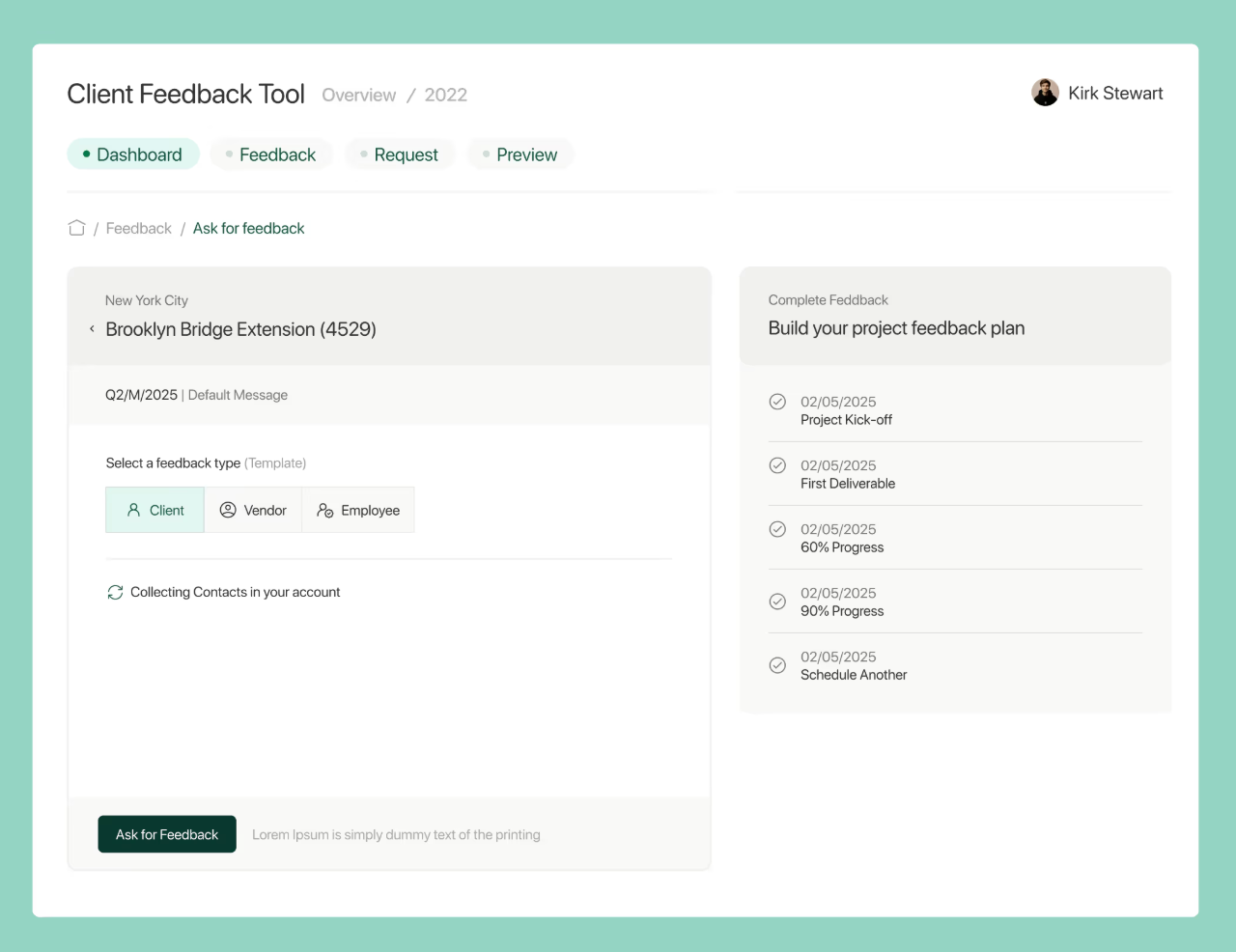
To avoid this, firms must measure client sentiment with structured feedback programs, milestone-based surveys, and real-time dashboards. Our client feedback software for AEC firms goes beyond basic surveys. It’s built on question models tested across thousands of architecture and engineering firms over the past 20 years. These surveys power Voice of Customer (VoC) programs that encourage clients to give honest, detailed feedback.
Meanwhile, our patented Client Experience Indicator (CXI®) scale identifies up to 380% more hidden pain points than NPS alone. That means your team can catch shifting expectations at each milestone and act before dissatisfaction grows.
In fact, firms using ongoing feedback see an average 17-point increase in NPS.
📌Interesting read: 11 Missteps You Can Learn From to Build a Successful CX Program
Lead with empathy, since your clients are under pressure too
A truly memorable client experience combines quick responses, smooth processes, reliable results, friendly interactions, and a human touch. That means turning every interaction into a real connection, using technology to make life easier, and giving your team the tools, guidance, and support they need to delight clients at every step.
However, clients are under pressure, too. They face funding challenges, shifting priorities, and unpredictable project landscapes. Firms that listen, understand, and respond earn trust and are seen as true partners, not just vendors.
To lead with empathy, focus on actions that show you care and build trust, such as:
- Be the reassuring presence your clients turn to.
- Show genuine concern in every interaction.
- Approach clients with empathy and understanding.
- Use small gestures and thoughtful communication to strengthen confidence, loyalty, and long-term relationships.
More than ever, now is the time to be human and put these principles into practice. Thoughtful, empathetic engagement turns routine projects into strong partnerships that last.
Build long-term resilience through CX
Firms that focus on customer experience in AEC firms keep more clients and grow faster. Recent research from Forrester shows that customer-focused companies achieve 41% faster revenue growth, and that 86% of B2B buyers are willing to pay more for superior experiences.
An AEC CX strategy also helps firms gain market share during downturns. While competitors cut costs, firms that invest in client relationships become the obvious choice. Clients notice when you prioritize their experience, and that trust translates into loyalty and repeat business.
A strong approach to CX in AEC firms also attracts top talent. When other companies are downsizing, firms with stable client relationships and a clear CX strategy can hire high-caliber professionals who help drive growth and maintain competitive advantage.
Operationalize CX, make it real, and not aspirational
To turn CX from an idea into results, start by appointing a CX owner or strategist. Just like safety officers became essential two decades ago, this role is now critical to ensure accountability and follow-through across every client interaction.
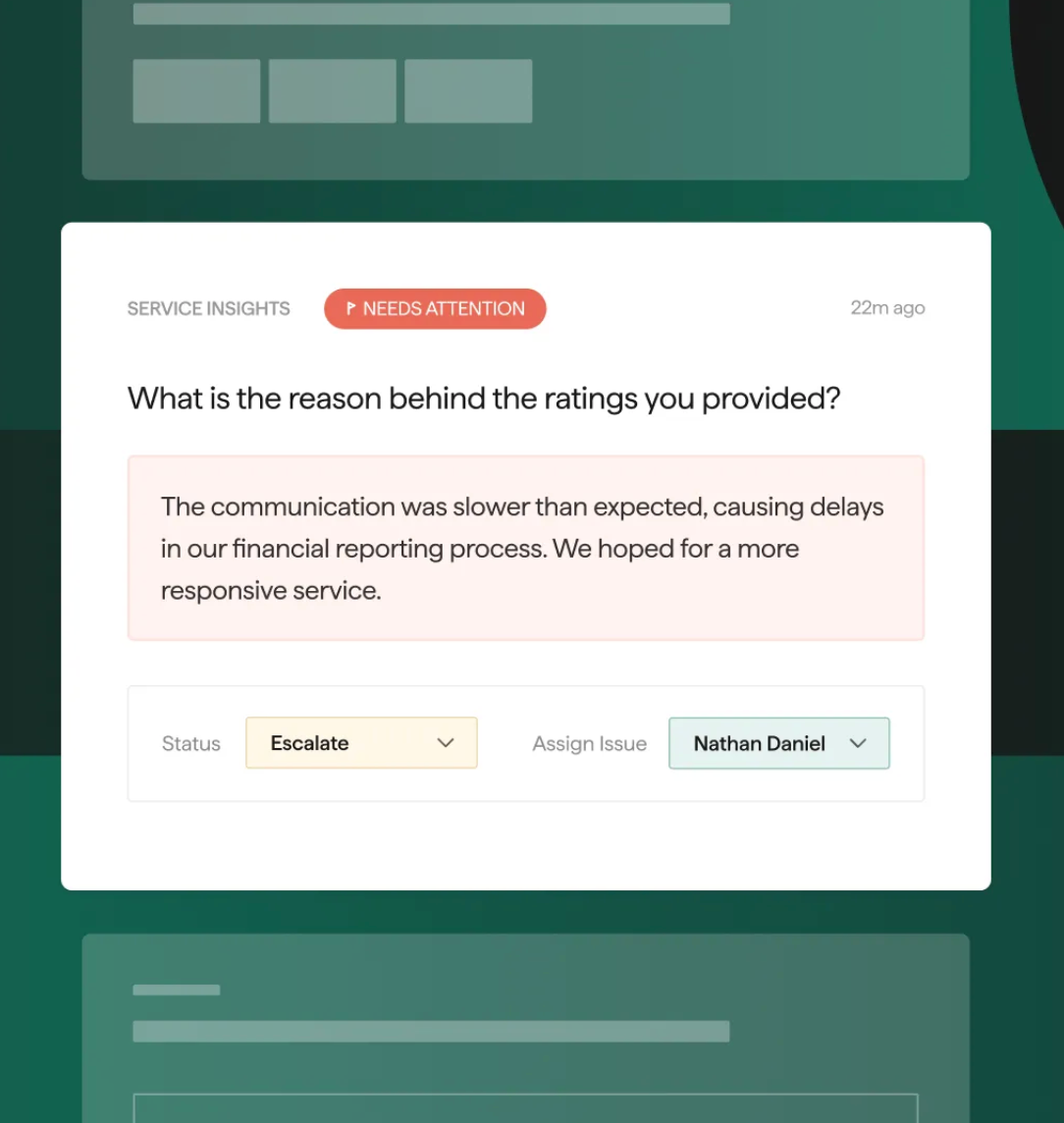
Next, implement structured feedback loops. Use tools like NPS tracking, milestone surveys, and real-time dashboards to capture client sentiment at every stage of a project. Projects in AEC unfold over long phases, during which client sentiment can shift quickly. Continuous listening lets your team spot issues as they arise, rather than waiting until the final delivery stage when fixes become costly.
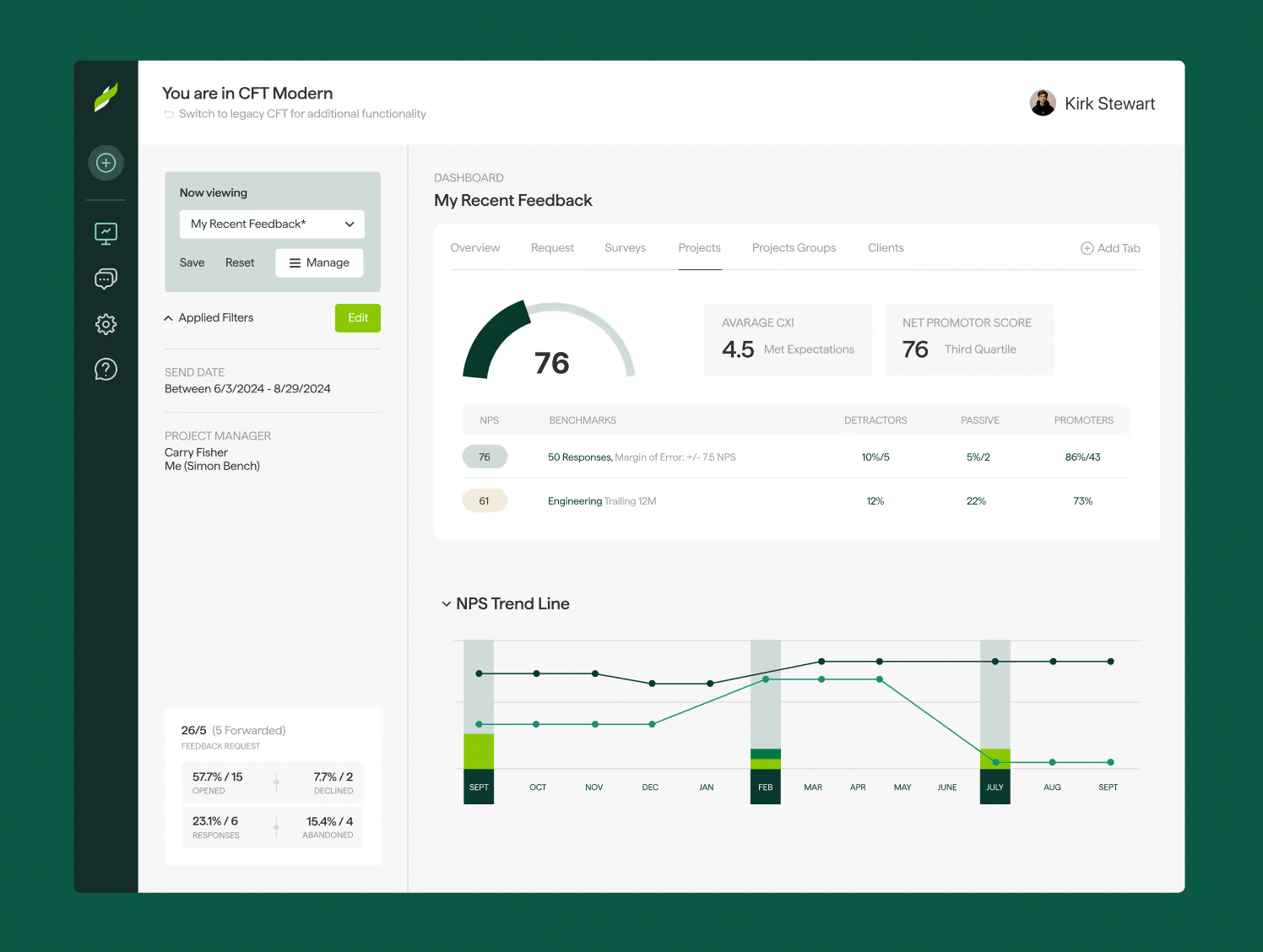
Our Client Savvy platform provides real-time insights and dashboards that show feedback at the individual, project, and client levels. It tracks NPS response rates, survey timing, and overall client experience, compared with those of hundreds of other AEC firms. Independent benchmarking highlights your strengths and exposes blind spots that self-reported data alone might miss.
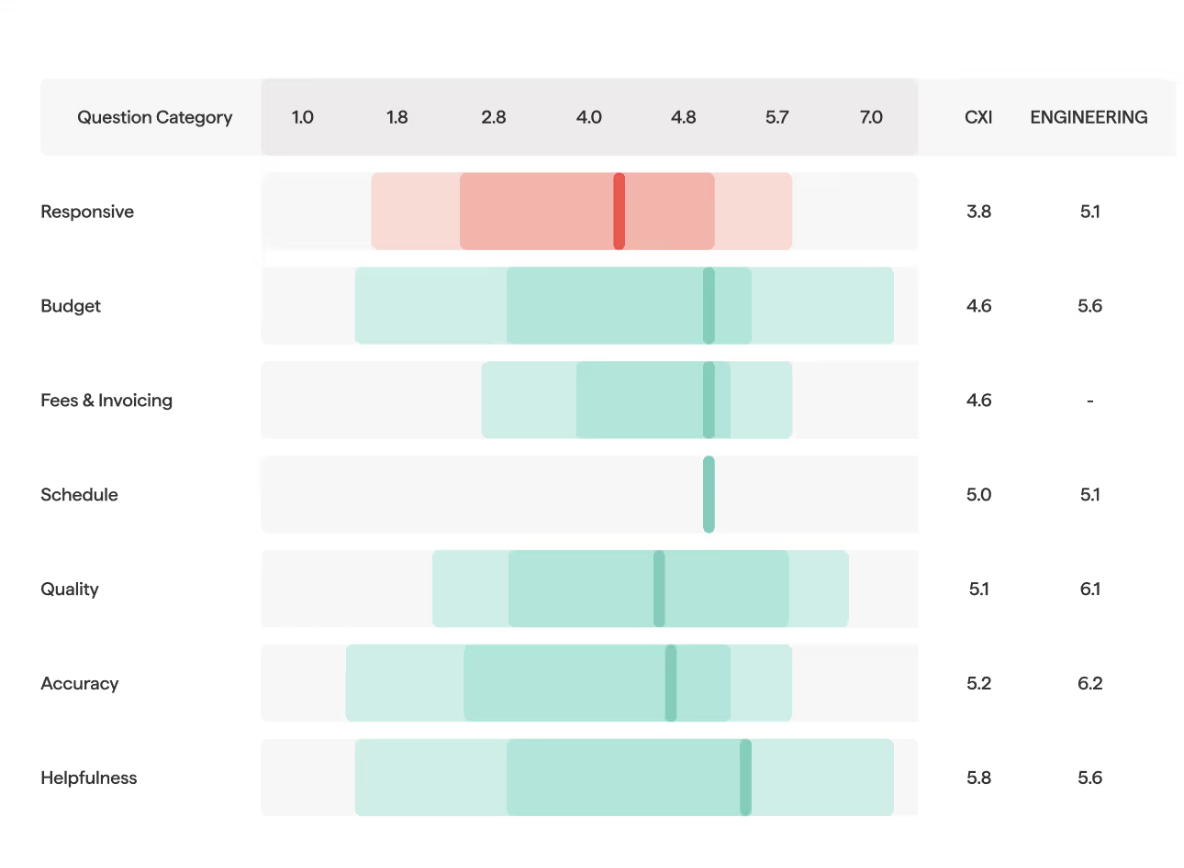
Firms using these insights discover up to 4x as many hidden pain points as with traditional NPS surveys. By closing the feedback loop, 83% of at-risk clients were retained, turning potential problems into opportunities to strengthen relationships.
Finally, benchmark continuously. Firms with a median NPS of 57 and measurable CX ROI are 94% more likely to achieve above-average growth. When you track client experience in real time, your team can connect specific actions with measurable reactions, build accountability, and make your AEC CX strategy deliver real, long-term results.
📌Bonus read: CX Trends to Watch for AEC and Professional Services
Turn CX Into Your Secret Weapon
In uncertain times, customer experience determines which firms survive, retain clients, and grow. Firms that take CX seriously win repeat business, build trust, and gain an edge when markets shift.
Take McDonald York Building Company, for example. They created structured feedback loops through surveys and internal discussions. In their second year, they collected 278 responses, which helped leadership identify issues, open honest conversations with clients, and strengthen trust. This approach drove a 15% increase in gross profit margin. They tracked complaints, defect claims, and client testimonials using ClearlyRated, turning client feedback for AEC firms into clear actions that improved loyalty and repeat business.
As Tanner Holland, President of McDonald York, says, “Start a project with a client, end the project with a friend.”
Our Client Savvy Platform helps AEC firms do the same. With milestone-triggered surveys, industry-specific templates, real-time dashboards, and benchmarking, teams can capture client feedback, act quickly, and measure results.
The next step is yours. Close the client experience gap, strengthen relationships, and drive growth. Schedule a personalized demo to turn client feedback into measurable business results.
FAQs
1. What is customer experience (CX) in the AEC industry?
Customer experience (CX) in the AEC industry refers to the overall perception clients develop through every interaction with a firm throughout the project lifecycle. This includes business development, project delivery, communication, billing, and long-term relationship management. A strong CX strategy ensures consistent, positive experiences that build trust and client loyalty.
2. Why is customer experience important for AEC firms?
Customer experience helps AEC firms retain clients, win repeat business, and differentiate themselves in competitive markets. As competition increases and margins tighten, firms that deliver excellent client relationships and communication stand out beyond technical expertise alone.
3. How does CX help AEC firms during economic uncertainty?
A well-implemented CX strategy helps firms strengthen client relationships, identify at-risk clients early, and create opportunities for repeat work and referrals. By focusing on client satisfaction and trust, firms can maintain stability even when project pipelines fluctuate.
4. What challenges are currently affecting AEC firms?
AEC firms face several challenges, including shifting federal spending, increased competition for non-federal work, tight profit margins, and rising client expectations. These factors require firms to rethink how they win projects and manage long-term client relationships.
5. What are the key components of an effective AEC CX strategy?
An effective AEC CX strategy typically includes structured client feedback programs, milestone-based surveys, real-time performance dashboards, clear accountability through CX leadership, and continuous benchmarking to improve client satisfaction and retention.
6. How can AEC firms measure customer experience?
AEC firms measure CX using tools such as Net Promoter Score (NPS), Client Experience Indicator (CXI®), milestone surveys, and client feedback dashboards. These metrics help firms track client sentiment, identify potential issues early, and improve project outcomes.

FAQs

.png)


.png)
.png)

