AEC Client Experience: What to Track, Why It Matters

April 2, 2026
AEC Client Experience: What to Track, Why It Matters
Client experience (CX) in architecture, engineering, and construction (AEC) explains why over 20% of clients fail to return despite projects finishing on time and under budget.
Many AEC firms measure project performance rather than CX—only 45% measured client satisfaction across all projects in 2023—and buyers report that a seamless experience (78%) and strong communication (68%) heavily influence firm selection.
Essential CX metrics include NPS (median ≈57; >50 = excellent), CSAT, communication quality, perceived progress versus reality, retention (≈80%) and churn (1–5% annually), client lifetime value, and composite relationship health scores.
Systematic CX tracking drives measurable business outcomes—firms with mature CX practices often derive 40–60% of recurring revenue from long‑term clients and customer‑focused companies show faster revenue and profit growth—while neglecting CX risks silent churn, reputation damage, and missed upsell opportunities.
Implementing structured CX programs and tools, illustrated by McDonald York and platforms like ClearlyRated’s Client Savvy, can increase NPS (average +17 points), recover 83% of at‑risk clients, and convert feedback into referrals and revenue.
- Many AEC firms track project metrics but miss the client experience signals that truly influence retention, even though only 45% measured client satisfaction across all projects in 2023.
- This gap creates blind spots that weaken relationships, which leads firms to rely on assumptions until issues escalate and affect repeat business.
- Strong CX metrics help firms prevent silent churn and uncover what clients really value, which sets the foundation for predictable growth.
- Our Client Savvy platform helps firms replace assumptions with structured feedback, real-time sentiment tracking, and benchmarks that turn satisfied clients into long-term advocates.
Why do over 20% of clients never return, even when projects finish on time and under budget?
On paper, your project is a success. It is delivered to spec, on schedule, and within budget. Yet months later, some of those clients quietly disappear.
What went wrong?
For many architecture, engineering, and construction (AEC) firms, the issue is not technical performance. It is the client experience.
In this article, we break down the AEC client experience metrics that directly influence profitability and long-term growth. You will learn why the industry is shifting from a project-first mindset to relationship management, what happens when firms rely on assumptions instead of data, and how structured client experience management helps architecture firms build more predictable, sustainable growth.
The State of Client Experience in AEC: Operating in the Dark
Many AEC firms continue to deliver complex projects with precision, yet they still navigate the client experience landscape with limited visibility. This creates gaps between what teams measure internally and what clients truly value.
Most firms track project metrics, not client experience metrics
Many AEC firms continue to focus on traditional project data such as deadlines, budgets, and deliverables, but they often ignore structured measures of how clients actually feel about the process. A recent report indicates only 45% of firms measured client satisfaction across all projects in 2023, even though that number reflects a 9% increase from 2022.
When firms focus only on deliverables and project completion, they overlook critical feedback loops. This practice prevents them from capturing what truly drives long-term relationships.
The disconnect between internal performance and client perception
Internal performance metrics often do not reflect the customer experience. For example, firms may pride themselves on delivering on time, staying within budget, and maintaining high technical standards. However, clients might still feel frustrated by poor communication, lack of transparency, or time-consuming processes.
Our 2025 Benchmarks, Insights, and Trends: Client Experience in the AEC Industry report suggests that 78% of buyers say a seamless experience influences their decision when selecting a firm. Another 68% of clients value strong communication and relationships as much as technical expertise. These numbers show that even firms that deliver technically perfect projects risk losing clients if they ignore the softer but vital elements of experience.
Why technical excellence alone doesn't guarantee client retention
As clients’ expectations evolve, firms must pair excellence in execution with high-quality service, transparency, and consistent engagement. When companies skip formal feedback or client-experience monitoring, they operate in the dark, assuming all is well simply because projects finish on time. That assumption can lead to silent dissatisfaction, eroding loyalty, and undermining future business growth.
By neglecting AEC client satisfaction tracking and defaulting to project-based client experience measurement, firms miss opportunities to identify pain points, improve communication, and turn one-time clients into long-term partners.
What Is Client Experience (CX) in the AEC Context?
Client experience in AEC refers to the overall perception clients form from their interactions with a firm throughout a project. It covers multi-phase, multi-stakeholder projects.
Compared to transactional industries, AEC firms deliver complex, long-term services where relationships matter as much as deliverables. Strong project management supports client experience, but it cannot substitute for systematically measuring client satisfaction, communication effectiveness, and engagement across the lifecycle.
Core Client Experience Metrics Every AEC Firm Should Track
Before diving into the details, this table provides a quick snapshot of the key CX metrics, what they measure, why they matter, and typical benchmarks.
Here's a detailed breakdown of the top six AEC customer experience KPIs every business should monitor, along with practical guidance on how to apply them.
1. Client Satisfaction and Net Promoter Score (NPS)
Client satisfaction and the Net Promoter Score (NPS) remain the two most reliable indicators of how clients perceive your firm after each major milestone. Post-milestone and post-project surveys capture immediate sentiment while details are fresh.
What NPS is
NPS, which measures how likely a client is to recommend your firm, provides an early predictor of high-quality referrals, long-term loyalty, and repeat business. You can ask clients to rate their experience on a scale from 0 to 10 and classify them based on their scores:
- Promoters score 9 or 10, remain loyal, and often recommend your firm.
- Passives score 7 or 8, feel satisfied, but show little enthusiasm to advocate for your firm.
- Detractors score 0 to 6, feel unhappy, and may harm your firm’s reputation.
How to calculate it
To calculate NPS, subtract the percentage of Detractors from the percentage of Promoters.
Your score can range from -100 to 100. Higher scores indicate stronger customer loyalty and advocacy.
For example, if 75% of clients are Promoters, 15% are Passives, and 10% are Detractors:
NPS = 75% (Promoters) - 10% (Detractors) = 65
NPS benchmarks
Here are the benchmarks for industry-wide NPS:
- Above 50: Excellent
- 30–50: Good
- Below 0: Needs improvement
Why it matters for AEC firms
A high NPS helps you attract repeat clients, lower client churn, and grow without constantly increasing marketing spend. In 2005, just two years after NPS was introduced, the London School of Economics found that increasing a company’s NPS by an average of 7 points is associated with a 1% increase in revenue.
Fast forward to 2025, and the median NPS across AEC firms sits at around 57. Tracking NPS helps AEC firms compare their client loyalty against these benchmarks, spot trends, and set realistic improvement goals.
When you regularly monitor NPS, you can prioritize improvements in service delivery and strengthen long‑term client relationships.
What is a client satisfaction score (CSAT)
Similarly, businesses gather customer satisfaction (CSAT) scores through simple, one-question surveys that reduce survey fatigue. A typical CSAT question asks: “How satisfied were you with your experience today?”
Clients respond with options like “Satisfied” or “Dissatisfied” and can leave comments for context.
How to calculate it
Calculate CSAT as follows:
For example, if 80 out of 100 clients rate their experience as “satisfied” or “very satisfied,” your CSAT score equals 80%.
Why it matters for AEC firms
When you combine CSAT with metrics like NPS and Customer Effort Score (CES), you gain a complete picture: CSAT measures satisfaction with each interaction, NPS tracks loyalty, and CES shows how easy or difficult the experience was.
If CSAT is high but NPS is low, treat this as a warning. Clients may be satisfied with the service, but may not feel loyal or willing to promote your firm. CSAT often aligns with first contact resolution (FCR) and average handle time (AHT), showing how operational efficiency affects satisfaction. A high CSAT with a low NPS indicates clients like your service but may not trust or advocate for your firm.
2. Communication quality and responsiveness
Clients consistently rate communication as one of the most important factors in their satisfaction with AEC firms. In fact, 65% of firms reported increased client retention after improving communication practices. Tracking how clients perceive communication helps teams uncover gaps between what they think they convey and what clients actually understand.
Measuring response times at each project phase highlights bottlenecks, especially during design development and construction administration. Firms that provide regular, proactive updates build trust and prevent the frustration that occurs when communication becomes reactive or inconsistent.
3. Project progress perception vs. reality
Perception often differs from reality, especially when clients lack visibility into complex schedules or budget structures. Monitoring client-perceived progress against actual timeline adherence exposes disconnects before they become escalations.
Transparent reporting on budget expectations versus actual spend reduces surprises and supports trust. When the project manager’s view, the client’s understanding, and billing data align, project delivery becomes far smoother and more predictable.
4. Client retention and churn rates
No business keeps every customer forever, and churn and retention rates reflect opposite sides of the same reality.
What is churn rate & how to calculate it
Churn rate measures how many customers leave during a specific period.
To calculate churn:
For example, if your business started with 5,000 customers, and by the end of the month, 250 customers had left, the churn rate for the month would be:
250/5,000 * 100 = 5%
In this case, 5% of your customers churned within the month.
Most businesses tolerate an annual churn rate of 1% to 5%. When churn exceeds that range, it indicates a potential problem.
What is retention rate & how to calculate it
On the other hand, retention rate measures how many customers remain, excluding any new additions. In fact, firms in the construction and engineering sector show an average client retention rate of around 80%. This means that many firms succeed in securing repeat business, but about 20% of clients do not return each cycle.
To calculate the retention rate, use this formula:
Where:
- E = Number of customers at the end of the period
- N = Number of new customers acquired during the period
- S = Number of customers at the start of the period
For example, if you begin the quarter with 1,000 customers, gain 200 new customers during the quarter, and finish with 950 customers, your retention rate equals 75%.
Retention rate shows how effectively your customer experience strategies perform. It reveals how well you maintain customer satisfaction and strengthen long-term relationships. Small changes in these rates can significantly affect revenue, especially in subscription-based models where recurring business drives growth.
5. Client lifetime value (CLV)
Client Lifetime Value (CLV) measures the total revenue a single client generates over the course of the relationship. You calculate CLV using the formula:
For example, if a client spends $100 per month, makes one purchase each month, and stays for two years, their CLV equals:
CLV = 100 × 12 × 2 = 2,400
Calculating CLV helps firms identify strategic accounts and understand how the quality of client experience affects long-term revenue. Tracking service expansion among existing clients shows how well the firm cross sells additional capabilities. When clients consistently refer new business, referral activity amplifies revenue and further increases overall CLV.
6. Relationship health score
A relationship health score combines client sentiment, engagement patterns, and financial metrics to predict the chances of renewal. AEC firms calculate relationship health scores using factors like:
- Satisfaction
- Communication frequency
- Decision-maker involvement
- Invoice timeliness
- Project performance
Tracking stakeholder sentiment across the project team reveals emerging friction before it turns into formal dissatisfaction.
📌Also read: The Complete Guide to Managing and Reducing Customer Churn
Why These Metrics Matter: The Business Case for Tracking CX
Tracking client experience (CX) metrics shapes the long‑term financial health and competitive edge of any AEC firm that treats clients as long‑term partners rather than single projects.
Drives client loyalty and repeat business
We’ve been saying this time and again that firms spend far less to retain existing clients than to acquire new ones. Additionally, loyal clients buy more frequently, expand their project scope, and initiate new engagements. This behavior reduces the need to source new business constantly and generates a steadier revenue stream over time.
Studies across B2B service industries show that firms with mature CX practices often derive 40-60% of their recurring revenue from long-term clients. High-quality client experience also produces portfolio-building case studies that drive referrals, upsells, and repeat engagements, further increasing lifetime client value.
Provides competitive differentiation
In an industry where many firms deliver on time and on budget, exceptional client experience distinguishes top performers from the rest. Broader B2B research highlights this, with Forrester reporting that customer-focused companies achieve 41% faster revenue growth, 49% higher profit growth, and 51% greater customer retention compared with firms that do not prioritize experience. Additionally, customers who rate their experience highly spend up to 140% more and stay loyal up to six times longer.
As more clients demand seamless, transparent, and responsive services, firms that integrate AEC client satisfaction tracking into their processes gain a strategic advantage. This positions client experience as a primary differentiator in a commoditized service market.
Identifies hidden pain points before clients leave
Many clients do not voice complaints before switching firms. Dissatisfaction often builds quietly through delays, miscommunication, or unclear billing.
Without systematic feedback loops, firms inadvertently overlook these subtle signals until it’s too late. Leading CX‑centred companies use structured surveys, regular check‑ins, and satisfaction metrics (such as post‑milestone surveys, Net Promoter Scores, and health scores) to detect early signs of disengagement and intervene proactively.
This early detection helps prevent silent churn and preserves long‑term relationships.
Informs strategic business decisions
Tracking client experience across projects uncovers patterns that inform decisions about which service lines generate the highest satisfaction, which project managers build the strongest relationships, and where process improvements deliver the greatest return.
Firms use these insights to allocate resources efficiently, refine service offerings, and prioritize investments in staff training, communication processes, and client management systems. This approach continuously improves client outcomes and internal efficiency.
Directly impacts profitability
Superior client experience delivers measurable financial results. B2B firms that excel in CX enjoy higher margins and sustainable growth. Satisfied clients expand project scope, approve add-ons, and accept pricing adjustments.
They generate referrals and bring in qualified new business at minimal acquisition cost. Firms that commit to managing client experience build a solid foundation for profitability that does not depend solely on winning new bids.
📌Interesting read: 11 Missteps You Can Learn From to Build a Successful CX Program
The Cost of Not Tracking Client Experience
Failing to monitor client experience systematically carries serious consequences. Here’s how:
Lost revenue from one-time clients who never return
When firms treat projects as isolated transactions rather than parts of an ongoing relationship, they often lose clients after the first assignment. In 2023, Conversica found that one in four companies did not respond to inbound leads at all, up from just 5% in 2020, mainly due to workforce reductions during the economic slowdown.
Among the companies that responded, most gave up too quickly. About 35% of contacted leads were contacted only once or twice, far below the recommended six to eleven attempts, and only 12% persisted long enough to meet this standard.
Despite these challenges, 17% of companies earned the highest overall grade, a notable improvement from 8% in 2020. These results show that treating projects as isolated transactions and failing to follow up systematically leads to lost clients and revenue, while persistent engagement drives measurable business growth.
Reputation damage from dissatisfied clients in tight-knit industries
When clients encounter slow responses, unclear communication, or opaque billing, dissatisfaction can spread quickly. Firms that ignore these issues often pay the price through poor word‑of‑mouth, negative reviews, and reduced referrals.
Once client reputation suffers, winning new business becomes harder and more expensive.
Missed opportunities for service expansion
Without tracking client experience, firms lack visibility into which clients are likely to return, request additional services, or refer new business. Smart B2B organizations use client success data to drive revenue through strategic upselling and cross-selling.
Research shows that firms have a 60 to 70% chance of selling to existing clients, compared with only 5 to 20% for new prospects. Effective cross-selling can also increase CLV by up to 14%. Firms that skip such tracking lose out on service expansion and long‑term account growth.
Competitive disadvantage as client‑centric firms pull ahead
Recent research shows that approximately 86 % of B2B buyers are willing to pay more for a superior customer experience in B2B transactions. This means that companies that fail to prioritize client experience lose revenue, loyalty, and market share.
Firms that neglect client experience lose these advantages to competitors who treat client experience as a strategic asset.
ClearlyRated: Built-In CX Tracking for AEC Firms
Many architecture firms rely on gut instinct to gauge client satisfaction, which often allows frustrations to go unnoticed and opportunities to slip away. ClearlyRated replaces assumptions with actionable data through feedback systems designed specifically for AEC workflows.
Our Client Savvy platform integrates structured listening into every project stage, turning everyday interactions into measurable insights that drive smarter decisions.
Selecting the right customer feedback software for AEC firms ensures your team captures insights at every stage without adding complexity to existing workflows.
Pre-built AEC metrics dashboard with industry benchmarks
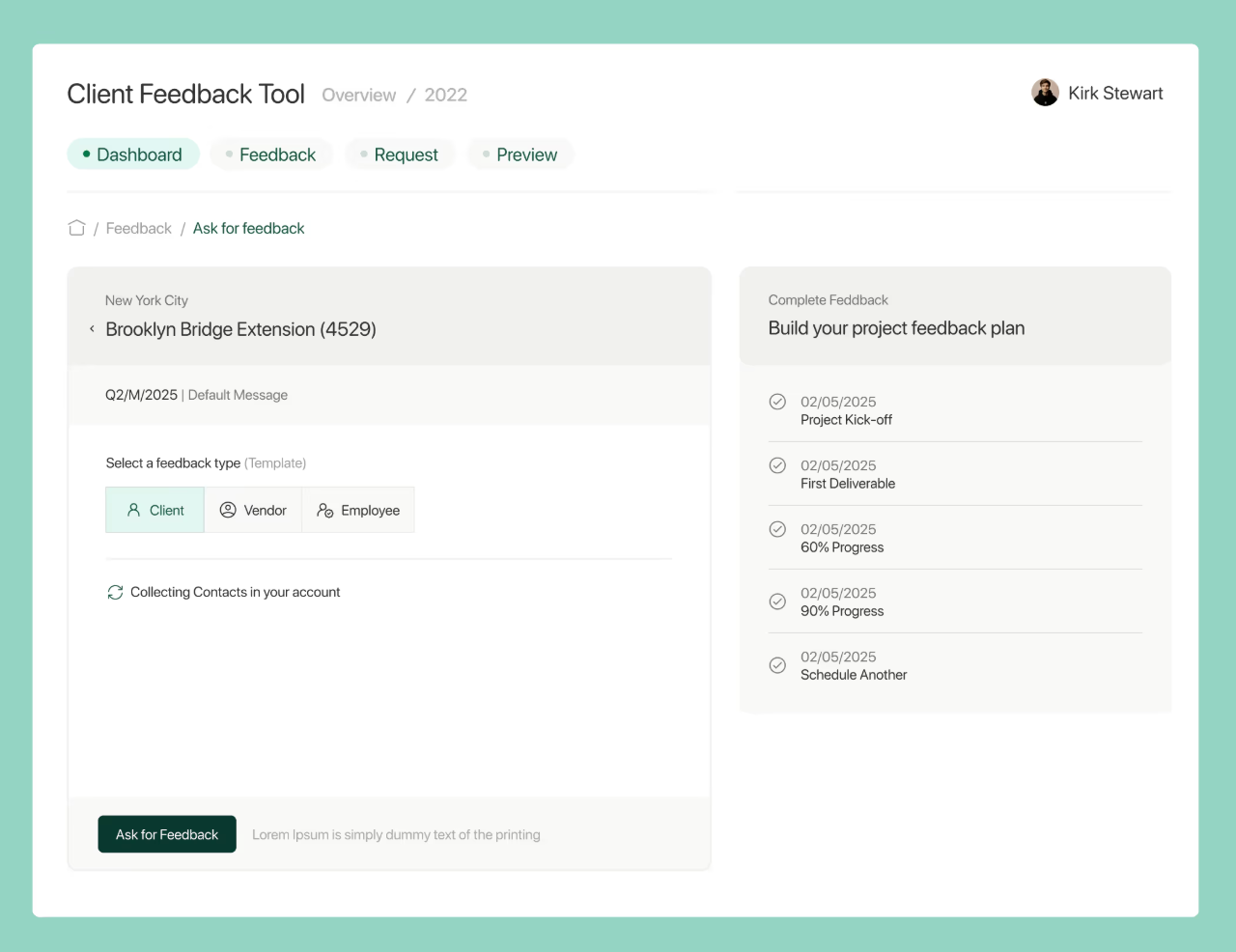
Our platform goes beyond basic survey tools. It uses question models tested across thousands of architecture and engineering firms over the past 20 years. These surveys form the backbone of its Voice of Customer (VoC) programs, encouraging clients to provide detailed and honest feedback.
The patented Client Experience Indicator (CXI®) scale identifies up to 380% more hidden pain points than NPS alone. Teams can track shifting expectations at each milestone and act before dissatisfaction grows. Firms using ongoing feedback have seen an average 17-point increase in NPS, showing that structured listening strengthens relationships and drives repeat projects.
Automated milestone-based survey deployment
Manual survey distribution wastes time and risks delays. Our platform automates survey delivery at key project milestones to collect consistent, actionable feedback. It automatically sends surveys when the design receives approval, when construction begins, and at project handover.
Milestone-triggered feedback helps teams catch issues early and respond while client concerns are still relevant.
Real-time client health scoring and at-risk alerts

Many firms only notice client frustration after a project ends, which often comes too late. Our platform continuously monitors client sentiment and generates real-time alerts for at-risk relationships. The system evaluates feedback across multiple touchpoints and categorizes clients as thriving, stable, or at-risk.
Project leaders can immediately follow up with clients who need attention, supported by AI-generated guidance to maintain a professional and empathetic tone. Firms using this system recovered 83% of at-risk clients in 2025, preserving long-term relationships and future business opportunities.
Turn CX data into marketing assets (testimonials, case studies, badges)
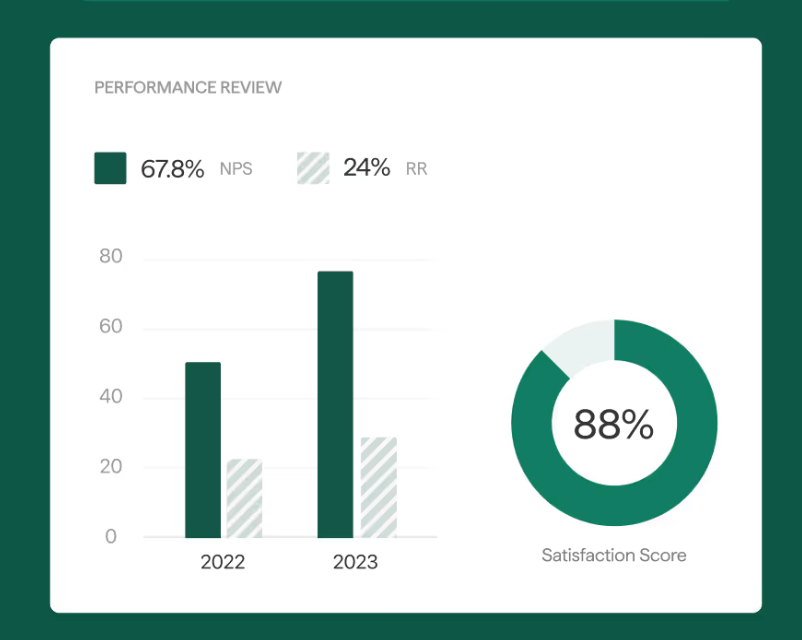
When clients feel genuinely valued, they naturally become advocates for your firm. Our analytics help teams identify promoters and transform their feedback into testimonials, referrals, and case studies.
Firms report generating an average of $1.8 million in new business through referral programs triggered by these insights. Every satisfied client becomes an authentic advocate while strengthening brand trust in competitive bids.
Measure What Matters to Clients, Not Just Projects
For AEC firms facing an increasingly competitive market, tracking financial KPIs alone does not guarantee success. They must focus on what to track in the AEC client experience to understand perceptions and uncover opportunities for improvement.
Our Client Savvy Platform makes this possible. Integrating client retention metrics for engineering firms with project and financial performance data provides leaders with clear insight into relationship health. As a result, firms can strengthen key accounts, optimize service delivery, and turn satisfied clients into repeat business and referrals.
McDonald York shows that implementing structured CX practices can turn everyday client interactions into stronger loyalty, repeat business, and long-term advocacy. If you want to achieve similar results, now is the time.
Ready to stop guessing and start measuring what matters? See how ClearlyRated helps AEC firms track the metrics that drive retention and growth. Schedule your demo today.
FAQs
What's the difference between project management metrics and client experience metrics in AEC?
Project management metrics measure deadlines, budgets, and technical milestones. Client experience metrics measure satisfaction, communication quality, perceived value, and relationship health.
How often should AEC firms collect client feedback during long-term projects?
Firms should collect feedback at key milestones, phase completions, and post-project. Platforms like ClearlyRated automate milestone-based surveys, ensuring timely insight and proactive relationship management.
What's a good client retention rate for architecture and engineering firms?
Top-performing AEC firms retain about 80% of clients annually. Retention above this benchmark indicates strong relationships, effective communication, and consistent client satisfaction.

FAQs





%20(1).png)
.webp)
.png)










.png)


.png)

.png)


