Top 5 Client Retention Strategies for Architecture Firms


- Many architecture firms lose clients quietly after successful projects because they lack systems to capture client feedback throughout the engagement.
- Structured surveys and NPS for architecture firms reveal client sentiment early, allowing teams to resolve issues before they escalate.
- Tracking the right client experience metrics across projects and stakeholders helps leaders spot trends that influence satisfaction and loyalty.
- Firms using structured feedback programs see an average 17-point increase in NPS and recover 83% of at-risk clients.
- Modern client feedback tools built for architecture firms, such as ClearlyRated, integrate surveys, analytics, and reputation management into a single platform to translate insights into measurable business growth
If your projects end successfully, why do one in four (23%) clients never come back?
Many AEC firms focus heavily on winning new work, yet the economics tell a different story. Research shows it costs five to six times more to acquire a new client than to reactivate an existing one. Firms that apply strong client retention strategies for architecture firms see better client loyalty and higher repeat business over time.
That imbalance creates a hidden problem in architectural practices. Projects close successfully, invoices get paid, and the team moves on. Months later, the same client hires another firm for their next project. In many cases, no one follows up to understand why. This “silent churn” reflects a deeper challenge with client experience in the AEC industry, where firms can lose long-term relationships without even realizing it.
The perception gap makes the problem even clearer. Around 80% of CEOs believe they deliver above-average client experience, yet only 8% of clients agree.
In this guide, we’ll explore five proven client retention strategies for architecture firms, from structured feedback loops and NPS benchmarking to reputation tools that help firms retain existing clients.
Why Client Retention is the Biggest Growth Lever for Architecture Firms
Architecture firms operate within a relationship-driven business model where each client relationship represents years of potential revenue. A single satisfied client may return for multiple projects across several years. When a firm loses that client, it loses future opportunities that could have sustained an entire project team.
Directly impacts profitability
Retention directly affects profitability. In fact, research from Bain & Company shows that a 5% increase in client retention can boost profits by 25–95%.
For an architecture firm with $5 million in annual revenue, that retention improvement could translate into $1.25 million to $4.75 million in additional profit, showing how even small improvements in loyalty deliver meaningful financial results.
Communication drives client loyalty in AEC
In architecture projects, communication often shapes the client experience just as much as the final design. Firms may take pride in delivering projects on time, staying within budget, and maintaining strong technical standards. But those internal performance metrics do not always reflect how clients actually experience the relationship.
A project can be technically flawless and still leave a client feeling frustrated if updates are unclear, communication is slow, or processes feel unnecessarily complicated. From the client’s perspective, the overall experience extends far beyond drawings and deliverables.
Recent AEC research highlights how strongly communication influences loyalty. Our 2025 Benchmarks, Insights, and Trends: Client Experience in the AEC Industry report shows that 78% of buyers say a seamless experience influences their decision when selecting a firm, while 68% say strong communication and relationships matter just as much as technical expertise.
These insights tell a simple truth, that great design may win a project, but clear communication and transparency are what bring clients back.
Referrals multiply the value of retention
Architecture is a reputation-driven profession where developers and property owners rely heavily on peer recommendations when choosing a firm. A positive client experience often leads clients to share that experience with colleagues, partners, and industry peers.
Loyal clients also tend to return with additional projects or expand the scope of existing engagements. Over time, this creates a steady stream of repeat work while opening the door to new opportunities through their professional networks.
Research across B2B service industries shows that firms with strong client experience practices generate between 40 and 60% of their recurring revenue from long term clients. Those satisfied clients often become advocates who recommend the firm to others.
The financial impact can be significant. In fact, firms that actively engage satisfied clients generate an average of $1.8 million in referral revenue. In an industry built on relationships and trust, strong client retention not only protects revenue. It helps firms grow through referrals.
The problem with informal relationship management
Despite these advantages, many firms still rely on informal relationship management rather than structured retention systems. Partners often assume that delivering high-quality design automatically guarantees loyalty.
This assumption ignores the broader AEC client experience, which includes communication, responsiveness, collaboration, and transparency throughout the project lifecycle.
Firms that want sustainable growth must address a simple but critical question. What can architecture firms do to retain the clients their teams worked so hard to win in the first place?
Strategy #1. Implement Structured, Milestone-Based Client Feedback Surveys
Architecture projects unfold over months or even years, moving through distinct phases where client expectations evolve:
- Planning sets the foundation by defining goals, scope, and feasibility.
- Schematic design translates ideas into initial concepts and layouts.
- Design development refines those concepts into detailed plans and specifications.
- Construction documents prepare the technical drawings and instructions required for execution.
- Construction administration oversees on-site execution, coordination, and issue resolution.
At each stage, expectations shift. Early excitement can fade if communication slows, decisions feel unclear, or stakeholders feel left out of the process.
That is why leading firms implement milestone-based feedback programs that track client sentiment throughout the project lifecycle. Structured surveys allow teams to track the right client experience metrics and address concerns before they escalate. The right client feedback tools built for architecture firms make this easy by automatically delivering surveys at key milestones and capturing meaningful insights.
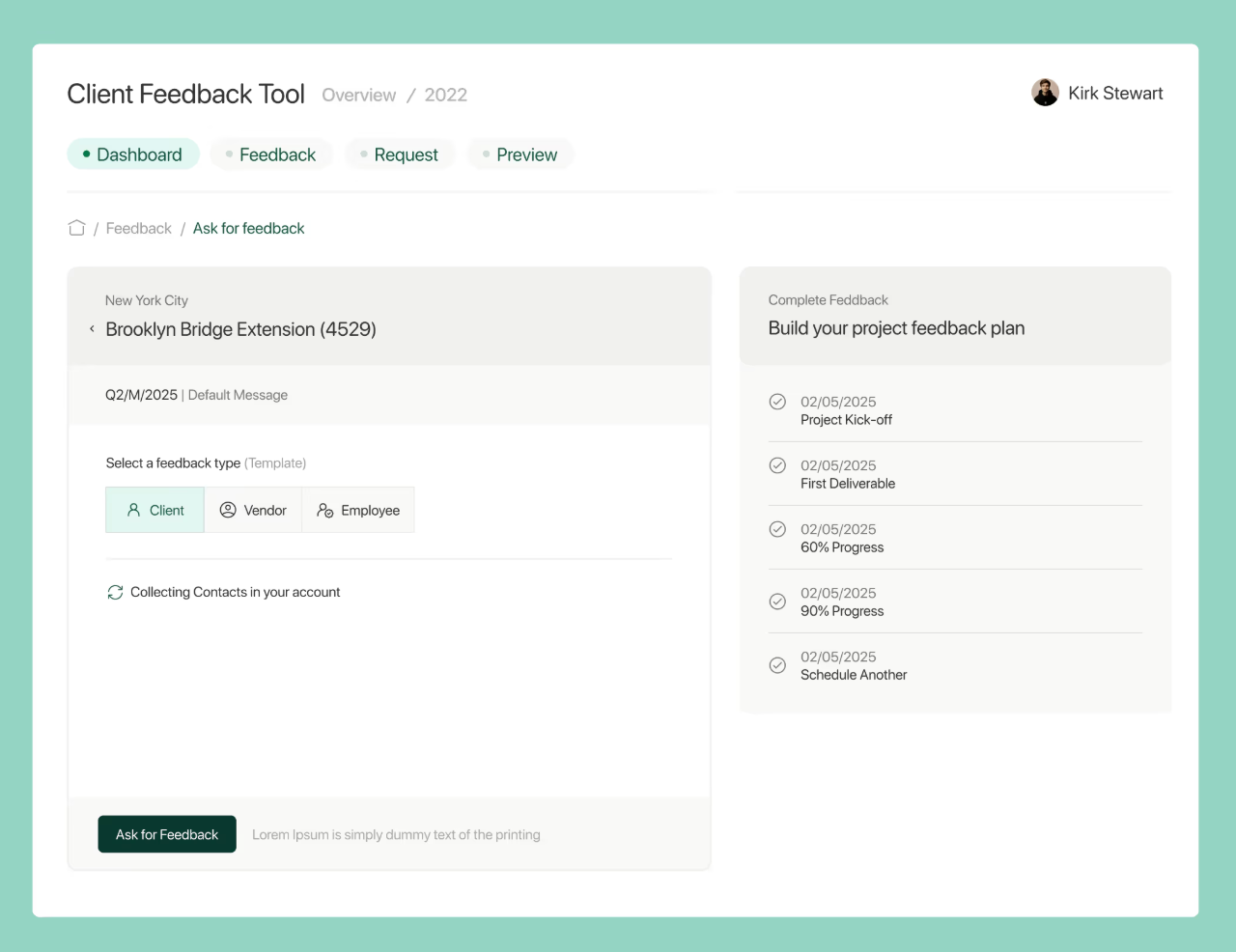
For example, ClearlyRated includes Net Promoter Score (NPS) for architecture firms as a core metric. It asks clients how likely they are to recommend the firm on a scale from 0 to 10. Responses fall into three groups:
- Promoters (9–10)
- Passives (7–8)
- Detractors (0–6)
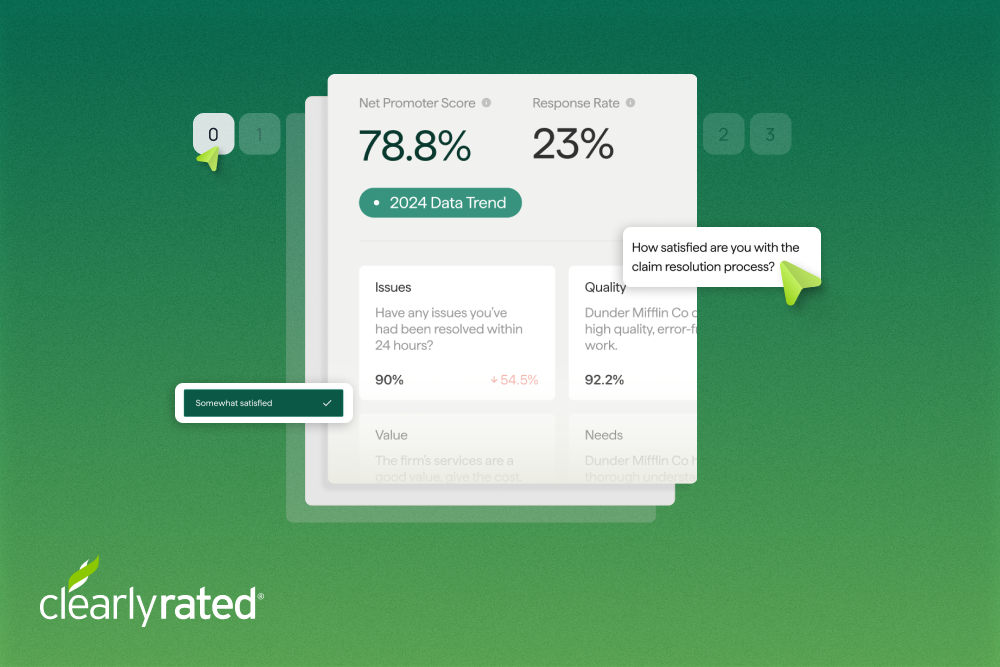
Our research shows the median NPS across AEC firms is about 57, and firms that implement our ongoing feedback programs often see an average 17-point improvement over time. Our Client Savvy platform also uses the patented Client Experience Indicator (CXI®) scale, which can identify up to 380% more hidden pain points than NPS alone, giving leaders deeper insight into the client experience.
Now, you might be wondering: How can firms put these insights into action at every stage of a project?
The best practice is to deploy surveys at key project milestones such as kickoff, the first major design presentation, mid-project review, near completion, and project closeout. These insights help firms strengthen architecture firm client feedback programs and build relationships that lead to repeat work and referrals.
Strategy #2. Build a Closed-Loop Accountability System for At-Risk Clients
After the construction documents phase, a project receives a Detractor score. The project lead calls the client the next day, learns they felt they had been out of the loop on design changes, and sets up weekly 15-minute progress calls with visual updates. The client regains confidence, and the relationship continues.
This is what acting on feedback looks like in practice, and it is where most firms fall short. Collecting feedback is only half the equation. The real impact on retention comes when teams respond quickly and consistently to what they learn.
With a closed-loop feedback system, every piece of negative or neutral feedback triggers a defined follow-up action, assigns an owner, and sets a timeline. This creates accountability and ensures that no critical signal is missed.
Architecture projects involve multiple stakeholders, including owners, contractors, consultants, and end users, each of whom experiences the project differently. This is where understanding the difference between client feedback and project feedback becomes essential.
Segmented feedback helps teams identify exactly where dissatisfaction is coming from, allowing them to act before small frustrations turn into lost clients. Real-time alerts enable project leaders to intervene within 24 to 48 hours, when recovery is still possible.
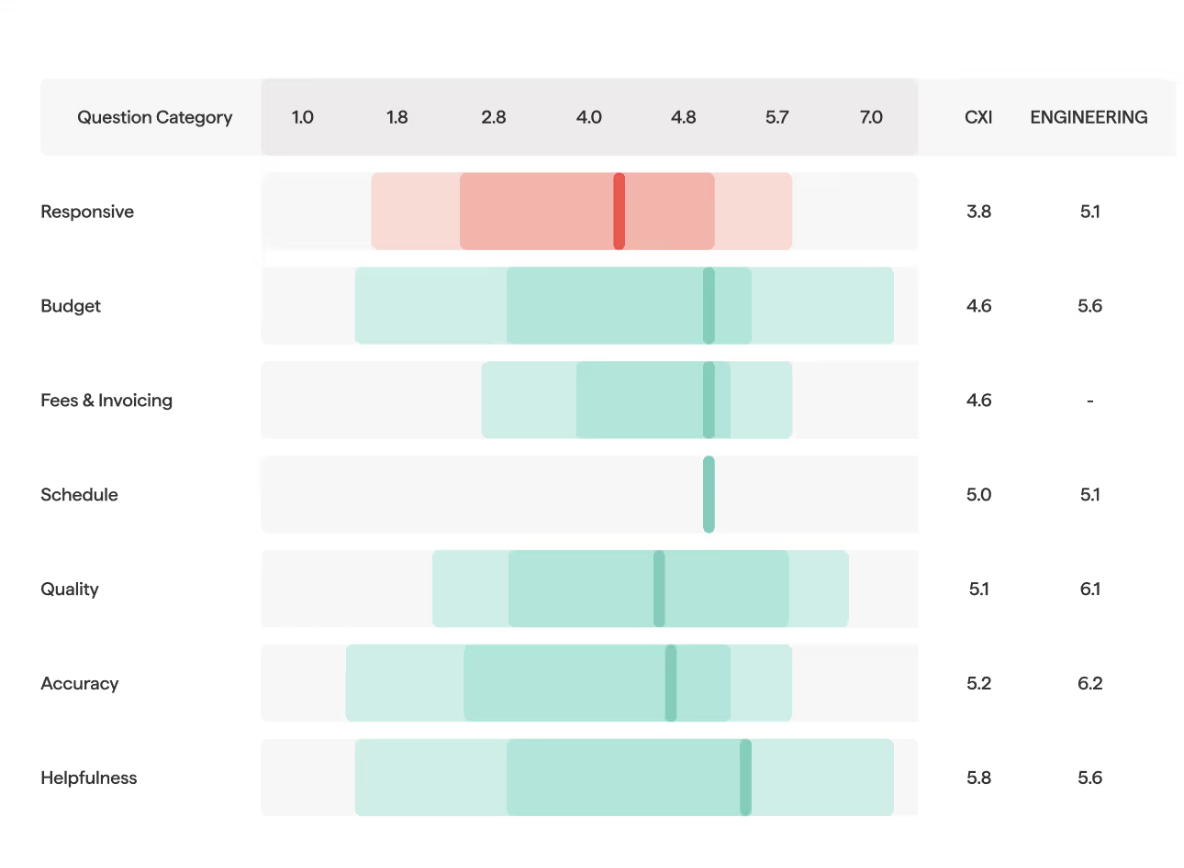
We make this simple by providing automated detractor alerts, AI-generated response guidance, and dashboards that categorize relationships as thriving, stable, or at-risk. Stakeholder segmentation ensures each group’s feedback informs timely action, turning client insights into stronger, long-term relationships.
In fact, firms with structured, closed-loop accountability programs reduce repeat client frustrations by 83%, helping reduce churn in architecture firms.
Strategy #3. Use Predictive Analytics and Industry Benchmarks to Anticipate Churn
Reactive retention strategies are costly and often too late. Waiting until a client leaves to ask what went wrong can lose years of potential business. Hence, the smartest firms spot warning signs early using predictive analytics.
Tracking NPS trends, sentiment over time, and engagement velocity creates an early warning system. For example, a client who scores 9 at kickoff but drops to 7 at the next milestone is technically still a “Passive,” but the decline signals an opportunity for proactive outreach. Proactive outreach at this stage often restores confidence and loyalty.
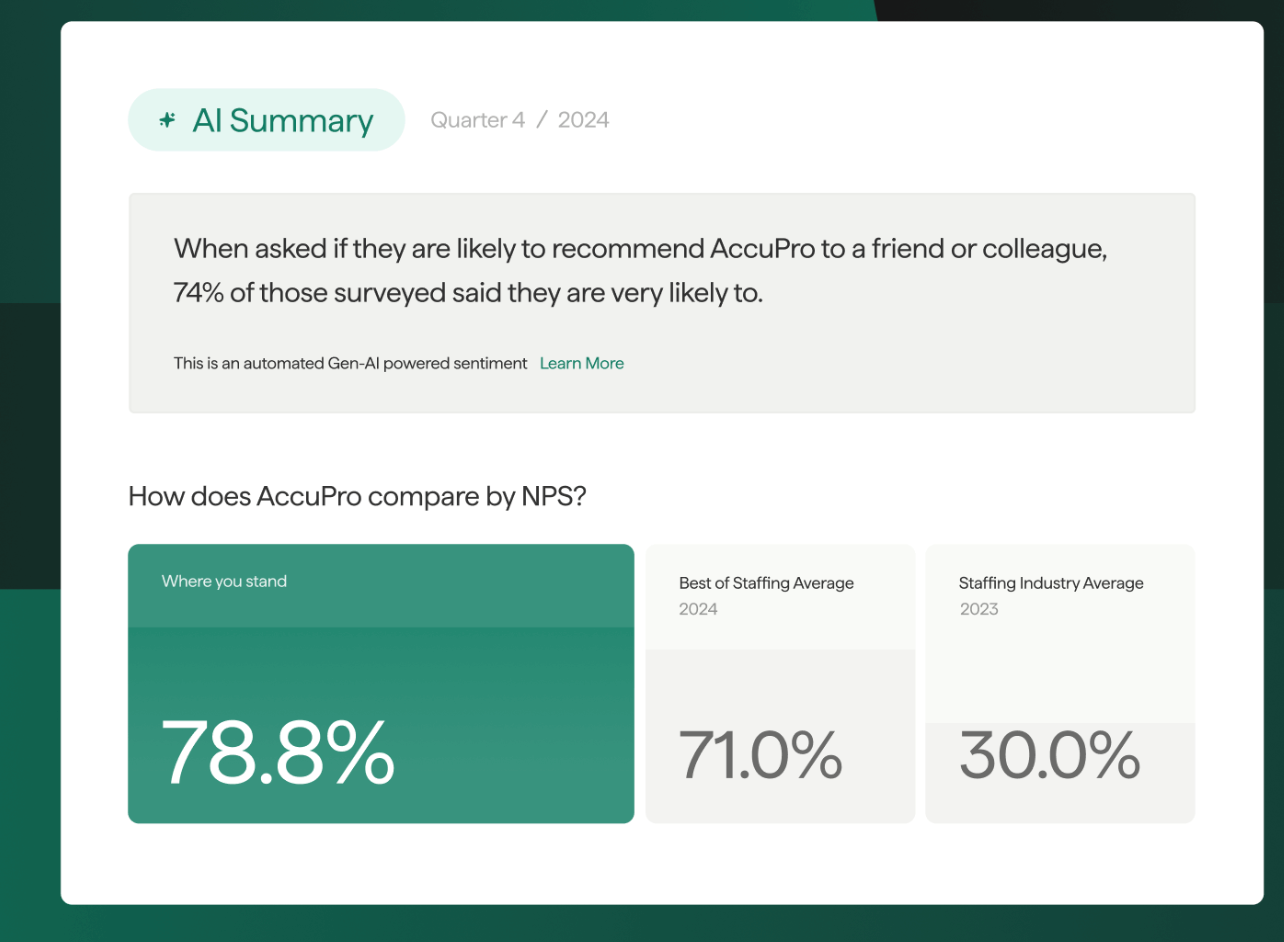
At ClearlyRated, we combine nearly 20 years of AEC-specific benchmarking data with AI-powered sentiment analysis. Our platform scans open-ended feedback, tracks trends across projects, clients, and service areas, and compares scores to industry benchmarks.
This context helps leaders identify where clients may be losing confidence and take action before small issues become bigger problems, thereby improving client retention metrics. It also helps firms showcase success with verified ratings, testimonials, and industry-specific awards, turning insights into repeat business and stronger client relationships.
Strategy #4. Convert Client Satisfaction Into Public Reputation Assets
Did you know 96% of prospective clients check online reviews before contacting a professional services firm?
What does this tell you?
That in architecture, reputation drives business development. However, many firms collect positive feedback and never turn it into visible proof.
Promoters from NPS surveys are a powerful resource. You can activate them in simple ways:
- Ask for a Google review while the experience is fresh
- Capture testimonials for your website
- Highlight client success stories in marketing materials
- Nominate your firm for industry-recognized awards using survey data as evidence
These actions also strengthen loyalty among existing clients. When clients see their feedback featured in testimonials, case studies, or award programs, they feel recognized and more connected to your firm.
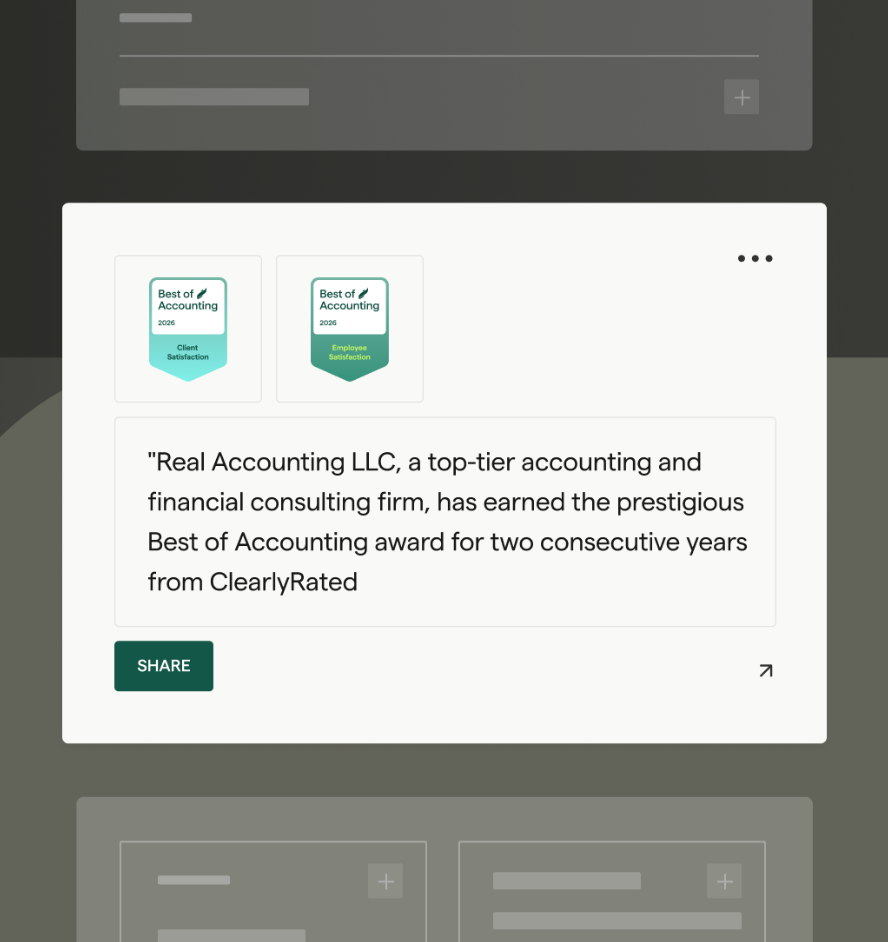
We make this easy. Our reputation management tools help firms turn positive survey responses into Google reviews, testimonials, and award nominations. You can gather star ratings, celebrate individual team members with Shout Outs, showcase client success stories on optimized public profile pages, and highlight achievements through our Best of AEC™ awards.
Together, these tools help improve client satisfaction for AEC firms by turning positive feedback into loyalty.
Strategy #5. Integrate Your Feedback Program With Your CRM and Project Management Stack
If your feedback data lives in one tool and your project data lives in another, your team cannot see the full picture of a client relationship.
Salesforce’s State of the Connected Customer report shows that 76% of customers expect every department they interact with to be on the same page. However, nearly 56% of them report that sales, service, and marketing teams often don’t share information.
Architecture firms often store feedback, project data, and CRM records in separate tools. This makes it hard for teams to see the full picture and act on client insights.
To address this, feedback programs need to integrate directly with the platforms teams already use, like Deltek, Salesforce, and other project management tools. When systems are connected, insights become actionable instead of isolated.
Our Client Savvy platform brings it all together with full integrations. Surveys trigger automatically when a project phase changes or a billing milestone occurs, responses update client profiles instantly, and follow-up actions track each concern so teams can resolve issues quickly.
Meanwhile, configurable rules prevent clients involved in multiple projects from getting overloaded, and dashboards sync in real time, giving leaders a clear view of client health.
Turn Client Retention Into Your Firm's Competitive Advantage
What if every piece of client feedback could actually help your firm win more work, earn more referrals, and keep clients coming back?
That’s exactly what happens when architecture firms move to a structured, data-driven retention strategy. Milestone surveys, closed-loop accountability, predictive insights, reputation management, and integrated feedback turn day-to-day interactions into opportunities to strengthen client loyalty and grow your business.
Built specifically for AEC firms, our Client Savvy platform makes this transformation practical and measurable. With nearly 20 years of industry-specific benchmarking data, AI-powered insights and integrations with leading AEC platforms, our platform gives teams the tools to act on client feedback at every stage.
In fact, many architecture firms rely on us to reduce churn, strengthen relationships, and grow more profitably. For example, McDonald York discovered that even projects delivered on time and under budget didn’t always bring clients back. They used our Client Savvy platform to collect milestone feedback, review responses within 48 hours, and integrate client insights into daily operations. If you want to achieve similar results, now is the time.
Ready to stop losing clients you never knew were at risk? Book a free demo and see how ClearlyRated helps implement effective client retention strategies for architecture firms to retain more clients, generate more referrals, and grow more profitably.
FAQs
1. Why is client retention important for architecture firms?
Client retention is critical because acquiring a new client costs five to six times more than retaining an existing one. A 5% increase in retention can boost profits by 25–95%, and loyal clients generate repeat projects and referrals that sustain long-term growth.
2. What is NPS and how does it apply to architecture firms?
Net Promoter Score (NPS) measures how likely clients are to recommend your firm on a scale of 0–10. Respondents are grouped as Promoters (9–10), Passives (7–8), or Detractors (0–6). The median NPS across AEC firms is around 57, and structured feedback programs can improve scores by an average of 17 points.
3. When should architecture firms collect client feedback during a project?
Firms should deploy surveys at key milestones: project kickoff, the first major design presentation, mid-project review, near completion, and project closeout. This milestone-based approach catches shifting sentiment early rather than waiting until the project ends.
4. What is a closed-loop feedback system in architecture?
A closed-loop system ensures every piece of negative or neutral feedback triggers a defined follow-up action with an assigned owner and timeline. This creates accountability and helps firms recover at-risk client relationships — research shows this approach resolves 83% of repeat client frustrations.
5. How can architecture firms turn client satisfaction into new business?
Firms can activate satisfied clients by requesting Google reviews, capturing testimonials, featuring success stories in marketing, and nominating for industry awards using survey data. Since 96% of prospective clients check online reviews before reaching out, visible social proof directly drives new business development.

FAQs

%20(1).png)
.webp)
.png)