The ROI of Client Experience: Proving CX Value to Your Leadership Team


- When firms improve client experience, they increase retention, drive upsell and cross-sell, generate referrals, and reduce churn, all of which directly boost revenue.
- Executives respond to evidence that links CX initiatives to tangible financial outcomes, not just satisfaction scores.
- To prove this impact, teams track metrics such as retention rates, customer lifetime value, referral revenue, and expansion revenue, tying them to measurable results.
- They calculate ROI by combining retained revenue, new revenue from CX improvements, and cost savings, then dividing by the total CX investment to produce a clear, quantifiable return.
- We help firms turn feedback into action by uncovering hidden pain points, benchmarking performance against peers, and presenting CX insights in a way that leadership can understand and act upon.
The vast majority of CX leaders are aware that client experience has a strong relationship with growth, as evidenced by renewal cycles and by the number of sales and commissions generated from subsequent contracts or bookings after renewals. However, a significant challenge for many CX leaders is providing evidence that CX investment delivers a tangible financial return.
Ultimately, executive leadership teams want specific numbers that tie directly to revenue, profitability, and overall business momentum. Executive leadership teams do not make strategic decisions based only on CX sentiment or satisfaction scores.
According to a recent study, around 70% of executives believe that customer expectations are changing faster than their ability to respond or deliver upon those expectations. Given the gap between customer expectations and their organization's ability to meet them, many executives have questioned the value of CX initiatives that do not deliver measurable financial outcomes. In fact, research suggests that only 20% of organizations that measure satisfaction can convert that data into action.
To ensure your CX budget remains intact and can grow, you must show that the improvements to the CX will translate into increased revenue, improved retention rates, and greater profitability. In this article, we will provide the tools, frameworks, and CX metrics to measure the ROI of client experience, along with executive-ready messaging to help you do so.
Why Leadership Questions CX Investments
Many customer experience (CX) leaders struggle to show the business value of their programs. As a result, many executives resist investing because they cannot find the link to financial outcomes.
The CFO's perspective
Investments are evaluated based on anticipated returns, and many execs tend to judge the success (or failure) of CX investments based on their history of using “soft” metrics (e.g., satisfaction scores, NPS) rather than “hard” dollars.
Because of this, when faced with tight budgets, executives will eliminate “intangible” investments first. CX leaders must be able to clearly articulate and demonstrate the financial impact of their CX programs to convince leadership teams to continue investing in CX and to show how it can contribute to future revenue growth.
Why CX feels "intangible" without the right metrics
Most CX leaders regularly report NPS measurement and benchmarking, or annual satisfaction scores, but do not connect them to business outcomes such as revenue retention, reduced customer churn, and overall growth opportunities.
The issue isn't that CX programs aren’t beneficial. Rather, it's how CX teams communicate the value they create. Only the CX programs linked to tangible business outcomes will withstand the scrutiny of executive budgeting processes.
What Is the ROI of Client Experience?
The customer experience ROI measures the financial return generated by investments in CX programs. These programs include client satisfaction surveys, feedback loops, CX technology, and service improvements.
It answers a simple question: For every dollar spent on CX, how much value do we get back?
When teams define ROI this way, executives see CX as a strategic growth lever.
The core CX ROI formula
Teams calculate CX ROI using this formula:
(Revenue gained from CX improvements − Cost of CX investment) ÷ Cost of CX investment × 100
They include revenue from higher retention, increased upsell and cross-sell, referral growth, and lower churn costs. This formula quantifies the customer experience ROI in a way leadership understands. If the result shows a positive return multiple times over, then the case for ongoing investment becomes hard to deny.
As a customer experience management software, ClearlyRated helps teams collect structured data and benchmark results. It enables teams to:
- Collect structured feedback consistently
- Measure experience trends over time
- Connect experience signals to business performance indicators
- Compare performance against industry benchmarks
5 Metrics That Prove CX Drives Revenue
Firms naturally measure customer experience through financial metrics such as costs and cash flow. However, teams should also gather insights that clearly show how CX investments drive returns.
1. Retention rate
Teams calculate customer retention by first defining the time period they want to measure. SaaS companies often track retention monthly or quarterly, while fast-moving teams may check it daily to catch issues early.
After choosing a timeframe, collect three numbers:
- S = Total customers at the start of the period
- E = Total customers at the end of the period
- N = New customers gained during the period
These three numbers feed the standard formula for retention:
Customer Retention Rate = [(E − N) ÷ S] × 100
For example, if you start the year with 100 customers (S), end with 100 customers (E), and gain 10 new customers (N), the formula gives:
[(100 − 10) ÷ 100] × 100 = 90%
This result shows that you retained 90% of the customers you already had at the start of the year.
CX programs reduce churn by identifying dissatisfaction before it escalates into lost contracts. Our platform helps track client sentiment and trigger interventions for at-risk clients. This is a core example of CX performance metrics transforming experience into revenue.
2. Customer lifetime value (CLV)
Customer Lifetime Value estimates the revenue a single customer generates over their relationship with your brand. Teams use CLV to decide how much to invest in keeping customers happy and when to prioritize acquiring new ones.
In SaaS, you can calculate CLV by multiplying the average revenue per user (ARPU) by the average customer lifespan:
CLV = ARPU × Average Customer Lifespan
In e-commerce, however, you multiply the average order value by purchase frequency, then by the average customer lifespan:
CLV = Average Order Value × Purchase Frequency × Customer Lifespan
When you track CLV, you identify high-value customers and focus retention and engagement efforts where they matter most. Pair it with churn and engagement data, and you’ll be able to identify who’s at risk and who deserves extra attention.
In any case, you need to remember that the longer customers stay, the more value they generate. Predictive analytics helps teams update CLV estimates regularly and act proactively to maximize long-term revenue.
3. Referral revenue
Referral revenue shows how customer experience turns satisfaction into growth. When clients trust your firm and value the relationship, they recommend you to peers. Those recommendations generate new revenue without increasing acquisition costs.
Teams track referral revenue by identifying customers who came through direct recommendations and calculating the revenue those customers generate.
Here’s what you can do to track referral revenue:
- Ask new clients how they heard about you
- Tag referral sources inside your CRM
- Measure the total revenue tied to referred accounts over a defined period
Referral Revenue = Number of Referred Customers × Average Revenue per Referred Customer
You can also compare referred customers to non-referred customers to uncover deeper insights. Many firms find that referred clients close faster, stay longer, and spend more. That pattern strengthens the financial case for measuring CX impact.
4. Upsell & cross-sell impact
Upsell and cross-sell revenue shows how client experience drives expansion from within. When clients trust your firm, they buy more services. When they see consistent value, they expand their relationship.
An upsell increases the value of an existing purchase. A cross-sell adds complementary products or services. Both depend on strong relationships, clear outcomes, and consistent delivery.
Teams measure the impact of upsell and cross-sell with a few core metrics. For example:
- Upsell rate measures the percentage of eligible customers who upgrade to a higher-tier product or service. Teams calculate it using the following formula:
- Upsell Rate = (Number of Customers Who Upgraded ÷ Total Eligible Customers) × 100
- Cross-sell rate measures the percentage of customers who purchase additional products or services beyond their initial offering. Teams calculate it as:
- Cross-Sell Rate = (Number of Customers Who Bought Additional Products ÷ Total Customers) × 100
- Net revenue retention (NRR) shows how much recurring revenue a company retains from existing customers after accounting for expansion, downgrades, and churn. This metric provides a comprehensive view of revenue health within the current customer base. Teams calculate NRR using this formula:
- Net Revenue Retention = (Starting Revenue + Expansion Revenue − Churned Revenue − Downgrade Revenue) ÷ Starting Revenue × 100
If NRR exceeds 100%, your existing customers generate more revenue over time even without new customer acquisition. Many high-growth SaaS firms treat NRR as a primary indicator of product value and customer loyalty.
5. Reduced churn costs
Every churned client drains revenue and forces you to spend again to replace that relationship. You lose the annual contract value. You also absorb the cost of sales, marketing, onboarding, and ramp time.
CX helps firms prevent those losses before they happen by uncovering hidden pain points early, giving teams visibility into client dissatisfaction. When issues are identified promptly, teams can resolve them before clients walk away.
Closed-loop accountability strengthens that protection. Teams follow up with dissatisfied clients, resolve concerns, and document outcomes. Our study shows that firms save 83% of at-risk clients when they implement structured follow-up processes.
When you reduce churn, you protect revenue, preserve lifetime value, and avoid replacement costs. You also free up growth capital that would otherwise go toward filling gaps. Reduced churn does more than stabilize performance. It directly increases profitability.
How to Calculate the ROI of Client Experience
You cannot defend a CX budget with belief alone. You must show leadership exactly how experience turns into financial return.
Step-by-step CX ROI formula
Use this practical process to calculate CX ROI in a way your executive team can replicate and validate.
1. Identify CX investment costs
The first step is to calculate all your CX investment costs. Include the money spent on technology, surveys, personnel, and training.
Once you gather all of these numbers, you have a clear picture of the total resources your CX programs consume, which sets the foundation for an accurate ROI calculation.
2. Measure revenue retained
Next, measure the revenue that your CX programs preserved by preventing churn. Count the number of clients you saved and multiply that number by the average contract value.
Once you perform this calculation, you can show leadership how much revenue your CX efforts protected.
3. Measure revenue gained
Now, calculate the expansion revenue tied directly to CX improvements. Add upsell revenue, cross-sell revenue, and referral revenue that followed experience enhancements.
Then, attribute these gains to specific CX initiatives so leadership sees a clear cause-and-effect relationship.
4. Calculate cost savings
After that, calculate the cost savings your CX programs deliver. Track reductions in support tickets, fewer escalations, and lower acquisition costs that occurred because of improved client experience.
You can then easily capture the full financial impact of your CX initiatives.
5. Apply the formula
Finally, add retained revenue, gained revenue, and cost savings to determine total financial gains. Then, apply the formula:
(Total Gains − Total CX Investment) ÷ Total CX Investment × 100
This calculation gives you a clear ROI percentage. When that percentage shows a strong return, you shift the conversation from opinion to evidence and from sentiment to financial performance.
Real-world B2B ROI scenario
Consider a mid-size B2B SaaS company investing $50,000 annually in CX:
- CX Investment: $50,000 per year (platform, surveys, CX lead time)
- Revenue retained from prevented churn: 5 clients × $30,000 average contract = $150,000
- Upsell revenue from satisfied clients: $60,000
- Referral revenue: 3 new clients × $20,000 = $60,000
Total return: $270,000
ROI = [(270,000 - 50,000)/50,000] x 100 = 440%
This simple example shows how structured CX investments translate directly into revenue, allowing leadership to justify and expand budget allocations.
Why benchmarking matters
A high NPS score or strong retention rate may seem impressive, but without context, these numbers carry little weight in financial discussions. That is why benchmarking is a critical step in proving the ROI of client experience.
Benchmarking allows teams to compare their CX outcomes against industry peers, identify gaps, and show performance excellence. At ClearlyRated, we provide built-in NPS measurement and benchmarking as well as CXI® scoring across multiple B2B industries. This functionality transforms raw feedback into actionable insights and enables CX leaders to present CX ROI metrics that matter to decision-makers.
For example, knowing that your CXI® score is in the top quartile of your sector immediately conveys performance credibility to a CFO or CEO.
Benchmarking also strengthens the financial argument when building a business case for CX. Leadership wants proof that every dollar invested produces a measurable return, not just within your company but relative to the market. When you can show that your retention, upsell, referral, and churn metrics outperform industry norms, you convert qualitative experience improvements into financial evidence.
Common Mistakes When Proving CX ROI
Even the most robust CX programs can fail to convince leadership if you misapply metrics and reporting. Here are the most common mistakes:
- Relying on vanity metrics: CX teams often report NPS or client satisfaction surveys without tying results to financial outcomes. While these metrics capture sentiment, they rarely show the overall revenue impact. When you report lagging indicators, such as annual surveys, instead of tracking leading indicators like real-time alerts for at-risk clients, you reduce the perceived value of your CX programs. Leadership interprets this as activity without measurable impact, making budgets vulnerable.
- Ignoring benchmarking: CX numbers lack meaning without industry context. Teams may celebrate a “good” NPS internally, but leadership wants to see how performance compares to competitors. Our platform provides industry-specific benchmarks across B2B service verticals, enabling teams to position metrics relative to peers.
- Collecting data without closing the loop: Firms often gather feedback but fail to act on it. Without follow-up, insights remain abstract and do not generate revenue or retention gains. When you act on feedback, you can automatically increase retention, drive upsell opportunities, and produce measurable customer experience ROI.
How ClearlyRated Helps You Measure and Prove CX Impact
Metrics only create value when you act on them to improve client relationships. You should never treat them as the finish line. When you gather feedback, you gain insights into what clients value, but you must act to turn those insights into measurable results.
A customer experience and reputation management platform like ClearlyRated gives you a structured way to do exactly that.
From feedback to boardroom-ready ROI
Our platform helps CX leaders connect client feedback directly to measurable business outcomes. Here’s how:
Patented CXI® scoring
Our platform patented Client Experience Indicator (CXI®) scoring, built on question models tested across thousands of architecture and engineering firms over 20 years. These surveys form the backbone of our Voice of Customer (VoC) programs and encourage clients to provide detailed, honest feedback.
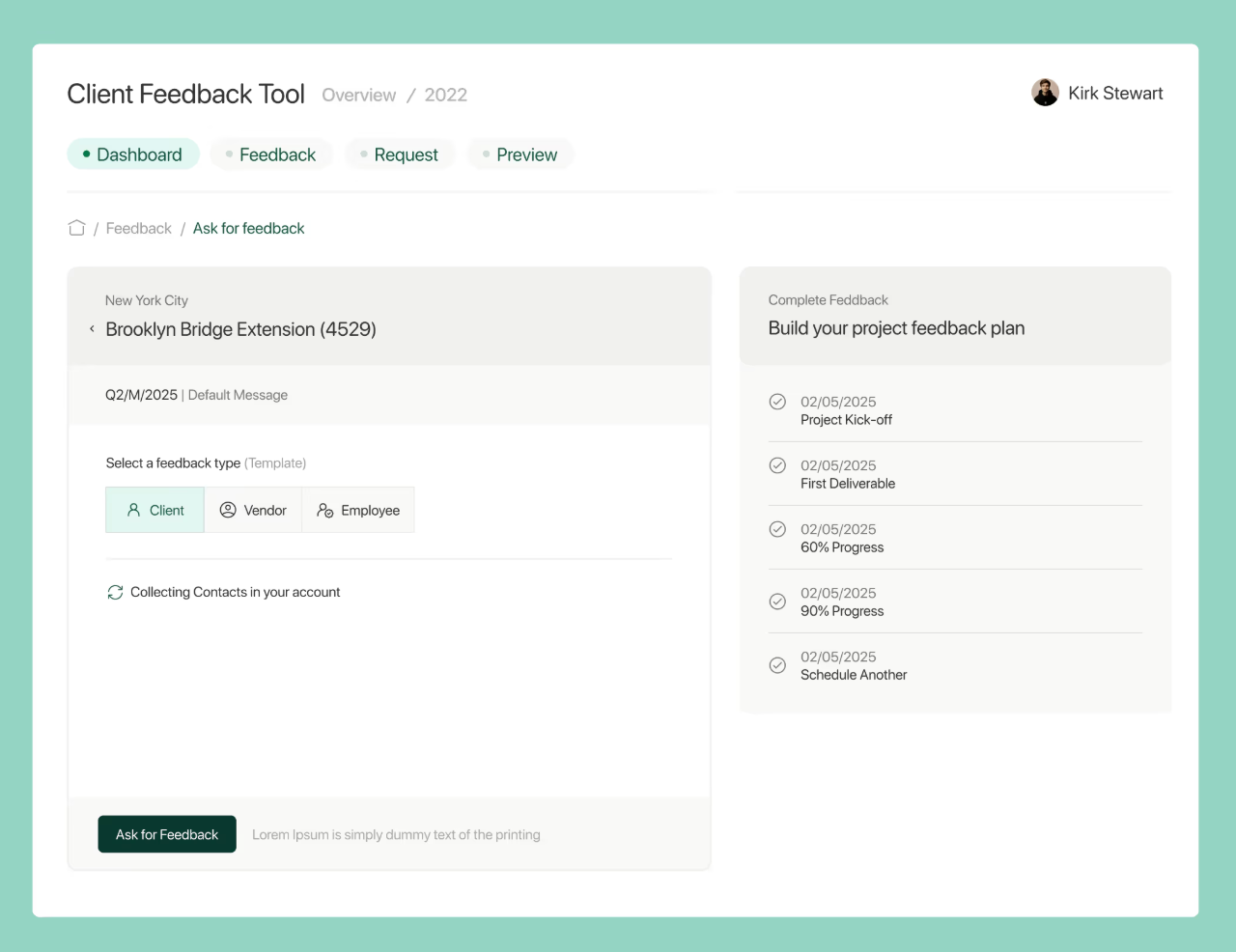
The CXI® scale identifies up to 380% more hidden pain points than NPS alone, allowing teams to fix issues before clients walk away. A top-quartile CXI® score immediately conveys performance credibility to CFOs and CEOs, showing that your client experience efforts are making a measurable impact.
McKinsey research shows that more than 50% of successful AI CX initiatives succeed because teams focus on change management, training, and user adoption. Firms that prepare teams, refine processes, and reinforce value achieve faster adoption and stronger business outcomes.
NPS benchmarking
ClearlyRated helps firms benchmark their NPS scores against industry standards. Since 2010, we have tracked NPS across various industries, giving clients insights into trends over time.
For example, our 2023 benchmarks show:
- Staffing: 36% (+38% change)
- Accounting: 41% (+2% change)
- Insurance: 36% (-6% change)
These benchmarks help leaders spot shifts in client sentiment early and take proactive steps before small issues escalate.
Real-time dashboards
We also have real-time dashboards that track NPS, CES, client health scores, sentiment trends, and team performance. Our platform displays feedback at the individual, project, and client levels and benchmarks response rates, survey timing, and overall CX against hundreds of other firms.
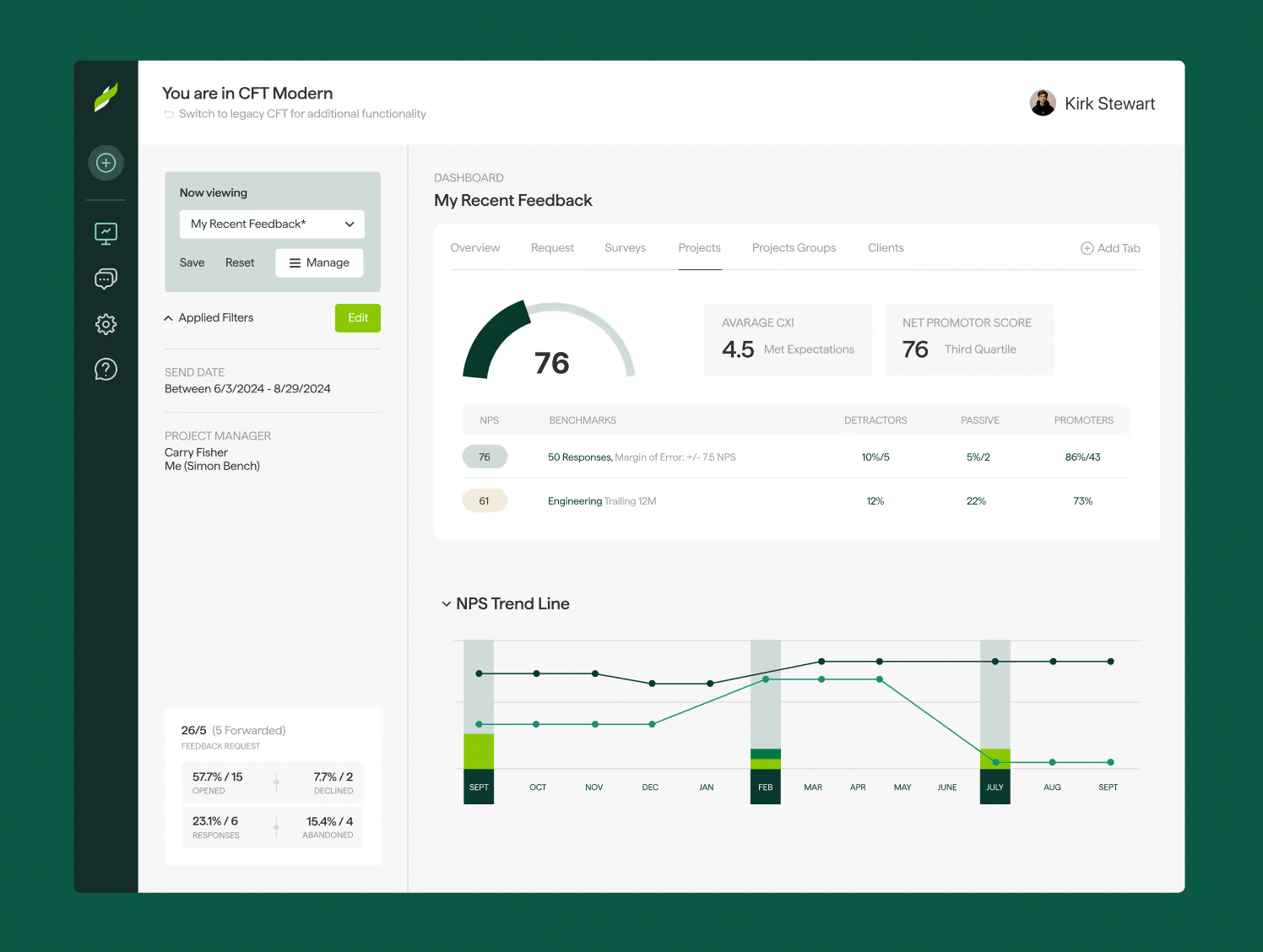
In fact, firms using the platform uncover 4x more pain points than with traditional NPS surveys, retain 83% of at-risk clients, achieve a 17-point NPS increase, and generate $1.8 million in referrals by activating promoters identified through the platform.
Closed-loop accountability
Every project milestone represents a point where client expectations evolve. We automate milestone-triggered surveys at key stages, such as planning, design, or handoff. This approach creates natural checkpoints for structured feedback, prevents small frustrations from accumulating, and provides project leaders with actionable insights.
Firms using closed-loop accountability report up to an 83% reduction in repeat client frustrations, directly lowering churn.
Executive reporting
We deliver data-driven dashboards that reveal real growth insights. Leaders can flag at-risk clients, benchmark satisfaction scores, and take timely action to maximize client value.
Our platform also tracks loyalty, risks, and satisfaction in real time, provides AI-driven sentiment analysis, and benchmarks results against industry standards. These insights help teams prioritize actions, manage issues proactively, and demonstrate the financial impact of CX to executives.
Turn Employee Experience Into a CX Advantage
Many companies ignore the employee experience, but disengaged employees directly weaken client interactions and limit CX ROI.
Leaders who connect employee engagement to client experience measure CX impact across feedback, engagement scores, and the full customer journey. At ClearlyRated, we help firms do this by collecting structured feedback from employees and clients, uncovering hidden pain points, and turning insights into measurable business outcomes. Firms that act on these insights improve retention, drive growth, and demonstrate clear ROI to leadership.
Schedule a meeting today to see how ClearlyRated can help your firm turn employee and client experience into tangible growth.
FAQs
How do you measure the ROI of client experience?
You can measure CX ROI by tracking retained revenue, expansion revenue (upsell/cross-sell/referrals), and cost savings (reduced churn and support costs). Then subtract the total CX investment from gains, divide by the investment, and multiply by 100.
Can customer experience increase revenue?
Yes, strong CX improves loyalty, reduces churn, and boosts referrals and expansion sales. Customers who feel valued buy more and stay longer, increasing lifetime revenue and driving measurable growth for the business.
What CX metrics matter most to executives?
Executives focus on metrics tied to financial outcomes: retention rate, CLV, revenue from referrals and upsell/cross-sell, churn rate, and benchmarked satisfaction scores that link directly to revenue impact.
How long does it take to see CX ROI?
Results vary by company, but teams often start seeing CX ROI within a few weeks to a few months once they act on structured feedback, fix process gaps, and align ownership across teams. Timelines tend to be shorter with real-time insights and closed-loop follow-through.
Is NPS enough to prove the financial impact?
No, NPS shows sentiment but doesn’t directly link to the financial outcome. To prove financial impact, teams must connect NPS to revenue outcomes like retention, referrals, and expansion revenue that executives can quantify.

FAQs












.png)


.png)

.png)


