The Power of AI in Customer Feedback: Enhancing Insights for Better Decisions

April 16, 2026
The Power of AI in Customer Feedback: Enhancing Insights for Better Decisions

- B2B firms collect large volumes of open-ended client feedback, but manual reviews often struggle to analyze responses quickly enough to uncover meaningful insights.
- AI customer feedback analysis solves this challenge by reading open-ended responses, detecting sentiment patterns, and surfacing hidden risks that traditional analysis methods often miss.
- These insights help firms identify at-risk accounts earlier and intervene before small issues escalate into lost clients or damaged revenue.
- When AI sentiment analysis combines with benchmarking data from platforms like ClearlyRated, leaders gain stronger context to understand how their client experience compares with industry performance.
- The best customer experience survey tools for 2026 integrate predictive analytics, automated follow-ups, and reputation management in one platform.
Organizations today collect more customer feedback than ever through NPS surveys, CSAT check-ins, open comments, and post-service reviews. However, many still analyze this information the same way they did a decade ago: via spreadsheets, manual tagging, and periodic reports. AI-powered customer feedback tools are changing that by automating analysis, surfacing insights in real time, and enabling faster, smarter decisions.
At the same time, customer expectations continue to rise. Research shows that two-thirds of millennials expect real-time service, while three-quarters of customers expect consistent experiences across channels. Traditional analysis methods simply cannot keep up. This is why some organizations are now automating up to 70% of customer contact using AI.
While most discussions about AI in customer feedback focus on B2C brands or SaaS companies, the potential impact for B2B professional service firms is arguably even greater. For B2B professional service firms, AI in customer feedback helps uncover patterns faster, improve responsiveness, and strengthen the customer retention metrics that drive growth.
In the sections that follow, we’ll discuss five ways AI feedback analysis tools help organizations act on feedback faster.
Why Traditional Feedback Analysis Falls Short in B2B Services
Feedback is valuable only when acted on. Traditional methods can’t keep up with volume or complexity, leading to challenges such as:
The volume-velocity problem
B2B service firms collect feedback from many places, including client surveys, project reviews, stakeholder interviews, and support conversations. Most of that feedback appears in open-ended comments, which contain the richest insights but require the most effort to analyze.
As feedback grows, people cannot read and categorize every response fast enough. Important signals hide in long comments or across datasets, and insights emerge only after teams spend hours sorting through them. While product teams report that AI can analyze data far faster than humans, the principle applies even more acutely to B2B services, where open-ended feedback is nuanced, relationship-specific, and project-dependent.
AI-powered customer feedback tools solve this problem by scanning thousands of responses instantly and grouping them into meaningful themes.
The delay-to-action gap
Speed matters just as much as scale. Traditional feedback reviews often happen quarterly or after a major project ends. By the time teams review the results, the moment to act has already passed.
In B2B services, this delay can damage client relationships. A frustrated client might flag concerns in a mid-project survey. If nobody analyzes that response for weeks, the client may already escalate internally or begin exploring competitors.
AI customer feedback analysis changes this dynamic. AI tools process feedback the moment it arrives. They score sentiment, identify emerging themes, and flag risk signals immediately. As a result, teams can respond while the conversation is still active, rather than reacting after the damage occurs.
The human bias blind spot
Manual analysis also introduces inconsistency. For example, two analysts might read the same response and tag it differently. One may focus on service quality while another highlights communication issues. Over time, those small differences distort the bigger picture.
Human psychology also plays a role. Recency bias pushes analysts to remember the latest responses. Confirmation bias encourages teams to find patterns that match existing beliefs.
AI-powered customer feedback systems apply the same classification logic to every response. They analyze feedback consistently across thousands of comments and multiple clients.
📌Suggested read: Top 5 Reasons AEC Firms Lose Repeat Clients (And How to Prevent It)
Five Ways AI Transforms Customer Feedback for B2B Service Firms
Collecting surveys is easy. The real challenge is turning responses into insights that actually guide decisions. Most B2B service firms get the data but struggle to act on it.
The following five capabilities show how AI customer feedback analysis turns survey responses into a strategic asset for B2B service firms.
1. AI-powered sentiment analysis: Understanding how clients really feel
Sentiment analysis represents one of the most powerful applications of AI customer feedback. At its simplest, it evaluates the emotional tone in written responses. AI reads each open-ended comment and classifies the tone as positive, negative, or neutral.
However, it detects subtle emotional signals in customer feedback, such as frustration, hesitation, urgency, or enthusiasm. It identifies when a client expresses polite dissatisfaction, even when their words appear neutral.
For example, a client writing, "The project was fine" after a $500K engagement isn’t truly satisfied. It signals lukewarm satisfaction at best, and AI captures this difference.
Research shows that one in three customers leaves after a single bad experience, and 92% abandon a brand after just two or three negative interactions.
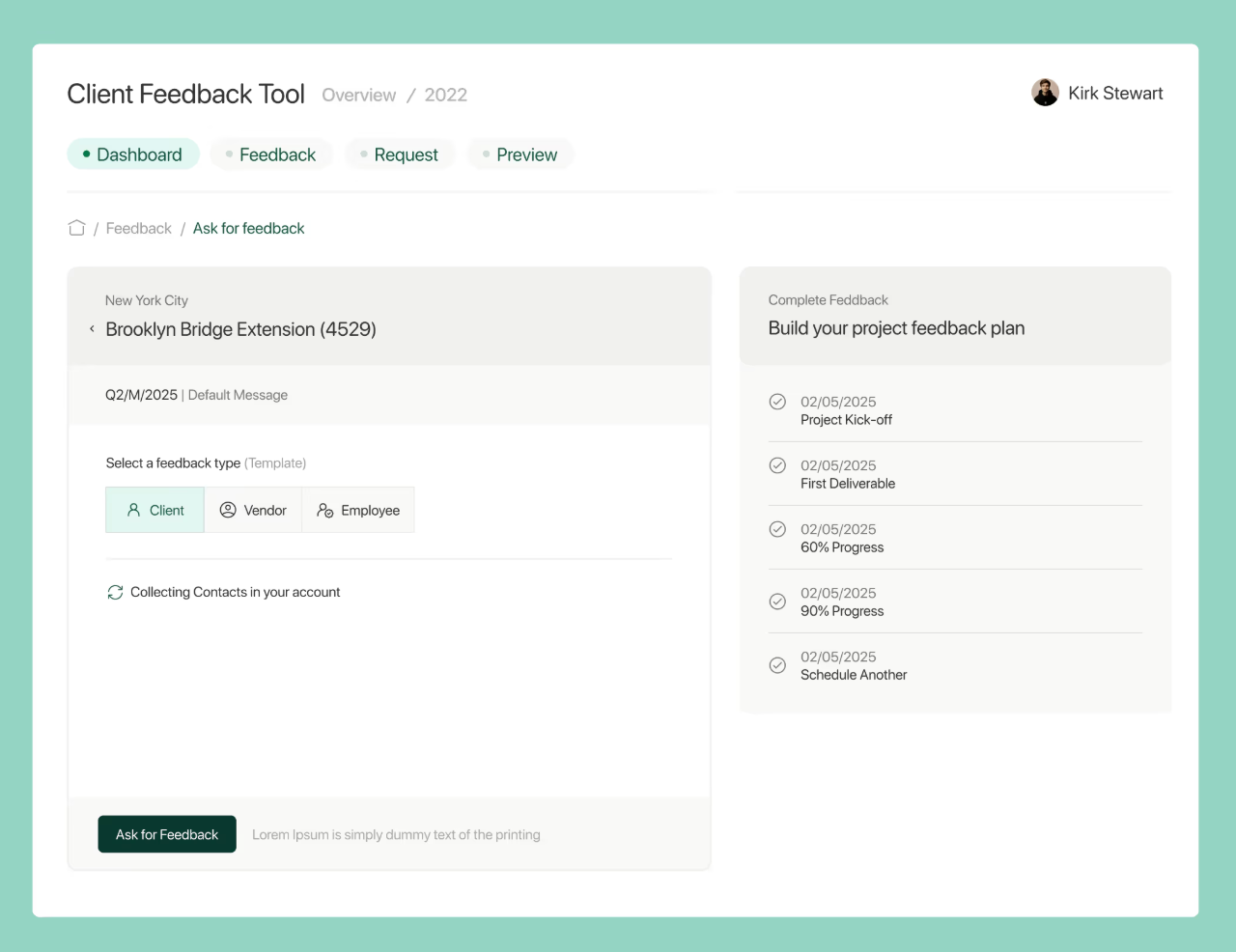
Our patented Client Experience Indicator (CXI®) scale combines quantitative scoring with AI-driven qualitative analysis, capturing up to 380% more hidden pain points than NPS alone. In fact, firms using this approach have seen an average 17-point increase in NPS, showing that real-time, structured listening drives stronger relationships and repeat projects.
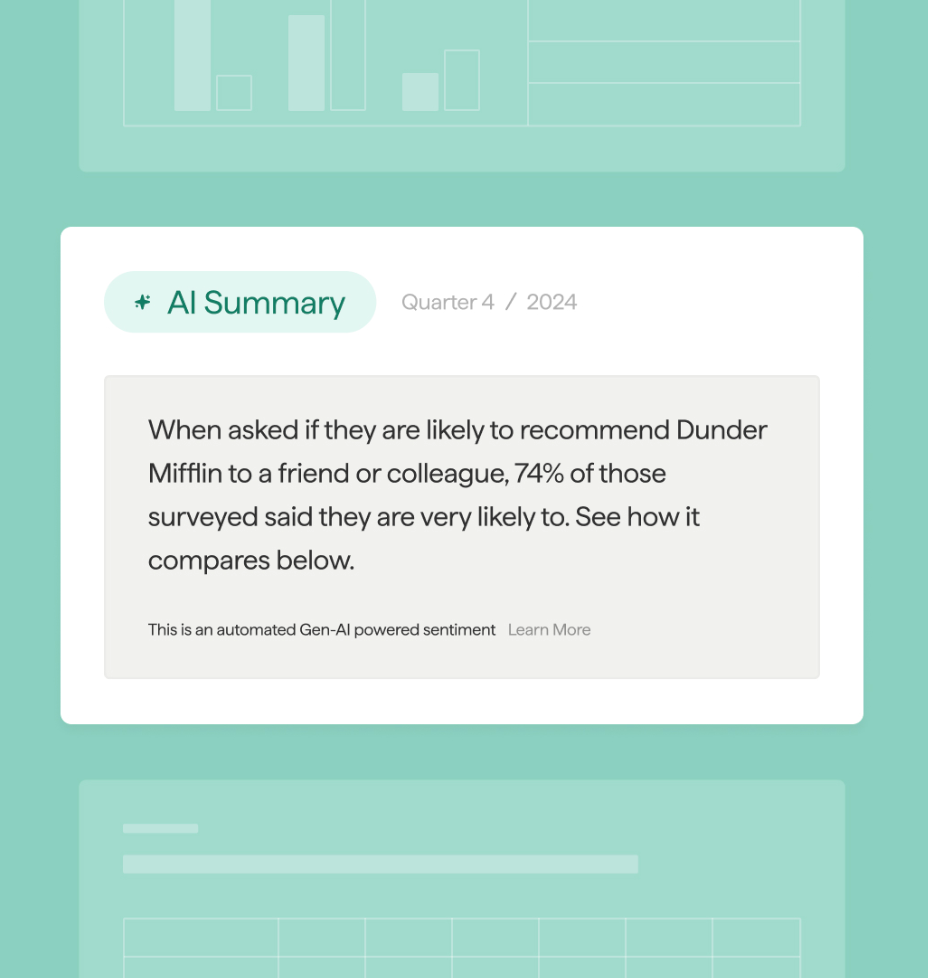
By using AI-powered sentiment analysis, teams gain actionable insights through dashboards that reveal trends across accounts, segments, and service lines. It goes beyond simple positive/negative scoring and decodes emotions like excitement, hesitation, frustration, or trust. This helps you understand not just what clients are saying, but how they feel about your work.
2. Theme detection and topic modeling: Finding patterns humans miss
With human analysis, each comment seems unique, and trends remain hidden until someone reads dozens or hundreds of responses. AI for customer insight changes that by automatically detecting themes across all feedback.
For example, an AEC firm might find that “change order communication” is the #1 driver of detractor scores across all project types. This kind of pattern often remains invisible when feedback is reviewed one response at a time.
Similarly, a staffing firm surveying 200 clients quarterly might discover that 34% mention “candidate quality follow-up” as a recurring pain point, something that would be easy to miss in manual reviews.
Advanced AI uses techniques like topic modeling, including linear discriminant analysis (LDA) and neural models, to cluster hundreds or thousands of open-ended responses into coherent themes. For instance, a staffing firm surveying 200 clients quarterly might find that 34% mention “candidate follow-up communication” as a pain point, which may be invisible when reviewing responses individually.
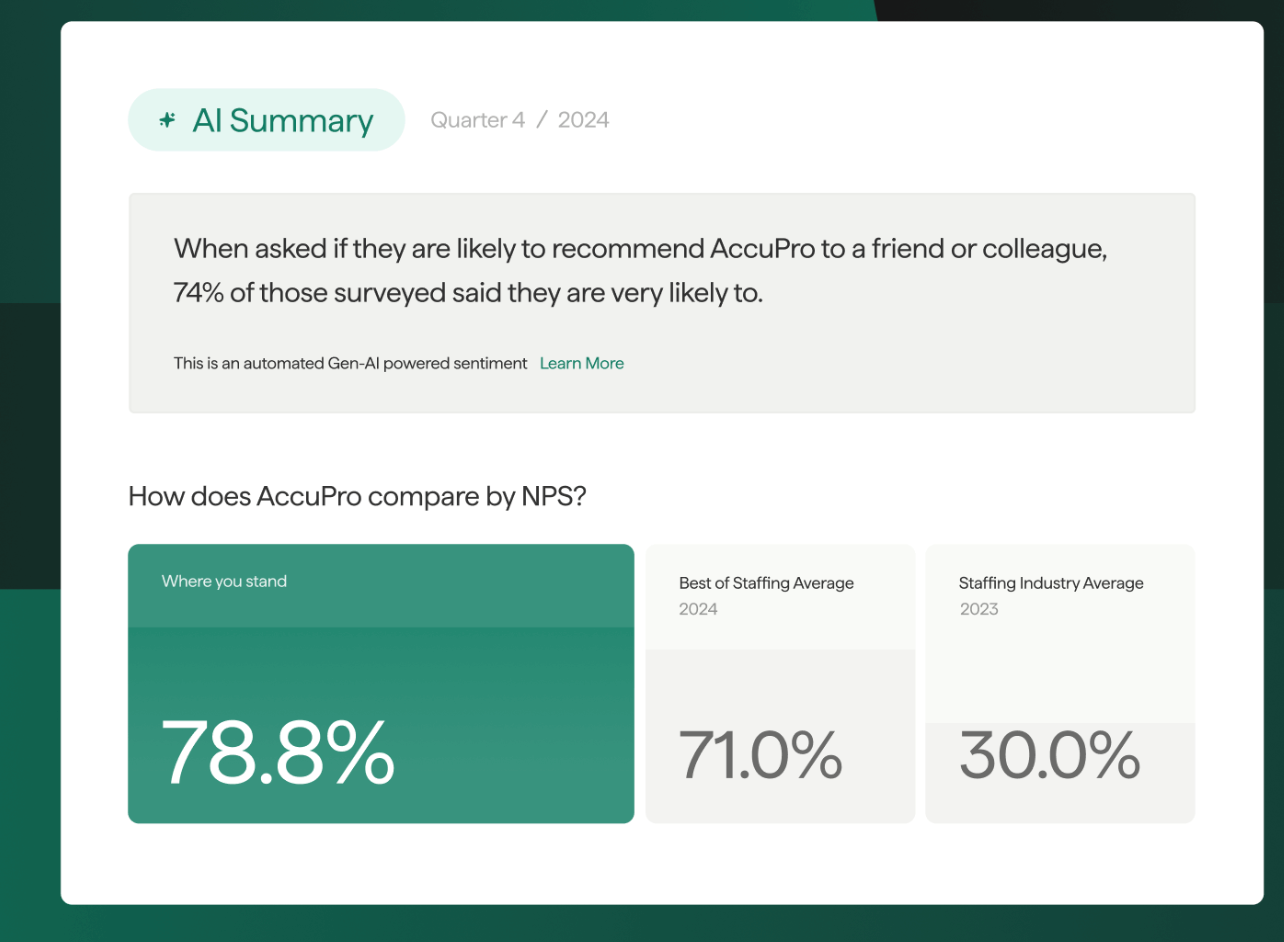
At ClearlyRated, we track how themes evolve, compare performance against nearly 20 years of industry benchmarks, and highlight issues before they escalate. Our Gen AI-powered insights engine does this automatically, surfacing actionable intelligence and providing temporal and comparative context.
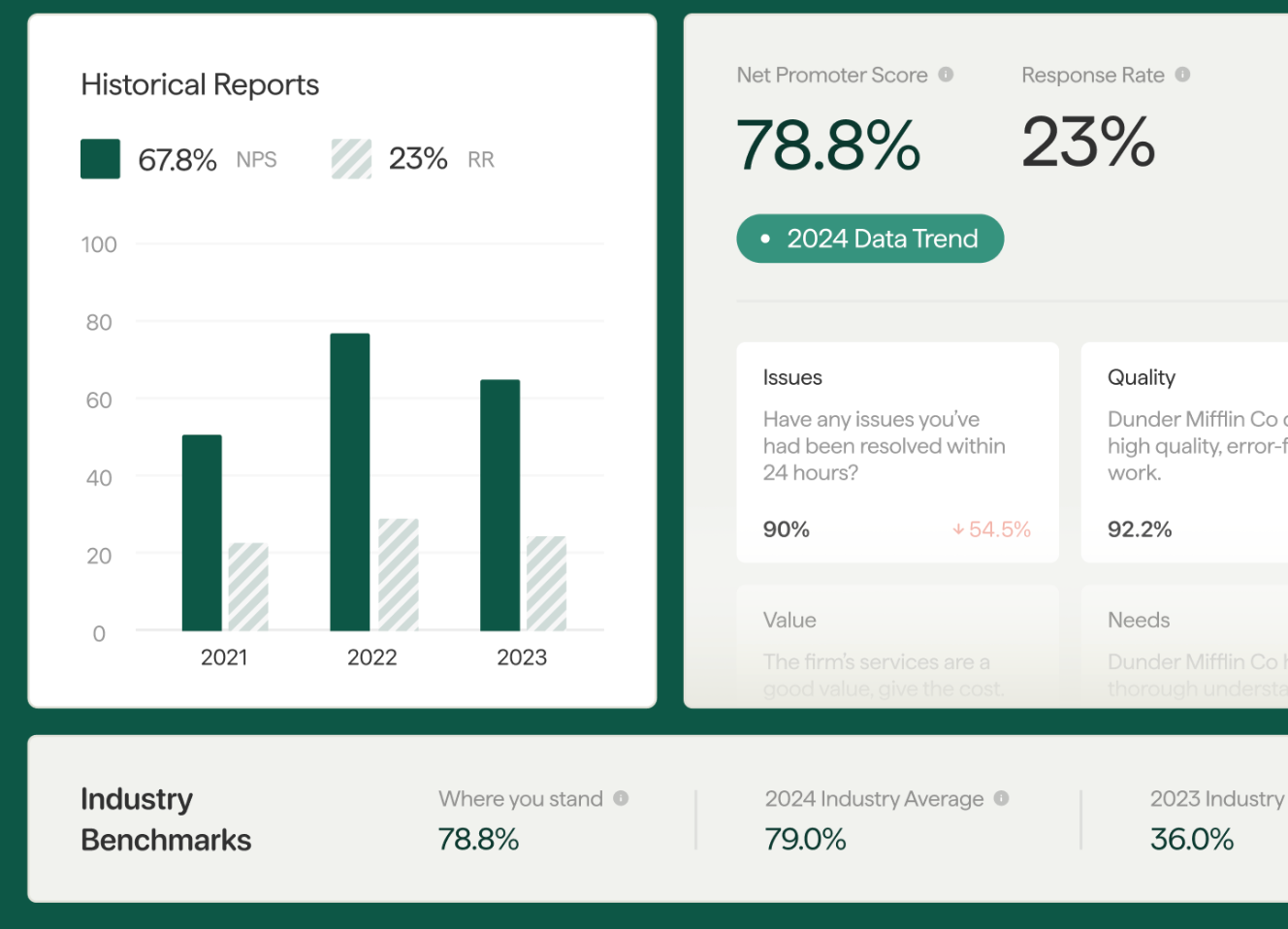
Instead of relying on anecdotal observations, leaders gain structured insights about what clients actually experience. Teams can prioritize improvements, anticipate churn, and strengthen client relationships with real-time, data-backed intelligence.
3. Predictive analytics and at-risk client detection: Intervening before it's too late
If you ask us what the most powerful capability of AI in customer feedback is, we’d say prediction, and rightly so. Let us explain.
While traditional feedback analysis focuses on past performance, predictive analysis focuses on future outcomes. In B2B professional services, the stakes are high, and losing a client means losing referral potential, institutional knowledge, and business development investments.
In most firms, client frustration only becomes visible after a project wraps up, which is often too late. We solve this by tracking multiple signals at the same time. Our platform monitors NPS scores over consecutive surveys, checks survey participation rates, and flags negative sentiment trends in open-ended feedback. It identifies high-risk phrases such as “considering alternatives” or “disappointed with.”
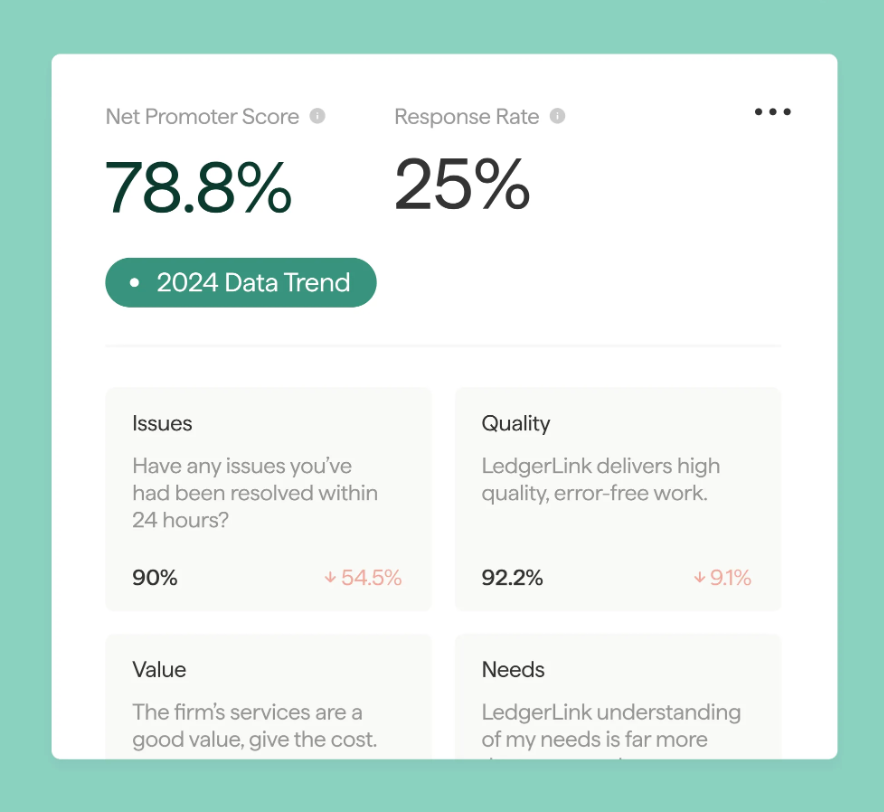
Meanwhile, our system evaluates sentiment across multiple feedback points and categorizes clients as thriving, stable, or at-risk. Project leaders receive real-time alerts and can follow up immediately, guided by AI-generated response suggestions that maintain a professional and empathetic tone.
Our research shows that firms that respond to client feedback promptly recover 83% of at-risk relationships.
4. Closed-loop feedback automation: From insight to action in hours, not months
Most firms collect feedback successfully, but far fewer close the loop. What this means is responding quickly to concerns and making sure every piece of negative feedback triggers a tracked follow-up assigned to a specific person.
ClearlyRated detects a detractor response or negative sentiment, and it triggers an automated workflow. The responsible account manager receives an alert, along with AI-generated response suggestions tailored to the issue. The platform creates a follow-up task with a clear deadline and tracks whether the client receives a response.
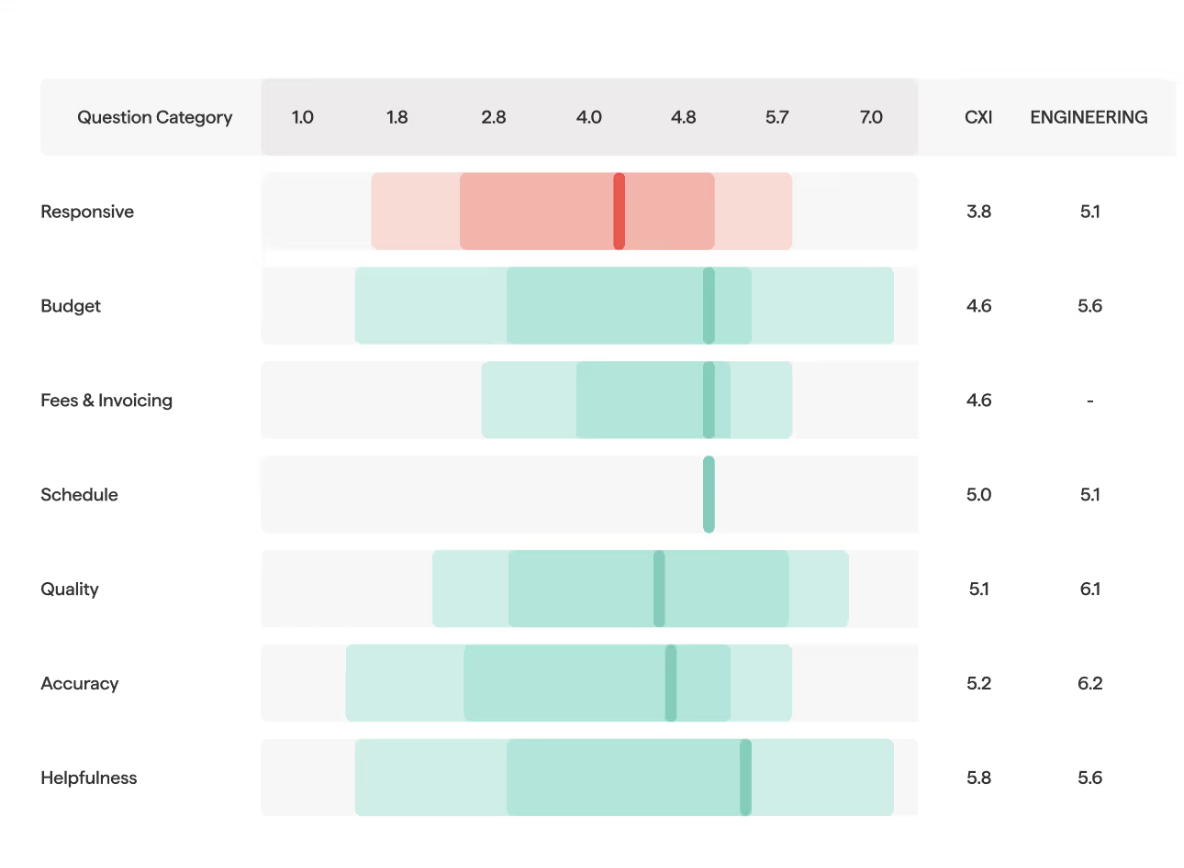
Account managers enter conversations fully informed. They know exactly what the client said, how the sentiment compares to prior touchpoints, and what the AI recommends as next steps. In B2B services, this approach keeps relationships alive and helps teams address concerns quickly.
Additionally, integrations with tools like Salesforce, Bullhorn, and Deltek bring feedback into the workflows teams already use. Leaders gain visibility into response timelines and progress without manually checking reports. Stakeholder segmentation highlights perspectives across projects and roles, enabling teams to act on client insights and build long-term trust.
5. The feedback-to-reputation pipeline: Turning AI insights into growth assets
Did you know 96% of prospective clients research firms online before contacting a professional services provider?
Many organizations collect feedback to fix problems, but smart firms use it to grow. They activate the feedback-to-reputation pipeline, turning satisfied clients into public advocates.
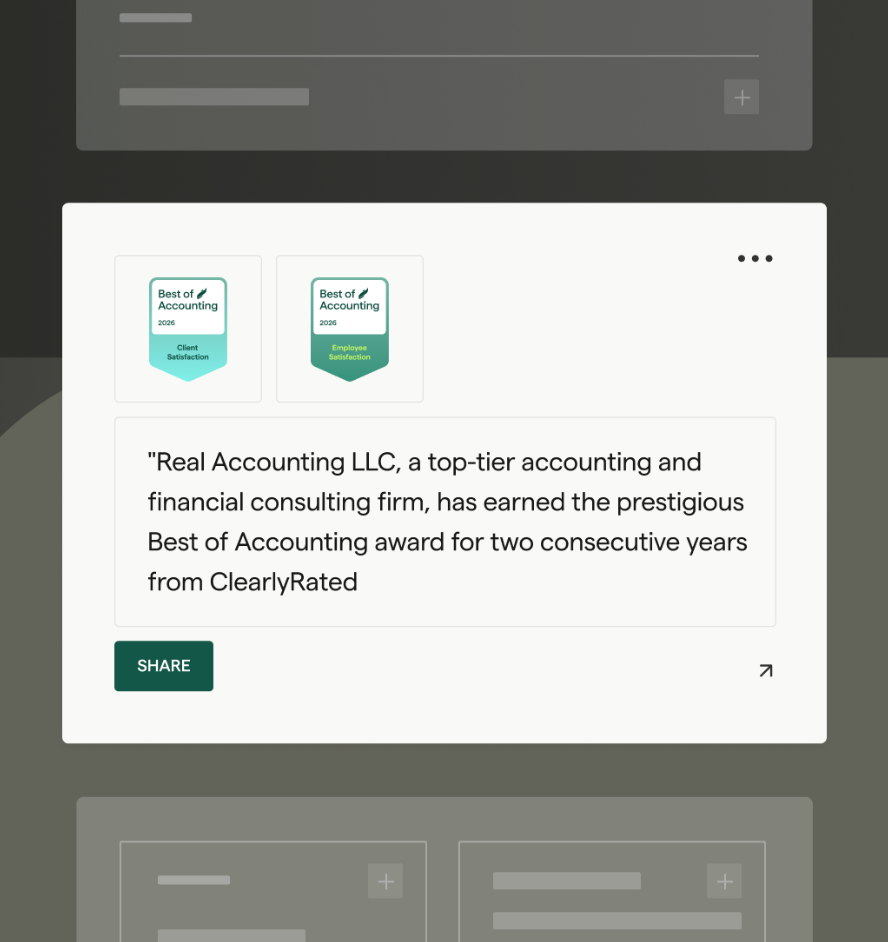
Here’s how you can achieve it with ClearlyRated:
- AI customer feedback analysis identifies satisfied clients who express strong positive sentiment and give high NPS scores. These clients become promoters.
- The platform activates structured reputation workflows.
- These workflows then invite promoters to submit verified online reviews, provide testimonials, participate in industry awards programs, and share case studies.
The strategy works because modern buyers research vendors carefully before engagement.
Our reputation management suite makes this easy. We transform positive survey responses into Google reviews, client testimonials, and award nominations. You can collect star ratings, recognize individual contributors with shout-outs, feature client success stories on optimized public profile pages, and highlight accomplishments through the Best of AEC awards.
In fact, firms using our structured programs generate an average of $1.8 million in new referral business.
📌Also read: Customer Acquisition vs. Retention: Where Should You Focus in 2026?
How to Evaluate AI Capabilities in Your CX Survey Tool
Many survey tools label basic sentiment tagging as AI, but real AI feedback analysis does much more. When deciding on a new platform, it’s important to understand how to choose a CX survey tool.
Prioritize features that go beyond basic sentiment tagging, uncover meaningful trends, and help your team act on feedback efficiently.
Five questions to ask your CX platform
To make sure your platform has genuine AI capabilities, evaluate it by asking these five key questions:
- Does the AI analyze open-ended feedback or just quantitative scores? Real AI feedback analysis processes free-text responses using natural language processing, not just averages like NPS numbers.
- Does it provide industry-specific benchmarking? Insights without comparative context are directionless. Knowing your NPS is 45 does not help if the industry median is 57.
- Does it automatically detect at-risk clients, or do you have to look for them? Check whether the platform automatically detects at-risk clients or if you have to find them manually. Real-time alerting gives teams a chance to intervene before issues escalate, whereas manual dashboards often reveal problems after the fact.
- Does it close the loop with automated workflows? Insights that don’t trigger follow-up actions remain just data and rarely improve client relationships.
- Does it connect feedback to reputation outcomes? If the tool stops at analysis and never converts satisfied clients into reviews, testimonials, or awards, your firm misses growth opportunities.
Unlock the Power of AI-Driven Client Feedback
Imagine turning every piece of client feedback into a tool for growth, retention, and stronger relationships.
That’s what happens when B2B professional service firms use AI that goes beyond basic sentiment analysis. You need a platform that understands project-based work, multiple stakeholders, and the full journey from insight to action.
ClearlyRated delivers just that. Our AI-powered sentiment analysis, combined with the patented CXI® methodology, surfaces hidden pain points, flags at-risk clients in real time, and provides nearly 20 years of industry benchmarking. It even helps turn satisfied clients into advocates, generating verified reviews, testimonials, and award nominations.
Want a quick peek at AI-driven feedback insights? Watch our 2-minute platform overview, or schedule a full personalized demo today.
Ready to see AI-powered feedback analysis at work in your firm? Book a free demo and get a personalized walkthrough today.
FAQs
What is AI customer feedback analysis?
AI customer feedback analysis is the use of artificial intelligence to evaluate survey responses, comments, and reviews. The technology reads open-ended feedback, identifies sentiment, detects themes, and highlights risks. This process delivers faster insight than manual analysis.
How does AI improve NPS survey analysis for B2B service firms?
AI evaluates both scores and written comments. It detects emotional signals, identifies patterns across multiple stakeholders, and flags accounts that show early dissatisfaction. These insights help teams respond quickly and protect valuable client relationships.
What is the difference between NPS, CSAT, and CES surveys?
NPS measures loyalty and willingness to recommend a company. In contrast, CSAT evaluates satisfaction with a specific interaction or service. Meanwhile, CES measures how much effort clients expend during an interaction. Each metric reveals a different aspect of the customer experience.
Can AI detect at-risk clients before they leave?
Yes. Predictive models analyze sentiment trends, score changes, and engagement patterns. These signals help platforms identify risk early. Teams receive alerts that allow them to address concerns before the relationship deteriorates.
What is the difference between AI sentiment analysis and traditional survey analysis?
Traditional analysis focuses on numerical scores and manual interpretation. AI sentiment analysis reads language patterns within comments and detects emotional signals. This approach reveals hidden dissatisfaction and identifies themes across large datasets.

FAQs



.png)
.webp)