AI Is Not Replacing Jobs in AEC


What 300 firms actually said — and why the doomsday narrative doesn’t apply here
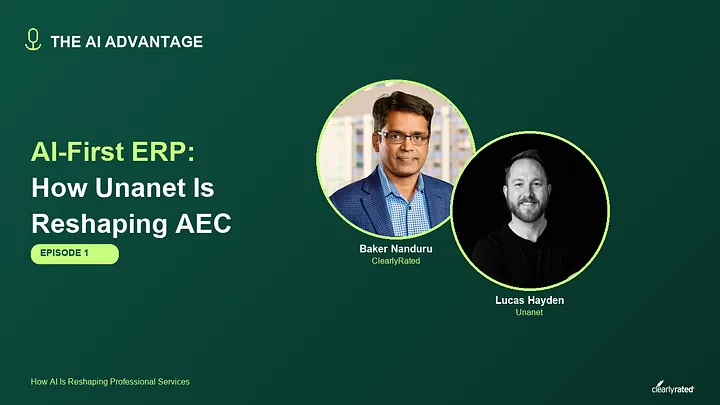
I just recorded my first podcast episode. My guest was Lucas Hayden, VP of Product Marketing at Unanet, an AI-first ERP company serving about 2,000 AEC firms. He brought data. Real data. And one number stopped me cold.
Only 13% of respondents in Unanet’s AEC Inspire Report said they expect AI to lead to headcount reduction. Out of 300 firms. Thirteen percent.
Meanwhile 71% said efficiency gains. 64% said effectiveness. Not fear. Not layoffs. Not the apocalypse your LinkedIn feed keeps promising you.
I had to sit with that for a minute.
Two Worlds
Here’s what’s actually happening. There are two completely separate conversations about AI and jobs, and people keep mashing them together.
In tech, AI IS replacing roles. Junior developer positions are shrinking. Content teams are getting cut. Entire categories of knowledge work are being automated out of existence. That’s real and I’m not going to pretend it isn’t.
But AEC is a fundamentally different animal.
You can’t automate a bridge inspection. You can’t send a robot to walk a jobsite and catch the framing issue that’s going to cost you six figures if it goes another week. You can’t replace the project manager who knows that the owner’s rep hates Tuesday meetings and the structural engineer is three days behind on calcs.
AI adoption in AEC went from roughly 50% to over 70% year-over-year. That’s a massive jump. But firms aren’t using it to shrink their teams. They’re using it to stop drowning.
What I Actually Heard
One architecture firm president told us they now create six design options in the time one used to take. Same team. Same headcount. But their clients see more possibilities, faster. The conversations changed. The win rate on pursuits went up because clients felt like the firm actually understood what they wanted.
A construction firm started using AI to route field data back to their business developers in real time. Seller-doers who used to wait until Friday to find out what happened on Monday’s site visit now get updates before lunch. That’s not replacement. That’s a communication upgrade for people who bill by the hour and can’t afford to waste any of them.
Lucas talked about how a full-day proposal process is getting compressed to hours. Anyone who’s pulled an all-nighter formatting an RFP response knows exactly what that means. The pursuit team still writes the win themes. Still tailors the approach. Still owns the strategy. AI handles the assembly and the formatting and the version control nightmare.
His line that stuck with me: “We still own the craft.”
Side note — I have a family member getting her architecture degree right now. When I told her about this conversation, she wasn’t worried about AI taking her job. She was annoyed that her professors still haven’t updated the curriculum to include it. Different generation, different fear entirely.
The Hiring Tell
If AI were actually replacing jobs in AEC, you’d see it in college recruiting. Programs would slow down. Entry-level pipelines would thin out. Firms would stop showing up at career fairs.
That’s not what’s happening. Lucas said his clients’ entry-level programs are firing on all cylinders. I hear the same thing from accounting firms. The labor gap is demographic. Boomers are retiring faster than universities can produce replacements. AI doesn’t solve a shortage by removing people.
So why does the fear persist?
The Wrong Import
Because firm owners read the same tech headlines everyone else does. They see a software company replace 40% of its customer support staff with chatbots. And they assume the same logic applies to project-based work.
It doesn’t.
Software scales without adding bodies. That’s the entire point of software. But every AEC project needs a PM. Every design needs a licensed architect or engineer. Every site needs boots on the ground. The business model is built on people, and no amount of AI changes the physics of putting steel in the air or concrete in the ground.
I get frustrated when I see AEC leaders making workforce decisions based on a narrative that was never about their industry. Freezing junior hires because a tech CEO tweeted about AI replacing entry-level workers. Delaying investments in training because they’re not sure the roles will exist in two years. Those roles will exist. The question is whether you’ll have anyone to fill them.
Now — I should be honest. I don’t know what this looks like in five years. Maybe AI gets good enough to handle preliminary designs or automate more of the estimating process. Lucas and I didn’t pretend to have that figured out. But right now, today, the data is overwhelming: AEC firms are hiring, not firing. And the ones using AI are getting more from the people they already have.
AI isn’t coming for the people who build bridges, design buildings, and manage projects. It’s coming for the parts of their jobs they never wanted to do in the first place. But the firm that arms their PMs with AI-powered monitoring while yours are still pulling reports by hand? They’re winning the next pursuit because the client remembers how smooth the last one went. That gap compounds every quarter.
Start with one thing: audit your data. What’s structured, what’s in spreadsheets, what’s in someone’s head. The firms that moved two years ago are already pulling away. The ones still reading headlines and waiting are hiring from a shrinking pool with the same tools they had in 2019.

FAQs